The Emperor and Nine of Swords Tarot as Feelings
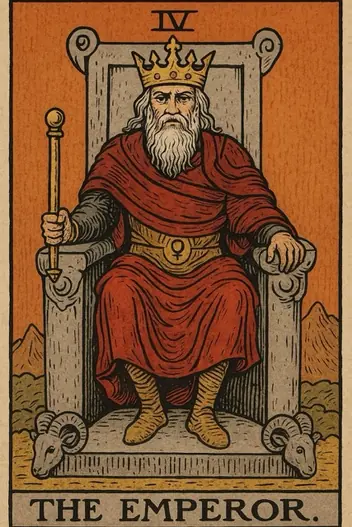

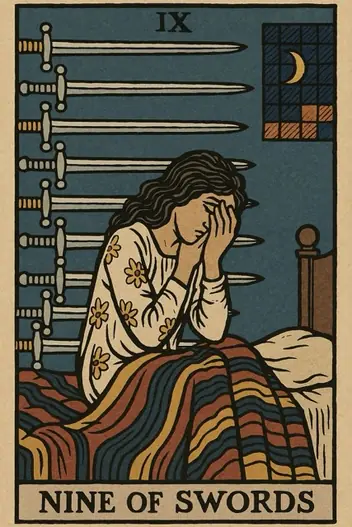
- Arcana
- The Emperor — Major Arcana; Nine of Swords — Minor Arcana, Swords
- Elements
- The Emperor — Fire; Nine of Swords — Air
- Elemental interaction
- Friendly elements — energies support each other
- Numerology
- 4 + 9 = 13 → 4
This card pair represents a high-stakes psychological collision: the archetype of structured authority (The Emperor) meeting the archetype of acute mental torment (Nine of Swords). In real-world terms, this often manifests as a leader, manager, or disciplined individual who is secretly plagued by paralyzing worry, insomnia, or obsessive overthinking. The Emperor’s fortress of control is being breached from within.
The core conflict here is between the need for decisive order and the reality of chaotic internal noise. The seeker may be overcompensating with rigid rules or authoritarian behavior to mask a deep fear of losing control. Alternatively, this combination can signal a person who has built a successful, structured life but now finds their own mind turning against them—waking up at 3 AM with a flood of worst-case scenarios. The strategic task is to diagnose the source of the anxiety and decide whether to reinforce the walls or tear some down.
Core Dynamics & Interpretation
When The Emperor and Nine of Swords appear together, the core dynamic is a crisis of authority within the self. The Emperor represents the rational, disciplined part of the psyche that builds systems, sets boundaries, and enforces order. The Nine of Swords represents the unconscious mind’s rebellion—a flood of catastrophic thoughts, guilt, or shame that the rational mind cannot suppress. This is not a passive card; it is a psychological emergency that demands immediate attention.
The mindset created here is one of hyper-vigilance and defensive control. The seeker likely feels that if they loosen their grip for even a moment, everything will collapse. This leads to a cognitive bias known as catastrophizing, where every minor problem is magnified into a potential disaster. In practice, this can look like a CEO who micromanages every detail due to a fear of failure, or a parent who imposes overly strict rules due to anxiety about their child's safety. The key insight is that the Emperor’s strength is being used to contain a shadow, not to build a healthy future.
The real-world implication is that the solution is not more control, but better boundaries. The Emperor’s true power lies in discernment: knowing what to protect and what to release. The Nine of Swords whispers that the current system is broken. The strategic move is to stop trying to silence the anxiety and instead listen to what it is trying to protect. Often, this card pair reveals a deep-seated fear of inadequacy that the seeker has been covering up with external achievements. The path forward requires integrating the shadow—acknowledging the fear without letting it dictate the rules.
Career and Finances
Strategic Opportunities:
Use your analytical skills to audit your current systems. The anxiety is pointing to a specific flaw—find it and fix it.
Strategic Opportunities:
Channel the Emperor’s discipline into a structured plan to address the root cause of the worry (e.g., a debt management plan, a project timeline).
Calculated Risks:
Do not make major financial decisions while in a state of panic. The Nine of Swords distorts risk perception. Wait 48 hours before signing any contract.
In the professional realm, this card combination often indicates a high-stakes situation where the seeker is under immense pressure to perform. This could be a CEO facing a hostile takeover, a manager dealing with a critical project deadline, or an entrepreneur worried about cash flow. The Emperor’s energy is present in the structure and systems you have built, but the Nine of Swords reveals that your mental state is your biggest liability. The most important financial warning here is to avoid "tunnel vision." When you are anxious, you tend to focus only on the worst-case scenario and ignore data that suggests a positive outcome.
Strategic action is your antidote. Break the problem down into small, manageable tasks that you can control. The Emperor loves a checklist; the Nine of Swords hates ambiguity. Create a risk management plan that outlines specific trigger points and responses. For example, if you are worried about a market downturn, define exactly what actions you will take if the market drops by 10%, 20%, or 30%. This transforms vague anxiety into calculated risk. Also, delegate where possible. The Emperor often tries to carry the entire burden alone, but the Nine of Swords shows that isolation amplifies fear. Bring in a trusted advisor, partner, or therapist to provide an objective perspective.
Your pair is already on the table. Ask your question and draw the clarifying card
or simply focus on it
The Emperor and Nine of Swords in Love Tarot
If you are single:
This pair warns against entering a relationship to "fix" your anxiety or to find a partner who will provide structure you lack. You must first stabilize your own internal authority before inviting someone else in.
If you are in a relationship:
This combination signals a power struggle fueled by one partner’s unspoken fears. The Emperor partner may be controlling, while the Nine of Swords partner may be paralyzed by worry about the relationship’s stability.
In relationships, The Emperor and Nine of Swords create a toxic feedback loop of control and anxiety. The person embodying The Emperor may feel compelled to manage every aspect of the partnership—finances, schedules, even emotions—because they are terrified of chaos. Meanwhile, the person resonating with the Nine of Swords may feel suffocated, unheard, or constantly criticized, leading to rumination and sleepless nights. The key relationship advice here is to stop trying to control the outcome. Instead, establish a clear boundary between your partner’s issues and your own. If you are the anxious partner, you must recognize that your fears are not facts. If you are the controlling partner, you must realize that your need for order is a defense mechanism that is destroying intimacy.
Emotional intelligence requires a ceasefire. Both parties must agree to a "no-blame" zone where feelings can be expressed without judgment. The Emperor must learn to sit with uncertainty, and the Nine of Swords must learn to voice fears before they become catastrophes. A practical step is to schedule a weekly "state of the union" conversation where both partners can speak openly about their anxieties and needs. This transforms the dynamic from a war of control into a strategic alliance.
Deepen your understanding
Find out exactly what this reading means for your current life situation with our oracle.
What If The Emperor or Nine of Swords Appears Reversed?
If The Emperor is Reversed:
Blocked potential turns into recklessness. You lose the ability to structure your life, and anxiety (the Nine of Swords) floods the entire space. This is a state of complete paralysis of the will. Advice: start small—regain control over just one hour of your day. Make your bed, drink a glass of water. Don't try to solve everything at once.
If the Nine of Swords is Reversed:
Internal resistance transforms into passive aggression. You don't scream in fear, but you sabotage any attempt to establish order. This is hidden anxiety that manifests through procrastination and forgetfulness. Advice: keep an anxiety journal. Write down exactly what you are afraid of when you postpone an important task. Specifying the fear strips it of its power.
If BOTH are Reversed:
A complete imbalance of dynamics. This is a state where you are simultaneously the tyrant and the victim. You can neither set rules nor cope with chaos. The logical way to correct this: consult a psychotherapist or a coach. You need an external, neutral "Emperor" to help you restore your internal structure without self-flagellation. It is almost impossible to break out of this cycle on your own.
Shadow Side & Pitfalls
The shadow side of The Emperor and Nine of Swords is a paranoid, authoritarian mindset that destroys trust and innovation. The seeker may become a tyrannical leader who rules through fear, believing that only their rigid control can prevent disaster. This is a cognitive distortion known as "control fallacy"—the belief that you have total power over outcomes, which leads to burnout and resentment from others. The shadow manifests as self-sabotage through perfectionism: the seeker spends so much energy trying to prevent every possible failure that they become paralyzed and fail to act at all.
Another major pitfall is projection. The Emperor partner may project their own inner chaos onto their partner or employees, accusing them of being "irresponsible" or "unreliable" when, in reality, the anxiety is internal. This creates a toxic blame culture where no one feels safe. The seeker may also engage in ruminative revenge fantasies—spending hours mentally replaying conflicts or imagining worst-case scenarios about being betrayed. The cognitive bias here is "mind reading" —assuming you know what others think of you (usually negative) without evidence. The path out of the shadow requires radical self-honesty: admitting that the fear is coming from within, not from external threats.
The Emperor and Nine of Swords Combined Message
The constructive use of the Emperor's energy is not about tightening control, but about creating a safe structure for healing. Your task is to become a wise ruler, not a tyrant. A wise ruler knows that their primary duty is to care for the well-being of their subjects (your psyche). This means: establishing a sleep and rest schedule as an unbreakable law, creating rituals to reduce anxiety (meditation, exercise, hobbies), and implementing a "one task per day" rule to lower cognitive load.
To balance the Nine of Swords, use the Emperor's energy for rationalizing fear. Do not try to suppress anxiety—structure it. Keep a table: "What am I afraid of?", "How likely is this?", "What can I do to minimize the risk?". This translates fear from the irrational realm into a plane of manageable tasks. A deep strategic insight: accept the fact that you cannot control everything. The Emperor who understands this becomes truly strong. Your strength lies not in rigidity, but in flexibility and the ability to withstand uncertainty.
The key to transformation is vulnerability. Allow yourself, once a day, to do something imperfectly. Write a letter with a mistake. Show up to a meeting without a plan. You will see that the world did not collapse. This will become your new experience, gradually rewriting the program of fear. The combination of the Emperor and the Nine of Swords is an invitation to evolve from a "controller" to a "leader" who knows how to manage not only circumstances but also their own inner world.
Your Next Step: Personal Context Matters
The core message of The Emperor and Nine of Swords is that true authority begins with mastering your own mind. You cannot build a stable external world while your internal world is in turmoil. This combination demands that you stop fighting the anxiety and start using your discipline to understand it. The Emperor’s strength is not in suppressing fear, but in creating a structure that can contain and process it. Your next step is to identify the specific fear driving the Nine of Swords—whether it’s a fear of failure, loss of control, or inadequacy—and then apply the Emperor’s logic to create a realistic action plan.
While this article provides a deep archetypal analysis, the true power of Tarot comes when it is applied to your unique life situation. Your specific question, relationship, or career challenge may shift the meaning of these cards in subtle but crucial ways. Don’t settle for a general interpretation. Use the Fortune Cards app right now to get a personalized reading tailored to your exact query. Whether you’re on the web or mobile, you can download it and receive a deep, customized interpretation of The Emperor and Nine of Swords for your specific context. Your breakthrough is one question away.
Interpretation by the Fortune Cards editorial team, based on the Rider–Waite tradition and Jungian archetypes. About our methodology · Updated: 2026-08-26
Other Combinations with The Emperor
Other Combinations with Nine of Swords
Explore Individual Card Meanings
Ready to find answers to your questions?
Start your first reading now and look at your situation with fresh clarity. The cards are ready to reveal deeper meaning.