The Hermit and Nine of Swords Tarot Combination
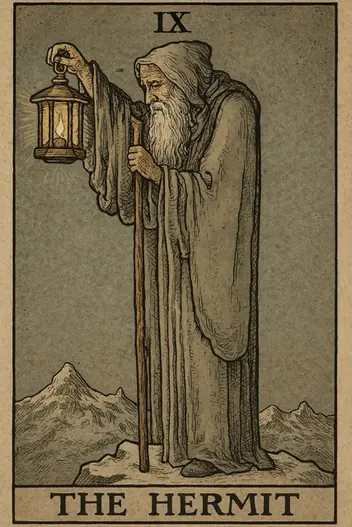

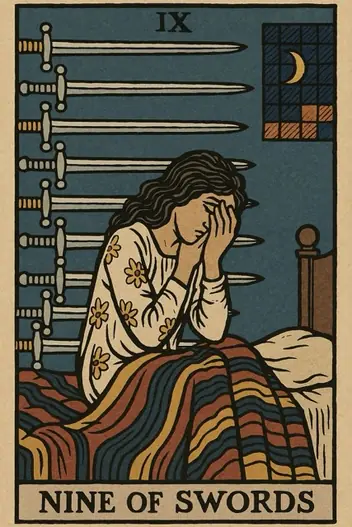
- Arcana
- The Hermit — Major Arcana; Nine of Swords — Minor Arcana, Swords
- Elements
- The Hermit — Earth; Nine of Swords — Air
- Elemental interaction
- Opposing elements — energies create tension
- Numerology
- 9 + 9 = 18 → 9
When the hermitic withdrawal of The Hermit collides with the nocturnal anxiety of the Nine of Swords, we encounter a profound psychological paradox. The Hermit seeks solitude for enlightenment, while the Nine of Swords represents the torment of being trapped inside one’s own mind. This combination often signals a period where the seeker is forced to confront their deepest fears—not in a chaotic world, but in the silence of their own company. The strategic question here is not whether to retreat, but whether that retreat is a sanctuary or a prison.
Analytically, this pairing reveals a breakdown between self-reflection and self-flagellation. The Hermit’s lamp illuminates the darkest corners of the psyche, but the Nine of Swords amplifies the shadows. The result is a high-stakes internal audit: are you analyzing your life with objective clarity, or are you punishing yourself with obsessive rumination? The pragmatic path forward demands distinguishing between productive introspection and the spiral of catastrophic thinking.
The Hermit and Nine of Swords: How These Energies Interact
The core dynamic here is anxiety seeking a resolution through isolation. The Hermit represents the archetype of the wise elder who withdraws to find truth, but the Nine of Swords injects a dose of acute mental distress—insomnia, guilt, or crushing worry. In real-world terms, this suggests a person who believes they need to “figure it all out alone,” yet their internal monologue is dominated by self-criticism and worst-case scenarios. This creates a cognitive bottleneck: the more they retreat, the louder the inner critic becomes.
Psychologically, this combination often appears during recovery from a major mistake, betrayal, or a period of burnout. The Nine of Swords indicates the emotional cost of past actions, while The Hermit demands a forensic examination of what went wrong. The key insight is that solitude is necessary for healing, but it must be structured. Without a framework—journaling, therapy, or a disciplined meditation practice—this energy devolves into a feedback loop of shame and fear. The strategic move is to set time limits on introspection and actively seek external data points (a trusted friend, a mentor) to break the echo chamber.
The Hermit and Nine of Swords as Feelings
If you are single:
This pair suggests you are projecting past relationship trauma onto new possibilities. You may be over-analyzing potential partners to the point of paralysis. The advice is to pause dating for a defined period, but use that time to write down specific, objective criteria for a healthy partner—not a list of fears.
If you are in a relationship:
The dynamic is likely one partner withdrawing emotionally while the other feels attacked or abandoned. The Nine of Swords partner may be ruminating on past arguments or feeling guilty about a transgression, while The Hermit partner feels the need to “fix things alone.”
In relationships, this combination is a warning against emotional isolation as a coping mechanism. The Hermit’s need for space is valid, but the Nine of Swords’ anxiety will twist it into a belief that “I am not worthy of love” or “I am a burden.” Boldly, the most effective action is to schedule a structured conversation—not a confrontation—where each partner speaks for five uninterrupted minutes about their internal state. This prevents the spiral of silent resentment. Avoid the trap of solving your partner’s anxiety for them; instead, offer presence without advice. The goal is to let the light of The Hermit illuminate the fear, not to extinguish it.
Your pair is already on the table. Ask your question and draw the clarifying card
or simply focus on it
The Hermit and Nine of Swords: Career and Money
Strategic Opportunities:
Use this period to conduct a deep audit of your professional skills and weaknesses. The Hermit favors research, so compile data on industry trends or your own performance metrics.
Strategic Opportunities:
Develop a single, high-value skill in isolation (e.g., a certification, a coding language). This turns anxiety into productive focus.
Calculated Risks:
Avoid making major financial decisions while in a state of high anxiety. The Nine of Swords distorts risk perception, leading to either reckless spending (to soothe nerves) or paralyzing frugality.
The career interpretation of this combination is about managing the psychological cost of ambition. The Hermit suggests a period of strategic withdrawal—perhaps a sabbatical, a lateral move to a quieter role, or focusing on a long-term project. However, the Nine of Swords warns that this withdrawal can easily become procrastination disguised as planning. Boldly, the key is to set external deadlines. If you are a freelancer, commit to a client deliverable. If you are an employee, ask for a specific review date. The Nine of Swords’ energy must be channeled into risk mitigation—check your insurance, update your contracts, or create a financial buffer. Do not trust your gut feelings about money right now; trust your spreadsheets.
Get a personalized interpretation
Unlock the combined meaning of your cards in the context of your unique question — for free.
The Hermit and Nine of Swords Reversed: How to Read It
The Hermit Reversed:
The person is forced to emerge from isolation, but does so chaotically and without a plan. The blocked potential of the Hermit turns into superficiality and a refusal to reflect. The fear of making a mistake (Nine of Swords) drives impulsive action to drown out the inner voice. Advice: Do not make any important decisions within 48 hours of an emotional outburst.
Nine of Swords Reversed:
This indicates an internal resistance to acknowledging the problem. The person represses their anxiety, pretending everything is fine. The upright Hermit amplifies this self-deception—solitude is used to build illusions, not to seek truth. The main risk: psychosomatics. The body will begin to signal the problem if the mind refuses to see it.
BOTH Reversed:
Complete imbalance. The person is lonely, but not wise; anxious, but unaware of the causes. This is a state of chronic frustration, where neither solitude nor socializing brings relief. The logical way to correct this is a forced change of scenery and physical activity. The frozen energy needs to be "shaken out" through the body: sports, a walk, rearranging furniture. Only after this should one return to analysis.
Negative Meaning of The Hermit and Nine of Swords
The shadow of this pairing is masochistic introspection. The seeker may unconsciously use The Hermit’s solitude as a way to punish themselves, replaying a past failure on an endless loop. The cognitive bias at play is confirmation bias: you search for evidence that you are flawed or doomed, ignoring contradictory data. This can lead to social withdrawal that is not healing but self-sabotaging, where you ghost friends, decline invitations, and isolate yourself from support networks. Another pitfall is intellectualizing emotions—using analysis as a defense against actually feeling the pain. If you find yourself writing long journal entries but still waking up at 3 AM with a racing heart, you are in the shadow. The antidote is embodied action: a cold shower, a walk outside, or a single phone call to a grounded friend.
The Hermit and Nine of Swords: The Combined Message
How can the Hermit's energy be used constructively to balance the Nine of Swords? Transform solitude from a punishment into a research laboratory. Your task is not to get rid of anxiety (that is impossible), but to localize it and study it as a phenomenon. The Hermit gives you a tool—distance. Use it to ask yourself not "why am I afraid?", but "what specific thing can I do in 15 minutes to reduce the risk by 5%?".
The deep strategic advice is to apply the "Stop Signal" technique. As soon as you notice you have started replaying the same anxious scenario (Nine of Swords), immediately stand up and change your physical location (the Hermit in action). This breaks the neural connection between anxiety and immobility. Then, using the Hermit's cold analysis, write down three objective facts about the situation. Not assessments, not feelings—only facts. This shifts the brain from catastrophizing mode to problem-solving mode.
Clarity does not come from ceasing to be afraid. Clarity comes from understanding the specific price of your inaction. The Hermit and the Nine of Swords together are a powerful call to stop wasting energy on worrying about the future and to start building defense mechanisms in the present.
Applying This to Your Situation
The Hermit and Nine of Swords together deliver a stark message: you must face your fears alone, but you don’t have to figure it all out alone. The core task is to transform the agony of isolation into the clarity of solitude. This requires structure, external accountability, and a willingness to stop the mental loop and take one small, concrete action.
For a truly accurate reading, however, the specific context of your life is everything. The cards are a mirror, but the reflection changes based on your question and your current situation. To get a personalized, step-by-step interpretation of this exact combination for your love life, career, or a specific decision, use the Fortune Cards app. You can access it on the web or download it now to receive a deep, customized analysis that accounts for your unique circumstances and gives you the next right move.
Interpretation by the Fortune Cards editorial team, based on the Rider–Waite tradition and Jungian archetypes. About our methodology · Updated: 2026-09-17
Other Combinations with The Hermit
Other Combinations with Nine of Swords
Explore Individual Card Meanings
Table of Contents
- The Hermit and Nine of Swords: How These Energies Interact
- The Hermit and Nine of Swords as Feelings
- The Hermit and Nine of Swords: Career and Money
- The Hermit and Nine of Swords Reversed: How to Read It
- Negative Meaning of The Hermit and Nine of Swords
- The Hermit and Nine of Swords: The Combined Message
- Applying This to Your Situation
Ready to find answers to your questions?
Start your first reading now and look at your situation with fresh clarity. The cards are ready to reveal deeper meaning.