The Hermit and Knight of Swords Together in Tarot
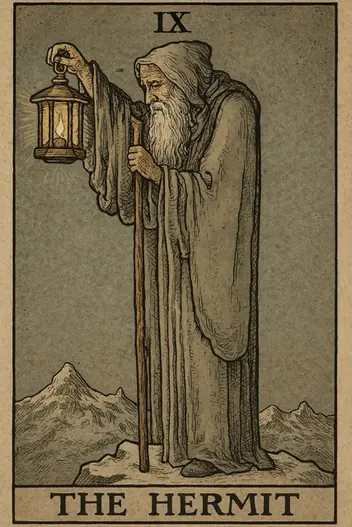
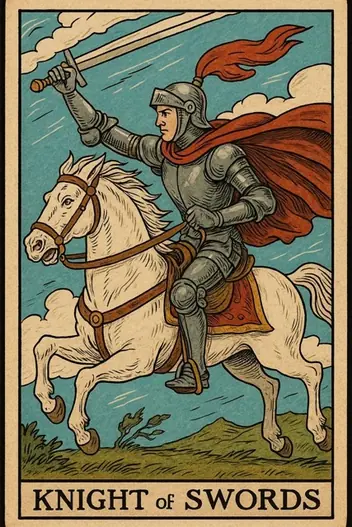
- Arcana
- The Hermit — Major Arcana; Knight of Swords — Minor Arcana, Swords
- Elements
- The Hermit — Earth; Knight of Swords — Air
- Elemental interaction
- Opposing elements — energies create tension
- Numerology
- 9 + 12 = 21 → 3
When the solitary, introspective Hermit meets the swift, assertive Knight of Swords, we witness a psychological collision between deep contemplation and decisive action. In practical terms, this pairing suggests a moment where you have gathered enough inner knowledge—through isolation, study, or reflection—and now feel an urgent need to apply it. The Hermit provides the map; the Knight provides the speed. However, without careful integration, this can lead to impulsive decisions based on incomplete data or a rigid, dogmatic certainty that shuts out new perspectives.
Psychologically, this combination represents a critical transition from insight to implementation. The Hermit’s lantern illuminates a path forward, but the Knight of Swords charges ahead with such velocity that he may miss the subtle details along the way. The key challenge here is balancing the need for thorough analysis with the momentum required for effective action. In Jungian terms, this is the tension between the Introverted Thinking function (Hermit) and Extraverted Thinking (Knight)—a dynamic that, when managed well, produces sharp, targeted decisions. When mismanaged, it creates a brittle, defensive mindset that mistakes speed for progress.
Core Dynamics & Interpretation
The core dynamic of The Hermit and Knight of Swords is a strategic paradox: the loner who must now act in the world. The Hermit represents a period of withdrawal, where you have been mapping your inner terrain—examining beliefs, values, and past patterns. The Knight of Swords then bursts onto the scene, demanding that you take that hard-won clarity and turn it into a decisive, public move. This is not a time for endless deliberation; it is a time for calibrated action.
In real-world terms, this combination often appears when someone has done the hard work of therapy, coaching, or self-study and now feels compelled to make a major life change—changing careers, ending a relationship, or launching a project. The psychological risk is that the Knight’s urgency overrides the Hermit’s caution, leading to premature actions. Conversely, the psychological reward is a perfectly timed breakthrough where your inner wisdom aligns with external opportunity. The key is to set a deadline for analysis and then commit to action, trusting that you have enough data to proceed.
The most critical insight is that this pairing demands intellectual honesty without arrogance. The Hermit’s solitude can breed certainty, but the Knight’s charge can blind you to counter-evidence. You must remain open to feedback even as you move forward. This is active wisdom, not passive knowledge.
What Do The Hermit and Knight of Swords Say About Love?
If you are single:
This combination suggests you may be over-analyzing a potential partner. Take one concrete step—like a direct conversation or a date—to test your theories against reality. Avoid waiting for perfect clarity.
If you are in a relationship:
Your partner may feel you are emotionally distant or overly critical. The Hermit’s solitude plus the Knight’s sharp tongue can create a dynamic where you withdraw to think, then attack with words. Prioritize listening over lecturing.
In relationship dynamics, The Hermit and Knight of Swords often indicate a power imbalance in communication. One partner (the Knight) may be pushing for immediate resolution or change, while the other (the Hermit) needs space to process. The psychological danger is intellectualizing emotions—using analysis as a shield against vulnerability. Your key relationship advice is to schedule a “reflection period” before any major discussion. Agree to take 24 hours to think separately, then reconvene with the goal of understanding, not winning. This honors both the need for solitude and the need for action.
If you are single, this combination warns against romanticizing the “lone genius” archetype. You may attract partners who admire your intellect but feel emotionally starved. Instead, practice sharing your inner world incrementally—not all at once, but not never. The Knight of Swords’ energy can be channeled into asking direct, clarifying questions early in a relationship, such as “What are your non-negotiables?” This saves time and prevents fantasy.
Your pair is already on the table. Ask your question and draw the clarifying card
or simply focus on it
What Do The Hermit and Knight of Swords Indicate for Your Career?
Strategic Opportunities:
Launch a solo project or research phase where you can work independently before presenting findings. This is ideal for thought leadership, consulting, or academic work.
Strategic Opportunities:
Use this energy to critique and streamline existing processes. The Knight’s sharpness combined with the Hermit’s depth is perfect for auditing systems, cutting inefficiencies, or writing a strategic plan.
Calculated Risks:
Avoid public confrontations or aggressive negotiations until you have all the data. The Knight of Swords can come across as arrogant or combative. Objectively, this is a poor time for partnerships or team-based initiatives.
In professional contexts, this pairing signals a period of intense focus and rapid execution on a specialized task. You may be working alone on a high-stakes project, such as a report, a patent application, or a business plan. Your financial warning is to resist the urge to make large investments based on a single insight. The Hermit’s wisdom is valuable, but the Knight’s haste can lead to overconfidence. Instead, set a “decision delay” rule—wait 48 hours before committing money to any new idea.
Your strategic tip is to document your reasoning process. This not only clarifies your thinking (honoring the Hermit) but also creates a record you can defend if challenged (honoring the Knight). This combination excels in roles requiring critical analysis and decisive action, such as crisis management, legal strategy, or data-driven consulting. However, it struggles in roles requiring diplomacy or emotional labor.
Reversed Positions: What Changes?
If The Hermit is Reversed:
This indicates blocked potential and recklessness. The person cannot or will not withdraw for reflection, yet impulsively attacks. The result is actions based on incomplete information and emotional indulgence. Advice: Consciously slow down. Any activity now will be destructive. You vitally need to find at least an hour of silence to avoid making a huge mistake.
If the Knight of Swords is Reversed:
This indicates inner resistance and weakness. The aggressive impulse is suppressed, but the Hermit cannot find peace. A state of paralysis of the will arises: you understand what needs to be done but cannot force yourself to start. This is self-sabotage through over-analysis. Advice: Lower the bar of your demands. You don't need a "brilliant solution." It's enough to simply take the first, albeit imperfect, step.
If BOTH are Reversed:
Complete imbalance. This is chaos and inner emptiness. The person is simultaneously incapable of reflection and action. They oscillate between apathy and useless bustle. The logical way to correct this: Acknowledge your powerlessness and seek external help (coach, psychologist, mentor). It is extremely difficult to get out of this pit on your own.
Ask your specific question
Don't rely on generic meanings. Get a customized reading tailored specifically to your energies.
The Hermit and Knight of Swords: Warning Signs
The shadow side of The Hermit and Knight of Swords is intellectual arrogance masking as wisdom. When this energy is blocked or expressed irrationally, the seeker may become a dogmatic recluse—someone who believes they have all the answers and dismisses outside input as irrelevant. This is the cognitive bias of “confirmation bias” on steroids: you only seek evidence that supports your pre-existing conclusions, and you attack any challenge with the Knight’s sharp tongue.
Another pitfall is paralysis by analysis followed by reckless action. You may spend too long in the Hermit’s solitude, then suddenly snap and make a hasty decision that you later regret. This is a classic “binge and purge” cycle in decision-making. Self-sabotage occurs when you use the Hermit’s introspection to avoid responsibility, then use the Knight’s energy to blame others for the consequences.
Poor judgment manifests as a refusal to ask for help. The combination suggests a belief that you must solve everything alone. This is a trap of the ego. In reality, the most effective leaders know when to stop thinking and start asking. If you feel a growing sense of isolation combined with righteous anger, pause. This is a shadow signal that you are mistaking certainty for truth.
Synthesis: Strategic Conclusion
How to constructively use this dynamic? Your task is to direct the Knight of Swords' energy toward defending the boundaries built by the Hermit, rather than destroying them. Imagine the Hermit as the architect who designed a fortress (your inner self), and the Knight of Swords as the guard who protects its gates. The guard must not burst inside and smash the furniture. Their job is to repel external threats that hinder the architect's work.
In practical terms, this looks like: you withdraw (the Hermit), formulate the problem, and find a solution. Then you activate the Knight of Swords not for argument, but for a clear and well-reasoned presentation of your solution to the outside world. You do not attack opponents; you defend your point of view with facts.
Strategic advice:
Start small. Set aside 30 minutes of complete silence (the Hermit). Write down one most important thought. Then set aside 15 minutes to write one clear message or make one call based on that thought (the Knight of Swords). Do not mix these processes. First — silence, then — action. This simple ritual will allow you to use the best of both archetypes while avoiding their destructive shadows. You will become not a hermit-brawler, but a strategist who knows when to be silent and when to strike the decisive blow.
Applying This to Your Situation
The core message of The Hermit and Knight of Swords is “act with clarity, but stay humble.” You have the insight to move forward, but the speed of your action must match the depth of your understanding. Your next step is to write down your key insight and then take one small, irreversible action within 24 hours. This honors both the need for reflection and the need for momentum. Remember: wisdom without action is fantasy; action without wisdom is chaos.
While this article provides a general archetype, the true power of Tarot emerges when it’s applied to your unique situation. The Fortune Cards app lets you get a deep, personalized interpretation of this exact combination for your specific question—whether it’s about a relationship, career move, or personal dilemma. Use the app on the web or download it now to receive a tailored reading that accounts for your context, your timing, and your psychology. Don’t guess—get clarity.
Interpretation by the Fortune Cards editorial team, based on the Rider–Waite tradition and Jungian archetypes. About our methodology · Updated: 2026-08-26
Other Combinations with The Hermit
Other Combinations with Knight of Swords
Explore Individual Card Meanings
Table of Contents
Ready to find answers to your questions?
Start your first reading now and look at your situation with fresh clarity. The cards are ready to reveal deeper meaning.