Nine of Swords and Ten of Pentacles Meaning in Tarot
- Arcana
- Nine of Swords — Minor Arcana, Swords; Ten of Pentacles — Minor Arcana, Pentacles
- Elements
- Nine of Swords — Air; Ten of Pentacles — Earth
- Elemental interaction
- Opposing elements — energies create tension
- Numerology
- 9 + 10 = 19 → 1
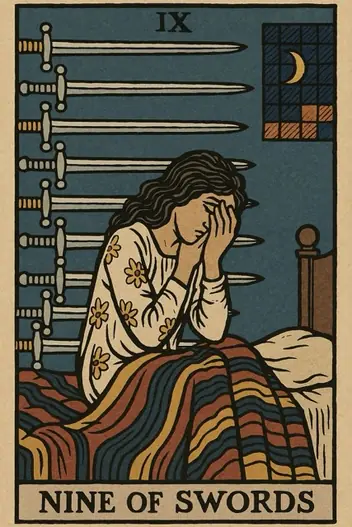
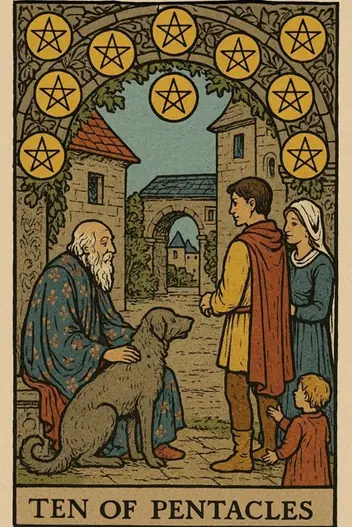
When the Nine of Swords—the card of nocturnal dread, overthinking, and mental torment—collides with the Ten of Pentacles—the archetype of family legacy, financial stability, and generational wealth—we witness a powerful psychological tension. This pairing often surfaces when a person feels that their hard-won stability or inherited security is being undermined by internal fears rather than external threats. The core conflict is between the objective reality of material safety and the subjective experience of psychological crisis.
Strategically, this combination demands that we separate perceived risk from actual risk. The Ten of Pentacles represents a solid foundation: a home, a business, a family structure. The Nine of Swords represents the mind’s tendency to catastrophize about losing that foundation. In Jungian terms, this is the Shadow of the Caretaker archetype—where the drive to preserve and protect becomes a source of obsessive worry. The pragmatic question becomes: Is your anxiety a signal of a real problem, or a symptom of an overactive internal alarm system?
Nine of Swords and Ten of Pentacles Card Meaning Explained
The psychological state created by the Nine of Swords and Ten of Pentacles is one of guilt-ridden vigilance. You may feel you do not deserve your current stability, or that you are failing to live up to the expectations of your family, ancestors, or social circle. This can manifest as imposter syndrome in a leadership role or as a paralyzing fear of making a financial mistake that will undo years of progress. The mind fixates on worst-case scenarios: bankruptcy, family breakdown, or public shame.
The real-world implication is a blocked decision-making process. While the Ten of Pentacles encourages long-term planning and legacy-building, the Nine of Swords whispers that any move could be catastrophic. This creates a cognitive dissonance where you have the resources to act but lack the psychological permission. The key insight here is that this anxiety is often a misplaced sense of responsibility. You are not worrying because things are fragile; you are worrying because you care deeply about preserving what you have built. The task is to channel that care into structured risk management rather than rumination.
Your pair is already on the table. Ask your question and draw the clarifying card
or simply focus on it
Nine of Swords and Ten of Pentacles for Career and Money
Strategic Opportunities:
Audit your actual risk exposure. List your assets, debts, and safety nets. Often, the Nine of Swords exaggerates threats that the Ten of Pentacles has already mitigated.
Strategic Opportunities:
Delegate or automate worry. Hire a financial advisor, use budgeting software, or create a standard operating procedure for your business. This offloads the mental burden.
Calculated Risks:
Avoid making rash decisions based on fear. Do not sell assets, quit a stable job, or break a partnership purely because you feel anxious. The threat is likely internal, not external.
Professionally, this combination is a warning against analysis paralysis. You may be in a position of significant responsibility—managing a family business, handling large sums of money, or overseeing a team—and the weight of that responsibility is triggering anxiety attacks. The pragmatic solution is to systematize your decision-making. Create clear criteria for when to act and when to wait. Financially, this is a time to prioritize liquidity over illiquid investments. Having accessible cash will soothe the Nine of Swords’ fear of being trapped. The bold financial warning is this: Do not confuse a temporary emotional state with a permanent financial crisis. Your foundation is likely more solid than you feel.
Deepen your understanding
Find out exactly what this reading means for your current life situation with our oracle.
Nine of Swords and Ten of Pentacles in Love and Relationships
If you are single:
This pair suggests you may be evaluating potential partners through a lens of financial and social security while simultaneously fearing that you are not "good enough" for a stable relationship. Your anxiety about family expectations could be blocking authentic connection.
If you are in a relationship:
The dynamic often involves one partner feeling burdened by legacy (family pressure, inheritance issues) while the other struggles with expressed fears about the future. There may be a hidden conflict about money or family loyalty.
In relationships, the Nine of Swords and Ten of Pentacles combination points to a crisis of emotional inheritance. You may be carrying unresolved family patterns—such as a parent’s financial anxiety or a history of marital instability—into your current partnership. The most important relationship advice here is to externalize the fear. Talk openly about your anxieties regarding money, home, and future planning. Do not let the Nine of Swords become a secret burden that isolates you from your partner. Set a boundary between your internal fears and your partner’s actions. Just because you feel insecure does not mean they have done something wrong. Use this combination as a prompt to create a joint financial and emotional contingency plan—the very act of planning reduces the power of the anxiety.
Nine of Swords and Ten of Pentacles Reversed: How to Read It
If the Nine of Swords is reversed:
Anxiety surfaces and becomes explicit. This can signify a crisis that can no longer be ignored. On one hand, it shatters the illusion of stability; on the other, it provides an opportunity for real change. Advice: Do not try to suppress the panic. Use it as fuel for action, but act rationally.
If the Ten of Pentacles is reversed:
External stability begins to crumble. This could be a family conflict, loss of inheritance, or business collapse. In combination with the upright Nine of Swords, this indicates that your worst fears are starting to come true. Warning: Do not fall into despair. The Nine of Swords exaggerates the threat. Focus on what you can save, not on what you have lost.
If BOTH are reversed:
Complete imbalance. Inner anxiety (reversed Nine) and outer chaos (reversed Ten) amplify each other. This is a state of acute crisis, where a person feels their world is collapsing and they cannot find any footing. A logical way to correct this: Consciously give up trying to control everything. Focus on one specific task (e.g., finding a new job or mending a relationship with one family member), ignoring the rest. This is the only way to break the vicious cycle.
Negative Meaning of Nine of Swords and Ten of Pentacles
The shadow manifestation of this pairing is paralytic perfectionism masked as diligence. You may convince yourself that you are being "responsible" by worrying, when in fact you are self-sabotaging through rumination. This is a classic cognitive bias known as catastrophizing—overestimating the likelihood of disaster and underestimating your ability to cope. Another pitfall is projecting your anxiety onto others, blaming your family or partner for "causing" your stress when the source is internal. In extreme cases, this combination can lead to hoarding behaviors (financial or material) as a misguided attempt to control the future. The shadow here is the belief that worrying is a form of protection. It is not. It is a form of suffering that drains the energy needed to actually protect what you value.
Nine of Swords and Ten of Pentacles: Tarot Advice
The key to harmonizing this pair is transforming anxiety into strategic planning. The Nine of Swords is an energy that demands attention to detail and foresight of threats. Instead of allowing it to paralyze you, use it to create a reliable security system.
First Step:
Acknowledge that your anxiety is not a curse, but a signal. It indicates that your psyche considers the situation unsafe, even if your mind says otherwise. Instead of fighting the anxiety, begin a dialogue with it. Ask yourself: "What exactly am I afraid of? What is the worst-case scenario? What will I do if it happens?" This will strip the anxiety of its aura of uncertainty.
Second Step:
Integrate the resources of the Ten of Pentacles. This card indicates that you have support — family, traditions, experience, capital. Lean on them. Do not try to handle everything alone. Delegate, ask for advice, use your connections. The Ten of Pentacles is about collective strength, not individual struggle.
Third Step:
Create "buffer zones." These are concrete actions that reduce risks. For example, build a financial safety net for six months. Draft a contingency plan for a crisis. Establish clear boundaries in communication with family. When you have a concrete plan, the Nine of Swords loses its power. You cease to be a victim of circumstances and become the architect of your reality. Your task is not to get rid of anxiety, but to learn to act despite it, relying on real resources.
Where to Go From Here
The core message of the Nine of Swords and Ten of Pentacles is that your legacy is not threatened by your fears, but by your inaction stemming from those fears. The stability you have built is real; the anxiety you feel is a signal to manage your psychology, not to abandon your strategy. To move forward, you must distinguish between a genuine risk and a manufactured dread.
While this article provides the general archetype, the true magic happens when Tarot is applied to your unique situation. Your specific question—about a relationship, a career move, or a family matter—deserves a tailored interpretation. That is why you should use the Fortune Cards app. You can access it on the web or download it to get a deep, personalized interpretation of this exact combination for your specific question right now. Stop generalizing your fears; start clarifying your path.
Interpretation by the Fortune Cards editorial team, based on the Rider–Waite tradition and Jungian archetypes. About our methodology · Updated: 2026-08-26
Other Combinations with Nine of Swords
Other Combinations with Ten of Pentacles
Explore Individual Card Meanings
Table of Contents
- Nine of Swords and Ten of Pentacles Card Meaning Explained
- Nine of Swords and Ten of Pentacles for Career and Money
- Nine of Swords and Ten of Pentacles in Love and Relationships
- Nine of Swords and Ten of Pentacles Reversed: How to Read It
- Negative Meaning of Nine of Swords and Ten of Pentacles
- Nine of Swords and Ten of Pentacles: Tarot Advice
- Where to Go From Here
Ready to find answers to your questions?
Start your first reading now and look at your situation with fresh clarity. The cards are ready to reveal deeper meaning.