Nine of Swords and Eight of Pentacles Tarot Combination
- Arcana
- Nine of Swords — Minor Arcana, Swords; Eight of Pentacles — Minor Arcana, Pentacles
- Elements
- Nine of Swords — Air; Eight of Pentacles — Earth
- Elemental interaction
- Opposing elements — energies create tension
- Numerology
- 9 + 8 = 17 → 8
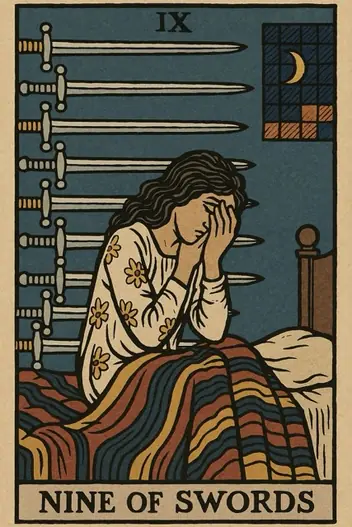
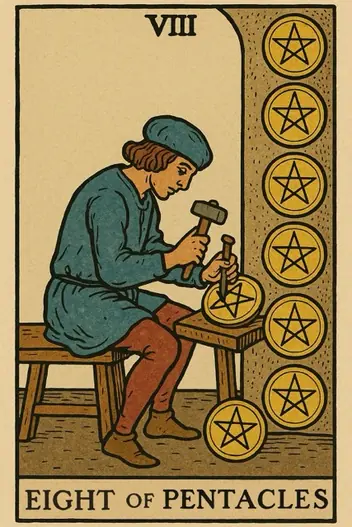
The collision of Nine of Swords (the card of nightmares, overthinking, and acute anxiety) with Eight of Pentacles (the card of focused craftsmanship, routine, and skill-building) creates a paradoxical tension. On one hand, you are gripped by catastrophic fears—perhaps about your competence, your future, or a specific failure. On the other, you are being called to sit down, shut out the noise, and do the slow, repetitive work of mastery. This combination often appears when your inner critic is so loud that it threatens to paralyze the very hands you need to build a solution.
Psychologically, this pairing represents the struggle between the anxious mind (Nine of Swords) and the disciplined ego (Eight of Pentacles). The Nine of Swords whispers that everything is falling apart, while the Eight of Pentacles insists that steady, incremental effort is the only antidote. The key insight here is that the fear is not a sign to stop—it is a symptom of being in the middle of a difficult but necessary learning curve. The cards suggest that your anxiety is not a prophecy, but a reaction to the pressure of self-improvement.
Nine of Swords and Eight of Pentacles Together: Meaning
When the Nine of Swords meets the Eight of Pentacles, the primary dynamic is one of overwhelming mental pressure versus grounding action. The Nine of Swords represents the mind’s tendency to spin worst-case scenarios, often about one’s own inadequacy. You may be lying awake at night, replaying mistakes, or fearing that you are not skilled enough, smart enough, or fast enough. The Eight of Pentacles offers a counterbalance: it says, “Stop thinking. Start doing. One stitch at a time.”
This is not a comfortable combination because the Eight of Pentacles demands patience, while the Nine of Swords demands immediate relief from pain. The psychological trap here is that you might try to “work harder” to outrun the anxiety, but the Eight of Pentacles is not about frantic effort—it is about deliberate, mindful practice. If you rush, you will make mistakes that feed the Nine of Swords’ narrative of failure. The correct approach is to acknowledge the fear without letting it dictate your pace. Use the anxiety as data, not as a driver.
In practical terms, this combination often appears when you are learning a new skill, starting a demanding project, or recovering from a professional setback. The Nine of Swords is the voice that says, “You’ll never get this right.” The Eight of Pentacles is the evidence that says, “You are getting better, but only if you keep going.” The core interpretation is that your salvation lies not in solving the anxiety mentally, but in proving it wrong through disciplined action.
Nine of Swords and Eight of Pentacles: Career and Money
Strategic Opportunities:
This is a powerful time to upskill or master a specific technical area. Your anxiety about falling behind is a valid signal that you need to invest in your competence. Enroll in a course, seek mentorship, or practice a craft daily.
Strategic Opportunities:
Consider restructuring your workflow to reduce cognitive load. The Nine of Swords thrives on chaos; the Eight of Pentacles thrives on routine. Create a clear, repetitive process for your most important tasks to lower your anxiety baseline.
Calculated Risks:
Avoid taking on new projects that require high creativity or risk while you are in this anxious state. The Eight of Pentacles is about refinement, not innovation. Do not pivot your career or launch a risky venture now—instead, focus on deepening your existing skills to build a stable foundation.
For career and finances, this combination is a direct warning against “shiny object syndrome.” The Nine of Swords may push you to panic-switch jobs, chase a trend, or make a financial move out of fear of missing out. The Eight of Pentacles says: Master your current domain before expanding. This is particularly relevant if you are in a skilled trade, tech, design, or any field where precision matters. Your anxiety is likely tied to a real gap in your knowledge or execution. The solution is not to escape the gap, but to fill it through deliberate practice.
Financially, the Eight of Pentacles encourages steady, boring savings and investment in your earning capacity. The Nine of Swords may tempt you to hoard money out of fear or to spend impulsively to relieve stress. The pragmatic path is to create a budget that accounts for your anxiety—set aside a small “emergency buffer” to quiet the inner critic, then invest the rest in your professional development. This combination often leads to a breakthrough if you can tolerate the discomfort of not knowing the outcome while doing the work.
Your pair is already on the table. Ask your question and draw the clarifying card
or simply focus on it
Nine of Swords and Eight of Pentacles Love Outcome
If you are single:
This combination suggests you may be overthinking past rejections or future possibilities to the point of inaction. The Eight of Pentacles advises you to treat dating as a learnable skill—practice conversations, observe patterns, and refine your approach without attaching catastrophic meaning to each interaction.
If you are in a relationship:
You or your partner may be stuck in a cycle of worry about the relationship’s stability while simultaneously putting in the work to maintain it. The fear of failure is present, but so is the commitment to show up daily.
In relationships, this pairing often reveals a dynamic where one partner is the “worrier” and the other is the “worker.” The Nine of Swords energy can manifest as anxious attachment—fearing abandonment, replaying arguments, or assuming the worst. The Eight of Pentacles energy, however, manifests as consistent, unglamorous effort: making the coffee, listening without interrupting, or scheduling quality time. The critical advice here is to not let the worry invalidate the work. You can be afraid and still be a good partner. The danger is when the anxiety becomes a self-fulfilling prophecy—for example, obsessing over a flaw until you create a conflict. Instead, channel the worry into constructive action: if you fear distance, schedule a check-in; if you fear dishonesty, practice vulnerability. The Eight of Pentacles reminds you that love is built through small, repeated acts of reliability.
Negative Meaning of Nine of Swords and Eight of Pentacles
The shadow side of this pairing is obsessive perfectionism fueled by fear. The Nine of Swords can convince you that nothing you do is good enough, while the Eight of Pentacles can trap you in a loop of endless refinement. You may find yourself overworking to the point of burnout, constantly redoing tasks, or avoiding completion because you fear judgment. This is a classic cognitive distortion known as “catastrophizing” combined with “overcompensation.” You believe that if you just work a little harder, the fear will disappear—but it won’t, because the fear is not about the work; it is about your self-worth.
Another pitfall is tunnel vision. The Eight of Pentacles is about focus, but when paired with the Nine of Swords, that focus can become obsessive. You may ignore feedback, isolate yourself, or refuse to ask for help because you believe you must solve the problem alone. This is a recipe for mental exhaustion and poor decision-making. The shadow also manifests as resentment: you may feel that you are doing all the work while others are not, leading to bitterness that feeds the Nine of Swords’ narrative of victimhood. Recognize that the anxiety is not proof of your inadequacy—it is proof that you care deeply. The trap is caring too much about the outcome and not enough about the process.
Ask your specific question
Don't rely on generic meanings. Get a customized reading tailored specifically to your energies.
Nine of Swords and Eight of Pentacles Reversed: How to Read It
When cards appear in a reversed position, the dynamic becomes distorted, but does not disappear.
If the Nine of Swords is reversed:
The inner critic does not fall silent, but becomes irrational. This is a state where anxiety spills outward, transforming into aggression or recklessness. Instead of immersing oneself in work, a person may begin sabotaging their own projects, abandoning them halfway due to a sudden fear of success. Advice: Consciously lower your standards for yourself to a minimum.
If the Eight of Pentacles is reversed:
This is an internal resistance to mastery. The person knows what needs to be done but feels a revulsion toward routine. Work stagnates, and anxiety grows from the awareness of one's own laziness and incompetence. Warning: This is a state of "stuckness." Do not try to "pull yourself together"—start with the smallest, 2-minute action to break the stupor.
If BOTH are reversed:
Complete imbalance. Anxiety transitions into apathy, and work into a simulation of frantic activity. A person may be busy 24/7 but produce nothing of value. The logical way to correct this: A complete stop. A week of digital detox and physical rest. Any attempt to "work on yourself" will worsen the situation.
Overall Meaning of Nine of Swords and Eight of Pentacles
How can the energy of the Nine of Swords be used constructively to balance the Eight of Pentacles? The key lies in shifting focus from process to outcome. Your anxiety is a signaling system, not a guide for action. When you feel panic, your first reaction is to start doing something—any action. The strategic advice: force yourself to stop for 5 minutes and write down one specific goal for today.
The Eight of Pentacles is the card of apprenticeship. Instead of using it as a tool to escape fear, use it as a tool for mastering a new skill in anxiety management. For example, instead of redoing a report for the fifth time, spend that time learning a breathing technique or practicing an "emergency stop" exercise. Make your "project" not the work, but your own resilience.
The deep strategic conclusion is that the quality of your work will never replace the quality of your sleep. The Nine of Swords thrives in exhaustion. The Eight of Pentacles demands endurance. The only way to make this pair work for you is to impose strict limits on work. Make boundaries (e.g., "no work after 8:00 PM") your primary task. Only then will anxiety cease to be a driver and instead become fuel for conscious, rather than compulsive, action.
Your Next Step: Personal Context Matters
The core message of Nine of Swords and Eight of Pentacles is this: Your fear is a sign that you are growing, not that you are failing. The only way through the nightmare is to sit down and do the work, one painful, deliberate step at a time. Do not try to think your way out of anxiety—act your way out of it. Mastery is the antidote to dread.
This analysis provides the general archetype, but the true power of Tarot lies in applying it to your unique situation. Your specific question, your life history, and the other cards in your spread will dramatically shift the meaning. To get a deep, personalized interpretation of this exact combination for your specific question—whether about a relationship, a career move, or a personal struggle—use the Fortune Cards app. You can access it on the web or download it now to receive a reading that speaks directly to your life.
Interpretation by the Fortune Cards editorial team, based on the Rider–Waite tradition and Jungian archetypes. About our methodology · Updated: 2026-08-26
Other Combinations with Nine of Swords
Other Combinations with Eight of Pentacles
Explore Individual Card Meanings
Table of Contents
- Nine of Swords and Eight of Pentacles Together: Meaning
- Nine of Swords and Eight of Pentacles: Career and Money
- Nine of Swords and Eight of Pentacles Love Outcome
- Negative Meaning of Nine of Swords and Eight of Pentacles
- Nine of Swords and Eight of Pentacles Reversed: How to Read It
- Overall Meaning of Nine of Swords and Eight of Pentacles
- Your Next Step: Personal Context Matters
Ready to find answers to your questions?
Start your first reading now and look at your situation with fresh clarity. The cards are ready to reveal deeper meaning.