The Hermit and Five of Swords Reversed in Tarot
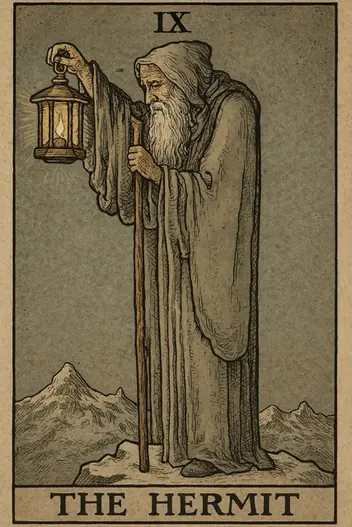

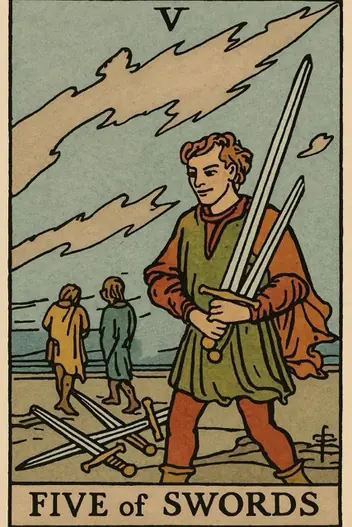
- Arcana
- The Hermit — Major Arcana; Five of Swords — Minor Arcana, Swords
- Elements
- The Hermit — Earth; Five of Swords — Air
- Elemental interaction
- Opposing elements — energies create tension
- Numerology
- 9 + 5 = 14 → 5
When The Hermit—the archetype of introspection, solitude, and inner truth—meets the Five of Swords—the card of conflict, defeat, and hollow victory—a complex psychological landscape emerges. This pairing signals a time when your need for clarity and withdrawal collides with a messy interpersonal battle. You may be fighting for a principle, but the real war is within.
This combination forces a critical question: Are you protecting your boundaries, or are you isolating yourself by winning at someone else’s expense? The Hermit’s lantern illuminates the Five of Swords’ battlefield, revealing that the prize you’re fighting for may not be worth the loneliness it brings. Here, strategic retreat often outweighs tactical victory.
The Hermit and Five of Swords Together: Meaning
The core dynamic here is a psychological conflict between self-preservation and social consequence. The Hermit represents a retreat into one’s own mind—a necessary pause to align with core values. The Five of Swords, however, represents a conflict that has already caused collateral damage. When combined, you are likely in a situation where you have won an argument, a negotiation, or a position, but the victory feels hollow because you’ve lost trust, respect, or connection.
This pairing often appears when someone is rationalizing a difficult decision through excessive introspection. You may tell yourself you’re being “strategic,” but the Five of Swords warns of a cognitive bias toward self-justification. The real insight from The Hermit is not to double down on your isolated stance, but to ask: Did I create this conflict to justify my need for solitude? The energy here demands you differentiate between healthy boundaries and self-defeating isolation.
Practically, this combination suggests a period where silence is more powerful than speech. The Five of Swords often indicates a situation where further argument is futile. The Hermit advises you to step back, observe the wreckage, and use the lesson to refine your approach. The most important takeaway is that winning a battle does not mean winning the war—especially if the war is within your own psyche.
The Hermit and Five of Swords in Love and Relationships
If you are single:
This pairing warns against picking fights as a way to test a potential partner’s worth. You may be using intellectual superiority or emotional withdrawal to keep someone at a distance. Ask yourself if your standards are boundaries or walls.
If you are in a relationship:
You or your partner may be holding onto a past argument as a reason to withdraw emotionally. The victory of being “right” is costing you intimacy. The relationship needs a ceasefire, not a winner.
In relationships, The Hermit and Five of Swords together signal a power struggle masked by introspection. One partner may be using silence as a weapon, retreating into their own world while the other feels defeated and unheard. The psychological pattern here is passive-aggressive control: instead of resolving a conflict, you disengage, leaving the other person to stew in the aftermath of a verbal battle.
The key advice is to recognize when your need for space has become a form of punishment. The Hermit’s wisdom is powerful, but when tainted by the Five of Swords’ bitterness, it becomes a cold, judgmental silence. To heal this dynamic, you must own your part in the conflict and use the introspection not to distance yourself, but to understand why you feel the need to win at all costs. Emotional intelligence here means choosing connection over being right.
Your pair is already on the table. Ask your question and draw the clarifying card
or simply focus on it
The Hermit and Five of Swords for Career and Money
Strategic Opportunities:
Use this period to reassess your professional values. The Hermit’s clarity can help you identify which battles are truly worth fighting.
Strategic Opportunities:
Document everything. The Five of Swords suggests a conflict where facts will matter more than feelings. Keep records of agreements, emails, and decisions.
Calculated Risks:
Avoid public confrontations or office politics. Winning a public argument may damage your long-term reputation and professional network.
In career and finances, this combination is a red flag for toxic competition. You may be in a situation where a colleague, competitor, or even a client is trying to undermine you. The Hermit advises you to step back and analyze the chessboard before making a move. The Five of Swords warns that engaging in a direct confrontation will likely leave you with a Pyrrhic victory—you win the point but lose the relationship.
Financially, this is a time for defensive strategy. Do not make major investments or financial moves based on a desire to “prove someone wrong.” The combination suggests that impulsive decisions driven by ego will lead to losses. Instead, use the Hermit’s energy to study the market, review your budget, and identify where you are vulnerable. The most strategic move is to consolidate your resources and wait out the conflict. Bold financial warning: Do not let pride dictate your spending. A costly victory is still a loss.
Ask your specific question
Don't rely on generic meanings. Get a customized reading tailored specifically to your energies.
The Hermit and Five of Swords Reversed Meaning
When cards appear in a reversed position, the dynamic becomes more complex, yet potentially less destructive.
The Hermit Reversed:
You can no longer rely on your intuition or inner compass. You seek answers externally, but the Five of Swords forces you into conflicts without a clear strategy. Warning: you risk getting drawn into a pointless argument from which you cannot exit with dignity. Advice: temporarily refrain from making important decisions until you restore inner clarity.
Five of Swords Reversed:
This indicates an internal resistance to conflict. You want to retreat into isolation (The Hermit), but fear being seen as weak or a loser. Instead of proving you are right, you engage in self-criticism and self-flagellation. Advice: your task is not to win, but to exit the situation while preserving your self-respect. In this case, defeat means abandoning your own boundaries.
Both Cards Reversed:
Complete imbalance. You are stuck between the desire to withdraw and the fear of losing. This is a state of paralysis of the will. You can neither defend your interests nor find refuge in silence. The logical way to correct this: urgently seek an external arbiter (psychologist, mentor) who can objectively assess the situation, as your own system of evaluation is completely distorted.
The Shadow Side of The Hermit and Five of Swords
The shadow side of The Hermit and Five of Swords is the martyr complex. You may convince yourself that your solitude is noble, when in reality, you are nursing a grudge or licking wounds from a battle you chose to fight. The cognitive bias here is confirmation bias: you withdraw to your “inner truth,” but only to find evidence that you were right and others were wrong. This prevents growth.
Another major pitfall is strategic paranoia. The Five of Swords can make you see enemies everywhere, while The Hermit isolates you from feedback that could correct this distorted view. You risk making decisions based on a skewed perception of threat, leading to unnecessary conflict or missed opportunities for collaboration. Self-sabotage manifests as a refusal to ask for help, believing that you must handle everything alone.
Overall Meaning of The Hermit and Five of Swords
Constructive use of this combination requires paradoxical thinking. You need to apply the Hermit's energy not to avoid conflict, but to choose your battlefield. Not every battle is worth winning. Your task is to use the Hermit's analytical detachment to assess the true cost of "victory" in each specific dispute.
Your strategic move is to transform the Five of Swords from a weapon into a tool. Instead of proving others wrong, use your sharpness of mind to cut away the excess from your life. Resign not with a sense of superiority, but with a sense of completion. End relationships not with a triumphant cry, but with a cold analysis of why it was necessary.
Deep advice: practice "strategic silence". This is not withdrawal into isolation, but a conscious decision not to engage in conflict when you understand that victory is not worth the resources. You are not losing—you are investing your energy in more important goals. It is this choice that distinguishes the sage (The Hermit) from the merely aggressive arguer (Five of Swords). Your strength lies not in breaking your opponent, but in understanding that your truth requires no proof.
Where to Go From Here
The core message of The Hermit and Five of Swords is that true victory is not about defeating others, but about aligning your actions with your deepest values. This combination asks you to pause, assess the cost of your battles, and decide if the prize is worth the isolation. The most powerful move you can make right now is to stop fighting and start listening—to yourself and to the people around you.
While this article provides the general archetype, the true magic happens when Tarot is applied to your unique situation. To get a deep, personalized interpretation of this exact combination for your specific question, use the Fortune Cards app. You can access it on the web or download it now to receive a tailored reading that considers your personal context, relationship dynamics, and career path. Get the clarity you need to turn this conflict into wisdom.
Interpretation by the Fortune Cards editorial team, based on the Rider–Waite tradition and Jungian archetypes. About our methodology · Updated: 2026-09-17
Other Combinations with The Hermit
Other Combinations with Five of Swords
Explore Individual Card Meanings
Table of Contents
- The Hermit and Five of Swords Together: Meaning
- The Hermit and Five of Swords in Love and Relationships
- The Hermit and Five of Swords for Career and Money
- The Hermit and Five of Swords Reversed Meaning
- The Shadow Side of The Hermit and Five of Swords
- Overall Meaning of The Hermit and Five of Swords
- Where to Go From Here
Ready to find answers to your questions?
Start your first reading now and look at your situation with fresh clarity. The cards are ready to reveal deeper meaning.