Ten of Cups and Five of Swords Reversed in Tarot
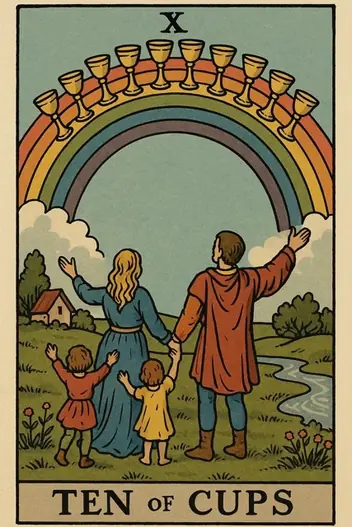

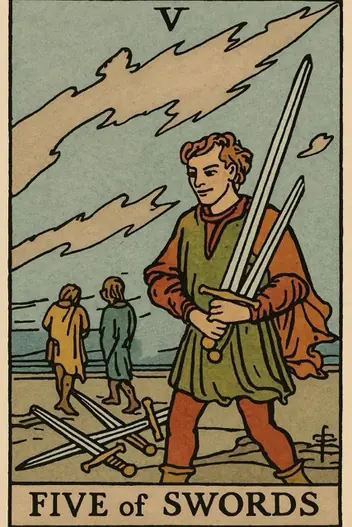
- Arcana
- Ten of Cups — Minor Arcana, Cups; Five of Swords — Minor Arcana, Swords
- Elements
- Ten of Cups — Water; Five of Swords — Air
- Elemental interaction
- Neutral elements — energies coexist without conflict
- Numerology
- 10 + 5 = 15 → 6
When the Ten of Cups, the archetype of emotional fulfillment and domestic harmony, collides with the Five of Swords, the card of conflict, defeat, and hollow victory, we witness a profound psychological tension. This is not a simple battle between good and bad, but a strategic dilemma: how much are you willing to sacrifice your inner peace to win a fight? The Ten of Cups represents the end goal of stability—a family, a partnership, a life built on mutual joy. The Five of Swords represents the immediate, often Pyrrhic, victory achieved through intellectual aggression or ego-driven combat.
The intersection of these two cards forces a pragmatic reckoning. You are likely facing a situation where achieving a short-term win (the Five of Swords) threatens the long-term emotional infrastructure (the Ten of Cups). The core question here is not if you can win, but what you will lose in the process. This combination demands a Jungian shadow integration: recognizing that the desire to be right can be a destructive force that undermines your deepest need to belong.
Ten of Cups and Five of Swords: How These Energies Interact
The psychological state created by the Ten of Cups and Five of Swords is one of cognitive dissonance. You are simultaneously driven by a deep-seated need for security, love, and community (Ten of Cups) and a sharp, competitive instinct to assert your intellect or defend your position at all costs (Five of Swords). This creates a fragile internal truce where you may feel you have to choose between being loved and being respected, or between harmony and honesty.
In real-world terms, this combination often appears when you are on the verge of achieving a major life goal—like buying a home, committing to a long-term relationship, or solidifying a team—but a recent argument, betrayal, or power struggle has left a bitter taste. The Five of Swords energy suggests that someone (possibly you) has already "won" the argument, but the victory feels empty. The key insight here is that the Five of Swords victory is often a delusion. You may have the last word, but you have lost the emotional safety net of the Ten of Cups.
This dynamic forces you to confront a pragmatic truth: not every battle is worth fighting, and not every truth needs to be spoken. The wisdom of this pairing lies in strategic surrender—knowing when to set down the sword to protect the cup. The shadow risk is that you will confuse passive-aggression with diplomacy, or that you will use the promise of future happiness (Ten of Cups) as an excuse to avoid necessary confrontation.
Ten of Cups and Five of Swords: Career and Money
Strategic Opportunities:
Use your sharp intellect to negotiate a settlement or close a deal that brings long-term stability. The Five of Swords gives you the edge to cut through red tape, but only if you focus on a win-win outcome.
Strategic Opportunities:
Identify a toxic team member or competitor who is creating unnecessary conflict. This combination empowers you to remove that person without destroying the team morale, if you act with emotional intelligence.
Calculated Risks:
Avoid public confrontations or legal battles where the cost of winning exceeds the value of the prize. The Five of Swords victory is often Pyrrhic; you may win the case but lose the client, the reputation, or the team's trust.
In a professional context, the Ten of Cups represents a harmonious work environment, a stable income, or a long-term career path. The Five of Swords represents a power struggle or a competitive threat. This combination often appears when you are considering leaving a secure job for a higher-paying but more hostile environment, or when you are tempted to sabotage a colleague to get ahead.
The core financial warning is about opportunity cost. You may be so focused on winning a single battle (a promotion, a bonus, a contract) that you lose sight of the bigger picture. Bold text: The most expensive mistake you can make here is to trade a decade of workplace peace for a single quarter of financial gain. The Five of Swords energy is seductive because it offers a quick, decisive win. But the Ten of Cups energy is sustainable—it builds wealth through relationships, trust, and consistency.
Pragmatic action steps:
- De-escalate office politics. If you sense a conflict brewing, use the Five of Swords' intellectual clarity to find a compromise, not to win an argument.
- Reassess your career goals. Are you chasing a title (Five of Swords) or a fulfilling work life (Ten of Cups)? This combination often reveals a misalignment between ego and values.
- Protect your financial boundaries. If you are in a partnership or shared business, ensure that past disagreements do not lead to a destructive split. Consider mediation to preserve the financial structure.
Your pair is already on the table. Ask your question and draw the clarifying card
or simply focus on it
Ten of Cups and Five of Swords Love Outcome
If you are single:
This pairing warns against a "win-lose" dynamic in early dating. You may be tempted to prove your intellectual superiority or win an argument, but doing so will sabotage the potential for genuine emotional connection. Focus on whether the relationship offers mutual support, not just intellectual stimulation.
If you are in a relationship:
You are likely in a cycle where one partner feels they have "won" a recent disagreement, but the other feels emotionally wounded. This creates a power imbalance that threatens the long-term stability of the partnership. The goal is not to keep score, but to repair the relational container.
In a committed relationship, this card pair signals a critical juncture. The Ten of Cups represents the ideal of the "happy family" or the "soulmate bond," while the Five of Swords represents a recent conflict that has challenged that ideal. The most common psychological trap here is scapegoating—blaming one partner for the conflict while the other claims the moral high ground. This is a shadow manifestation of the Five of Swords that poisons the Ten of Cups energy.
The strategic advice is to prioritize repair over victory. Ask yourself: Is being right worth losing the trust and intimacy you've built? Bold text: The health of the relationship depends on your ability to move from adversarial debate to collaborative problem-solving. If you are single, the same principle applies: do not mistake a clever argument for emotional compatibility. The Five of Swords energy in a new connection often indicates a narcissistic dynamic where one person dominates through intellect. The Ten of Cups asks you to walk away from that if it does not serve your long-term happiness.
Ten of Cups and Five of Swords Reversed: How to Read It
If the Ten of Cups is reversed:
The illusion of harmony shatters. You can no longer pretend that everything is fine. This removes the mask, and the Five of Swords becomes outright aggression or manipulation. Advice: use this moment for an honest, albeit painful, conversation. It is better to acknowledge the crisis than to live in a lie.
If the Five of Swords is reversed:
Aggression is suppressed or turned inward. You fear conflict so much that you sacrifice your own happiness. Warning: this is a path to passive aggression and depression. You are not defending your boundaries, and the Ten of Cups becomes a prison rather than a sanctuary. You need to learn healthy confrontation.
If BOTH are reversed:
Complete imbalance. You are simultaneously destroying the relationship and unable to let it go. This is a state of "suspended conflict," where there is neither winner nor loser, nor peace. A logical way to correct this: temporary isolation. Cease all contact for 24-48 hours to break the cycle of provocation and self-sacrifice. Only a cool head can restore order.
Uncover hidden insights
Let our advanced Tarot system interpret these archetypes specifically for your personal path.
When Ten of Cups and Five of Swords Signal Trouble
The shadow of the Ten of Cups and Five of Swords combination is a delusional sense of victory. You may believe you have achieved the perfect life (Ten of Cups) while ignoring the lingering resentment from a past conflict (Five of Swords). This is a classic cognitive bias known as "optimism bias" —the tendency to overestimate the likelihood of positive outcomes while underestimating the damage done.
Self-sabotage is another major pitfall. You might pick a fight with a loved one or a colleague (Five of Swords) precisely because you are afraid of the stability and happiness (Ten of Cups) that you are about to achieve. This is a Jungian shadow projection: you unconsciously sabotage the very thing you desire most, because deep down, you feel unworthy of it.
Poor judgment manifests when you use the Five of Swords' aggressive energy to "protect" the Ten of Cups' ideal. For example, you might cut off a family member or a friend to preserve your "perfect" household, only to discover that you have isolated yourself. The shadow here is that the sword you wield to defend your castle can also destroy its foundation. The key to avoiding this is to distinguish between healthy boundaries (necessary for the Ten of Cups) and emotional warfare (the shadow of the Five of Swords).
Overall Meaning of Ten of Cups and Five of Swords
To constructively harness the energy of the Ten of Cups for balancing the Five of Swords, one must grasp a key principle: harmony does not require sacrifice; it requires boundaries. Your task is not to destroy your opponent, but to protect your own "ecosystem" of happiness.
Strategically, this combination demands a paradigm shift from "me versus you" to "us versus the problem". The Five of Swords is a tool of defense, not offense. Use it as a scalpel, not a sword: a precise, cold solution for removing a threat, not a bloody massacre. The Ten of Cups is not a reward for war, but a space you safeguard.
Your deep strategic advice: learn to distinguish between a "battle for territory" and a "battle for values." If you are fighting for values (respect, honesty, family safety) — the Five of Swords is justified. If you are fighting for territory (who is right, whose turn it is to do the dishes, who earned more) — you lose, even if you win. Apply the 10/10/10 rule: how will this decision affect your harmony in 10 minutes, 10 months, and 10 years? If the victory won't matter in 10 years — retreat. This is not weakness; it is the highest form of wisdom.
Your Next Step: Personal Context Matters
The Ten of Cups and Five of Swords is not a static prediction—it is a strategic map of your current psychological terrain. The core message is clear: choose your battles wisely, and never sacrifice your long-term peace for a short-term win. Whether you are navigating a relationship conflict, a career power struggle, or a financial decision, the wisdom of this pair lies in knowing when to hold your sword and when to set it down.
However, the true meaning of this combination is deeply personal. Your specific question, your unique history, and your current emotional state will shift the interpretation. You need more than a general analysis—you need a reading that speaks directly to your life.
That is why you should use the Fortune Cards app. This article gives you the archetypal blueprint, but the app applies it to your exact situation. Whether you are asking about a specific person, a career decision, or a family conflict, the Fortune Cards app uses advanced Tarot algorithms to deliver a deep, personalized interpretation of this exact card combination. Download it now or use it on the web to get the clarity you need to move forward with confidence and emotional intelligence. Your future peace depends on the choices you make today.
Interpretation by the Fortune Cards editorial team, based on the Rider–Waite tradition and Jungian archetypes. About our methodology · Updated: 2026-08-26
Other Combinations with Ten of Cups
Other Combinations with Five of Swords
Explore Individual Card Meanings
Table of Contents
- Ten of Cups and Five of Swords: How These Energies Interact
- Ten of Cups and Five of Swords: Career and Money
- Ten of Cups and Five of Swords Love Outcome
- Ten of Cups and Five of Swords Reversed: How to Read It
- When Ten of Cups and Five of Swords Signal Trouble
- Overall Meaning of Ten of Cups and Five of Swords
- Your Next Step: Personal Context Matters
Ready to find answers to your questions?
Start your first reading now and look at your situation with fresh clarity. The cards are ready to reveal deeper meaning.