Five of Swords and Six of Swords Reversed in Tarot

- Arcana
- Five of Swords — Minor Arcana, Swords; Six of Swords — Minor Arcana, Swords
- Elements
- Five of Swords — Air; Six of Swords — Air
- Elemental interaction
- Same element — energies intensify each other
- Numerology
- 5 + 6 = 11 → 2
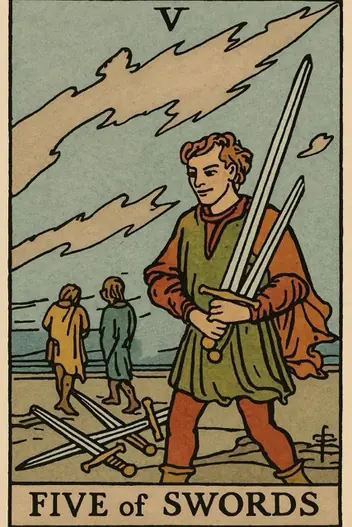
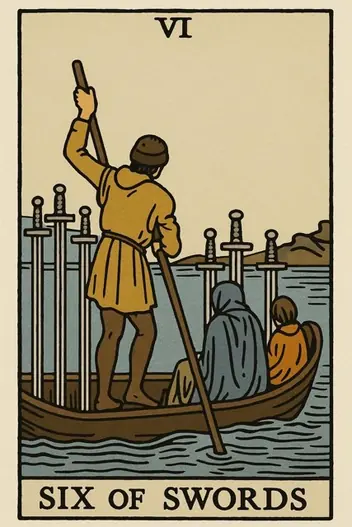
The intersection of the Five of Swords and the Six of Swords represents a critical psychological pivot: the moment after a bitter conflict when you must decide whether to cling to the "win" or to cut your losses and move on. The Five of Swords embodies the archetype of the Victorious But Isolated Warrior—someone who has secured a tactical victory but at the cost of trust, relationships, or inner peace. The Six of Swords introduces the Ferryman of Transition—a figure who navigates away from stormy waters toward calmer shores, but only by accepting what cannot be salvaged.
When these two cards appear together, they signal a cognitive dissonance: your ego may want to stay and fight to prove you were right, but your deeper psyche knows the battle has already drained your resources. The core dynamic here is strategic surrender—not weakness, but a calculated decision to prioritize future stability over past pride. This combination often appears when you are holding onto a "hollow victory"—a situation where you technically won an argument, negotiation, or competition, but the emotional cost makes the prize meaningless.
Five of Swords and Six of Swords Card Meaning Explained
The psychological state created by this pairing is one of restless ambivalence. The Five of Swords activates the Shadow of the Martyr—you may feel compelled to defend your position even when it's no longer beneficial, driven by a fear of being perceived as weak or wrong. Meanwhile, the Six of Swords represents the Healthy Ego's capacity for reality-testing: it asks, "Is this hill worth dying on?" The tension between these forces often manifests as analysis paralysis—you know you should move on, but your pride or unresolved anger keeps you tethered to the battlefield.
In real-world terms, this combination frequently surfaces after a breakup, a workplace conflict, or a legal dispute where one party "won" but lost the relationship. The key insight here is that the Six of Swords does not erase the Five of Swords' wounds—it simply provides a vehicle to carry them forward. You cannot undo the damage caused by harsh words or competitive tactics, but you can choose to reframe the experience as tuition for emotional intelligence. The most pragmatic approach is to acknowledge the loss without letting it define your identity. This is not about forgiveness; it's about resource allocation—your energy is finite, and continuing to fight a ghost drains the vitality you need for your next chapter.
Your pair is already on the table. Ask your question and draw the clarifying card
or simply focus on it
Five of Swords and Six of Swords Love Outcome
If you are single:
This combination warns against entering a new connection while still nursing the wounds of a past conflict. You may be projecting the "battle" of a previous relationship onto a new person, unconsciously expecting them to prove themselves or fight for your approval. The strategic move is to complete the emotional transition before seeking new partnerships.
If you are in a relationship:
This pairing often signals a power struggle that has left one partner feeling defeated while the other feels guilty for "winning." The dynamic may involve silent resentment masked by surface-level cooperation—you're sharing the same boat but rowing in different directions.
The relationship dynamics here are driven by unresolved competition. One partner may have asserted dominance through criticism, withdrawal, or manipulation (Five of Swords), while the other is now emotionally checked out, planning an exit strategy or building walls (Six of Swords). The core psychological error is treating the relationship as a zero-sum game—if one person "wins" an argument, both lose intimacy. Bold key relationship advice: To break this cycle, both partners must explicitly agree to stop keeping score. This means the "winner" must voluntarily relinquish their victory by validating the other's feelings, and the "loser" must commit to not using past defeats as ammunition. If this feels impossible, the Six of Swords suggests that the most loving act may be a respectful separation rather than a toxic stalemate. For couples who can navigate this, the reward is a deeper, more resilient bond forged through vulnerability rather than victory.
Your unique Tarot reading
See how these cards interact with your destiny. Start a free personal reading now.
Five of Swords and Six of Swords for Career and Money
Strategic Opportunities:
Use this moment to pivot from a losing position. If you've been in a toxic work environment or a failed project, the Six of Swords offers a lifeline—a new job, a different department, or a shift in strategy. The Five of Swords' lesson is to stop fighting battles that don't serve your long-term career goals.
Strategic Opportunities:
Leverage your hard-won expertise without re-litigating past conflicts. You may have gained valuable skills or industry knowledge from a difficult situation. Package this experience as strategic growth in interviews or negotiations, not as a story of victimhood.
Calculated Risks:
Avoid the temptation to "prove yourself" through revenge or one-upmanship. The Five of Swords warns that winning a petty war (like bad-mouthing a former boss or undercutting a colleague) will damage your reputation. The real risk is staying too long in a situation that has already turned you bitter.
Professionally, this combination is a decision matrix for resource management. The Five of Swords represents sunk costs—time, energy, and reputation you've already spent on a conflict that may never yield a return. The Six of Swords asks you to conduct a cost-benefit analysis of staying vs. leaving. Bold important financial warnings or strategic tips: Do not confuse persistence with wisdom. If a negotiation has devolved into personal attacks, or if a partnership is built on resentment, the most financially prudent move is to exit cleanly rather than fight for scraps. This is especially true for entrepreneurs or freelancers: a "win" that damages your professional network is a net loss. Instead, negotiate a dignified exit—a severance, a reference letter, or a transition plan that preserves your reputation. The Six of Swords promises that the calm waters ahead will yield better opportunities than the storm you're leaving behind.
Negative Meaning of Five of Swords and Six of Swords
The shadow manifestation of this pairing is the martyr who refuses to leave the battlefield. Psychologically, this is driven by cognitive biases like the sunk cost fallacy ("I've already invested so much, I can't give up now") and loss aversion ("If I leave, they'll think I lost"). The seeker may become trapped in a cycle of self-sabotage—winning arguments but losing relationships, securing short-term gains but eroding long-term trust. Another shadow pattern is the passive-aggressive retreat: outwardly moving on (Six of Swords) while secretly nursing grievances (Five of Swords). This creates a "cold war" dynamic where you withdraw emotionally but refuse to fully disengage, leaving both parties in limbo. The most dangerous pitfall is mistaking avoidance for resolution—you may physically leave a situation but carry the toxic mindset of the Five of Swords into your next chapter, repeating the same patterns with new players.
Five of Swords and Six of Swords Reversed: What Changes?
Five of Swords Reversed. If the upright card represents open conflict, the reversed indicates an internal struggle with guilt or suppressed aggression. The person may have lost but refuses to admit it, or conversely, won but is tormented by remorse. Paired with the upright Six of Swords, this signifies a poisoned journey: you are leaving, but dragging a burden of unspoken grievances with you. Advice: You need to acknowledge your role in the conflict, otherwise you will bring toxicity to the new place.
Six of Swords Reversed. This represents internal resistance to change and fear of the unknown. The upright Five of Swords indicates that the conflict has already occurred, but you refuse to learn from it. You are stuck in the past, continuing a pointless struggle. This is the most dangerous combination for career and relationships, as it leads to prolonged depression and stagnation. Advice: You must realize that your resistance to movement is a choice in favor of suffering. Take the first step, even if it feels wrong.
BOTH reversed. Complete imbalance and chaos. You simultaneously feel like a loser and are afraid to leave. This is a state of paralyzed will. The person is in a toxic environment (work, relationships) but has the strength neither to fight nor to flee. The logical way to correct this: seek external help (psychologist, coach, friend). You need a "ferryman"—someone to help you get into the boat and push it away from the shore before you drown in self-analysis.
Five of Swords and Six of Swords: The Combined Message
The Five and Six of Swords are not merely cards of loss and departure. They are instructions for an ecological exit from crisis. Your task is not to die heroically in battle, but to preserve yourself for future struggles. Constructive use of this energy demands ruthless honesty with yourself. Acknowledge where you were wrong, where your ego overrode your reason. Record this lesson as an asset you carry forward.
Strategic advice:
Imagine you are a general who has lost a battle but is thinking about the war. Your next move is not a counterattack, but a regrouping. Use the Five of Swords to conduct a "post-mortem": who was your ally? Where was the vulnerability? Then activate the Six of Swords: choose a direction that minimizes your weaknesses and maximizes your strengths. Do not try to fix the past—design the future.
This synthesis teaches us the wisdom of retreat. True strength lies not in never losing, but in knowing when to stop, gather the remnants of your army, and fall back to advantageous positions. The paradox of this pair is that by accepting your defeat, you achieve the most important victory—over your own pride. You are not running from the problem; you are strategically reallocating resources for future success. Remember: sometimes the best way to win a war is to refuse the battle you cannot win.
Where to Go From Here
The core message of the Five of Swords and Six of Swords is this: You cannot build a new future while clutching the trophies of a past war. The transition to calmer waters requires you to consciously release the need to be "right" and instead focus on being "effective." Your next step is to ask yourself: What am I still fighting for that I should be walking away from? The answer is not about weakness—it's about strategic intelligence.
While this article provides a deep archetypal analysis, the true power of Tarot lies in personalization. Your specific question, your unique history, and the positions of these cards in your spread will reveal nuances no general reading can capture. To get a deep, personalized interpretation of this exact combination for your specific situation, use the Fortune Cards app on the web or download it today. Let the cards speak directly to your life, not just to the archetype.
Interpretation by the Fortune Cards editorial team, based on the Rider–Waite tradition and Jungian archetypes. About our methodology · Updated: 2026-08-26
Other Combinations with Five of Swords
Other Combinations with Six of Swords
Explore Individual Card Meanings
Table of Contents
- Five of Swords and Six of Swords Card Meaning Explained
- Five of Swords and Six of Swords Love Outcome
- Five of Swords and Six of Swords for Career and Money
- Negative Meaning of Five of Swords and Six of Swords
- Five of Swords and Six of Swords Reversed: What Changes?
- Five of Swords and Six of Swords: The Combined Message
- Where to Go From Here
Ready to find answers to your questions?
Start your first reading now and look at your situation with fresh clarity. The cards are ready to reveal deeper meaning.