Strength and Six of Swords Meaning in Tarot
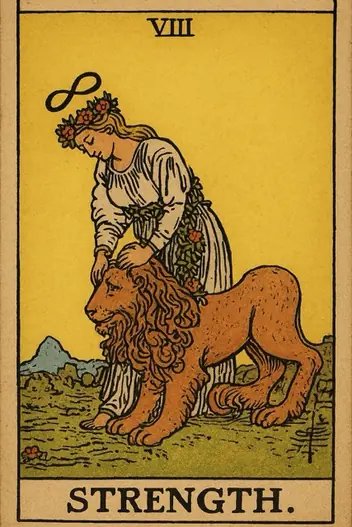

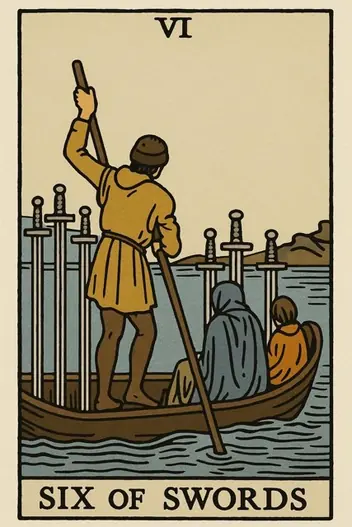
- Arcana
- Strength — Major Arcana; Six of Swords — Minor Arcana, Swords
- Elements
- Strength — Fire; Six of Swords — Air
- Elemental interaction
- Friendly elements — energies support each other
- Numerology
- 8 + 6 = 14 → 5
The intersection of Strength and the Six of Swords represents a profound psychological shift: the moment when raw resilience meets deliberate transition. Strength embodies courage, self-discipline, and the quiet mastery of inner chaos. The Six of Swords signals a necessary journey—often emotional or intellectual—toward calmer waters. Together, they create a powerful archetype of controlled passage through difficulty, where willpower is not about brute force but about strategic endurance.
In practical terms, this combination suggests you are leaving behind a situation that tested your limits, but you are not yet at your destination. The Strength card ensures you have the fortitude to complete the crossing, while the Six of Swords reminds you that movement itself is the therapy. This is not a time for dramatic confrontation; it is a time for calculated retreat, emotional regulation, and forward momentum without burning bridges.
Strength and Six of Swords Card Meaning Explained
When Strength and the Six of Swords appear together, the core dynamic is one of emotional intelligence applied to transition. You are not simply fleeing a problem; you are actively choosing to move toward a better mental or physical environment. The Strength archetype here functions as an internal anchor—your ability to remain calm under pressure allows you to navigate uncertainty without panic. This is a state of resilient detachment, where you observe your own fears and impulses without being controlled by them.
Psychologically, this pairing mirrors the process of cognitive reframing. The Six of Swords represents the boat carrying you from a known shore (past conflict, regret, or stagnation) to an unknown one (future growth, peace, or clarity). Strength provides the oars—the patience, self-compassion, and boundary-setting needed to row steadily. The key insight is that you do not need to eradicate your struggles; you need to outlast them with grace. This is about managing energy reserves, not winning every battle.
In real-world terms, this means you are likely in a phase where letting go is an active discipline, not a passive surrender. You may be ending a project, leaving a job, or healing from a loss. The cards urge you to trust your internal resilience while accepting that the journey will feel lonely or uncertain. Your greatest asset right now is your ability to stay consistent, even when progress feels slow or invisible.
Strength and Six of Swords in Love and Relationships
If you are single:
This combination suggests you are moving on from a past emotional wound or pattern. Focus on self-respect rather than rushing into a new connection. Your strength lies in setting boundaries that protect your peace.
If you are in a relationship:
You and your partner may be navigating a difficult transition—perhaps a move, a career change, or healing after a conflict. Prioritize calm communication and avoid power struggles. The goal is mutual support, not control.
In relationships, Strength and the Six of Swords indicate a phase of emotional migration. You are leaving behind old arguments, resentments, or unhealthy dynamics, but this requires active emotional labor. The Strength card warns against suppressing feelings in the name of "staying strong"; instead, it advocates for vulnerability with boundaries. The Six of Swords reminds you that distance—physical or emotional—can be a healthy tool for recalibration.
Key relationship advice:
Do not expect overnight resolution. This is a gradual journey where small acts of kindness and patience build the bridge to deeper trust. If you are single, do not mistake solitude for failure—your alone time is a strategic pause, not a rejection. For couples, avoid the trap of blame; focus on shared goals rather than past grievances. Your strength is proven by your ability to listen, not to dominate.
Your pair is already on the table. Ask your question and draw the clarifying card
or simply focus on it
Strength and Six of Swords in Career Readings
Strategic Opportunities:
Use this period to transition to a role or industry that aligns with your values. Your resilience will carry you through the learning curve.
Strategic Opportunities:
Delegate or outsource tasks that drain your mental energy. Focus on high-impact work that builds momentum.
Calculated Risks:
Avoid making impulsive career changes out of frustration. This is a time for planned exits, not dramatic resignations.
In professional settings, this combination signals a pragmatic pivot. You may be leaving a toxic work environment, shifting to a less stressful role, or navigating a company restructure. The Strength card advises you to maintain professional composure even if you feel undervalued. The Six of Swords suggests that financial stability may require a temporary sacrifice—perhaps a pay cut for better work-life balance or a lateral move for long-term growth.
Important financial warning:
Do not confuse movement with escape. Ensure you have a concrete plan before making major financial decisions. This is not the time for gambling on risky investments or quitting without a safety net. Strategic patience is your best asset; save for the transition and negotiate terms that protect your future. Your career strength lies in your ability to adapt, not in clinging to a sinking ship.
Uncover hidden insights
Let our advanced Tarot system interpret these archetypes specifically for your personal path.
Strength and Six of Swords Reversed: How to Read It
When cards appear in a reversed position, the dynamic becomes distorted, but does not disappear.
If Strength is reversed (and the Six of Swords is upright):
This indicates blocked potential and inner panic. You understand that you need to move, but lack the willpower. This is a victim state: "I know I need to leave, but I am too weak." Advice: start small — not with moving away, but with cleaning one shelf in a closet. Regain your sense of control through small actions.
If the Six of Swords is reversed (and Strength is upright):
This is internal resistance to movement. You are full of strength and confidence, but you have hit a wall. You are trying to row against the current. This can be a fear of the unknown or an unwillingness to let go of control. Warning: your Strength is being spent on holding onto what is already dead. Do not confuse persistence with foolishness.
If BOTH are reversed:
Complete imbalance. Recklessness (reversed Strength) mixes with chaotic flight (reversed Six of Swords). This is a scenario where, in a panic, you destroy what could have been saved and run to nowhere without a plan. Method for correction: stop completely. Take a 72-hour pause. Forbid yourself from making any decisions. Only after re-establishing contact with reality should you begin to act.
When Strength and Six of Swords Signal Trouble
The shadow of this combination emerges when resilience turns into stubbornness or when transition becomes avoidance. You may rationalize staying in a painful situation because you believe you "must be strong," when in reality, strength means knowing when to leave. Conversely, you could use the Six of Swords as an excuse to flee from accountability, moving to a new job or relationship without addressing the internal patterns that caused the original problem.
Cognitive biases to watch for:
The sunk cost fallacy—holding onto a failing project or relationship because you've already invested so much. Also, optimism bias—underestimating the difficulty of the transition ahead. The Strength card can manifest as toxic positivity, where you suppress valid emotions like grief or anger, believing you must always appear composed. The Six of Swords may lead to geographic cures—changing external circumstances without inner work.
Self-sabotage patterns:
You might rush the journey, expecting instant results, then feel defeated when progress is slow. Or you might isolate yourself, refusing help because you see it as weakness. The real shadow is mistaking endurance for growth. Moving forward without learning from the past is just rearranging deck chairs on the Titanic. True strength involves reflection, not just resistance.
Strength and Six of Swords: The Combined Message
How to constructively use this energy? Your strategy is "Controlled Evacuation with Resource Preservation". First: conduct an audit of what you take with you (skills, connections, values) and what you leave behind (toxic habits, past grievances, unpromising projects). Second: acknowledge that retreat is not defeat, but regrouping. You are not giving up — you are changing the battlefield.
Deep strategic advice: use the archetype of Strength to establish strict time management for your "departure". For example, allocate exactly 30 days to wrap up old affairs. No more. Otherwise, the process will drag on, and you will get stuck in the swamp of half-measures. Your task is to create a clear ritual of transition. This could be a symbolic gesture (selling an old car, changing your avatar on social media) or a concrete action (terminating a contract, moving).
Remember: true strength is manifested not in the ability to endure pain, but in the determination to stop its source. The Six of Swords gives you a map, Strength gives you a compass and oars. Do not wait for a tailwind — start rowing yourself. Clarity will come in motion, not in contemplation on the shore.
Where to Go From Here
The core message of Strength and the Six of Swords is this: You have the inner resources to navigate this transition, but only if you move with intention, not impulse. Your resilience is your compass, but your destination requires a map—one shaped by your unique circumstances, fears, and desires. General interpretations can guide you, but they cannot replace the insight that comes from applying these archetypes to your specific question.
For a truly personalized reading, use the Fortune Cards app to explore how Strength and the Six of Swords interact with your exact situation. The app provides deep, context-aware interpretations that go beyond generic meanings, helping you understand your next practical step in love, career, or personal growth. Stop guessing—let the cards speak to your unique journey. Download Fortune Cards now or use it on the web to get the clarity you deserve.
Interpretation by the Fortune Cards editorial team, based on the Rider–Waite tradition and Jungian archetypes. About our methodology · Updated: 2026-08-26
Other Combinations with Strength
Other Combinations with Six of Swords
Explore Individual Card Meanings
Table of Contents
- Strength and Six of Swords Card Meaning Explained
- Strength and Six of Swords in Love and Relationships
- Strength and Six of Swords in Career Readings
- Strength and Six of Swords Reversed: How to Read It
- When Strength and Six of Swords Signal Trouble
- Strength and Six of Swords: The Combined Message
- Where to Go From Here
Ready to find answers to your questions?
Start your first reading now and look at your situation with fresh clarity. The cards are ready to reveal deeper meaning.