Ten of Wands and Three of Swords Meaning in Tarot
- Arcana
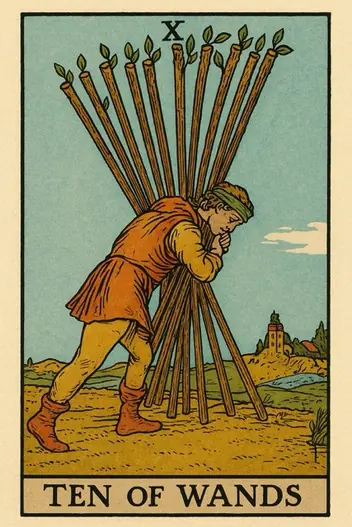
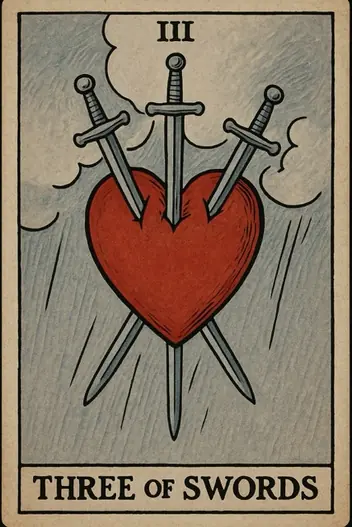
- Ten of Wands — Minor Arcana, Wands; Three of Swords — Minor Arcana, Swords
- Elements
- Ten of Wands — Fire; Three of Swords — Air
- Elemental interaction
- Friendly elements — energies support each other
- Numerology
- 10 + 3 = 13 → 4
When the crushing burden of the Ten of Wands meets the piercing clarity of the Three of Swords, we enter a psychological space defined by overcommitment and emotional injury. The Ten of Wands represents a state of burnout—carrying too many responsibilities, often for others, until the load becomes unsustainable. The Three of Swords introduces the sharp pain of betrayal, rejection, or a harsh truth that cuts through denial.
Psychologically, this combination signals a crisis where your work ethic has collided with your emotional limits. You may be exhausting yourself to prove worthiness or to avoid confronting a painful reality. The strategic insight here is that your current strategy of "just pushing through" is failing. The mind (Swords) is now forcing you to see that your burdens (Wands) are self-imposed or rooted in a painful misunderstanding of your own value. This is not a time for more effort; it is a time for surgical emotional inventory.
Ten of Wands and Three of Swords Card Meaning Explained
The core dynamic of the Ten of Wands and Three of Swords is a feedback loop of exhaustion and heartbreak. The seeker often feels that if they just work harder, sacrifice more, or absorb more pain, they will finally earn relief or love. Yet the Three of Swords reveals that this very strategy is the source of the wound. The burden is not external—it is internalized guilt, grief, or a mistaken sense of duty.
From a Jungian perspective, this pairing represents the Shadow of the Martyr archetype. You are stuck in a narrative where suffering is equated with virtue. The Three of Swords cuts through this illusion, forcing you to see that your pain is not noble; it is a signal. The practical implication is clear: stop sacrificing your well-being for outcomes that are not guaranteed. The mind must now be used to dissect the situation logically, not to justify the pain. Ask yourself: Which responsibilities can I drop right now to reduce my load? Which beliefs about myself are causing the deepest ache? The answer will reveal the path out of this cycle.
The key psychological insight is that this combination often manifests as cognitive dissonance—holding two conflicting ideas: "I must carry this burden to be worthy" and "I am deeply hurt by this burden." The resolution lies not in choosing one, but in reframing worthiness as separate from sacrifice. You can be valuable without being a martyr.
Ten of Wands and Three of Swords for Career and Money
Strategic Opportunities:
Delegation and prioritization are your only viable paths forward. Identify the one task that is causing the most stress and either automate it, delegate it, or drop it entirely.
Strategic Opportunities:
Use the Three of Swords' clarity to make a difficult decision about a project or role that is draining you. This is the moment to cut losses on a failing initiative.
Calculated Risks:
Avoid taking on new projects or financial commitments until you have reduced your existing load. The risk of burnout-induced errors is high.
In the career sphere, this combination is a red flag for overwork and under-recognition. The Ten of Wands speaks to a workload that is unsustainable, while the Three of Swords indicates that this effort is not yielding the expected rewards—financial or emotional. You may feel betrayed by a boss, client, or colleague who does not appreciate your sacrifice. The strategic error is assuming that more effort will eventually change the outcome.
Important financial warning:
Do not borrow money or invest capital to "keep up" with an unsustainable work pace. The Three of Swords warns of financial decisions made from a place of pain or desperation. Instead, conduct a ruthless audit of your time and money. Which activities generate the most return for the least emotional cost? Cut the rest. The path to professional health lies in strategic withdrawal, not heroic persistence.
Your pair is already on the table. Ask your question and draw the clarifying card
or simply focus on it
Ten of Wands and Three of Swords Love Outcome
If you are single:
This combination suggests you may be carrying emotional baggage from a past wound into new connections. Evaluate whether you are attracted to people who require you to prove your worth through effort rather than those who offer mutual support.
If you are in a relationship:
A clear warning of imbalanced emotional labor. One partner is likely over-functioning while the other under-contributes, and the over-functioner is now feeling betrayed or resentful. Open, direct communication about boundaries is non-negotiable.
In relationships, the Ten of Wands and Three of Swords point to a dynamic where one person is doing all the heavy lifting—emotionally, practically, or both—while the other is either absent or actively critical. The Three of Swords here is the pain of realizing that your efforts are not being reciprocated or appreciated. This is a classic scenario of burnout from unrequited emotional investment.
Key relationship advice:
Stop trying to fix the other person or the relationship through sheer effort. This strategy will only deepen the wound. Instead, set a firm boundary: communicate what you need to feel supported, and be prepared to walk away if that need is not met. Your pain is a valid data point—do not dismiss it as "overreacting." The healthiest path is to renegotiate the terms of the relationship with clear, direct words, not with more silent sacrifices.
Ten of Wands and Three of Swords Reversed: How to Read It
If the Ten of Wands is Reversed:
This indicates blocked potential and recklessness. You are not just tired; you are on the verge of a nervous breakdown but refuse to admit it. Instead of setting down the burden, you begin to carry it "heroically" alone, rejecting any help. Warning: this behavior leads to unjustified risks and mistakes due to distraction.
If the Three of Swords is Reversed:
This is internal resistance and suppressed pain. You feel the blow but do not allow yourself the right to suffer. You "swallow" the insult, pretend nothing happened, and continue carrying your cross. Advice: suppressed pain will not disappear—it will transform into psychosomatic illness or sudden outbursts of aggression. Give yourself time to grieve.
If BOTH are Reversed:
This is a complete imbalance. You are in a state of acute self-deception. You deny both your fatigue (reversed Ten) and the pain of the situation (reversed Three). You live in the illusion that "everything is under control," but reality is already crumbling. To rectify the situation, you must acknowledge the fact of the crisis. Pause, turn off your phone, and honestly answer the question: "What exactly am I refusing to notice?"
Ask your specific question
Don't rely on generic meanings. Get a customized reading tailored specifically to your energies.
Negative Meaning of Ten of Wands and Three of Swords
The shadow manifestation of this pairing is victimhood disguised as virtue. The seeker may unconsciously cling to their burdens because the pain provides a sense of identity or moral superiority. The Three of Swords' wound becomes a source of passive-aggressive power: "Look how much I suffer for you." This is a classic cognitive bias known as the "sunk cost fallacy" —continuing a painful path because so much has already been invested.
Other pitfalls include rumination (endlessly replaying the hurt without action) and self-sabotage (taking on more work to avoid confronting the emotional pain). The shadow here is a refusal to admit that the strategy is wrong. The mind (Three of Swords) is sharp, but it can also be used to construct elaborate justifications for staying in a painful situation. Watch for the tendency to intellectualize your suffering rather than act to relieve it. The most dangerous thought is: "I can handle this if I just try harder."
Overall Meaning of Ten of Wands and Three of Swords
How to use the energy of the Ten of Wands to balance the Three of Swords? The answer is paradoxical: you must stop carrying and start letting go. The Ten of Wands gives you immense endurance and discipline, but right now these qualities are working against you. You are using them to suppress pain rather than to resolve it. The strategic shift lies in directing this discipline not toward "doing," but toward "experiencing."
Your task is to consciously enter the state of the Three of Swords. Do not flee from the pain, do not numb it with work, but give yourself space for grieving. Allow yourself to feel disappointment, resentment, or sadness. This is not weakness, but an act of purification. Once you live through this pain, you will see that part of the burden has lifted on its own. You will realize that many of your obligations were merely a defense against this very pain.
The constructive path is amputation of the excess. Take a sheet of paper and list all your current projects, commitments, and roles. Next to each one, give a rating: "Does this bring me joy or only drain me?" and "Is this my responsibility, or did I take it on voluntarily?" Boldly refuse everything that brings no joy and is not your direct duty. This will be painful (Three of Swords), but it is the only way to shed the Ten of Wands. Remember: your psyche is not broken—it is simply screaming at you that you are going the wrong way.
Applying This to Your Situation
The Ten of Wands and Three of Swords combination delivers a clear message: stop carrying the weight of a wound that is not yours to bear. The path forward requires strategic withdrawal from overcommitment and honest acknowledgment of emotional pain. You must use the mind's clarity not to rationalize suffering, but to cut away what does not serve you. The core message is one of liberation through ruthless self-honesty.
For a deep, personalized interpretation of this exact combination for your specific situation, use the Fortune Cards app. While this article explains the general archetype, the true insight comes when Tarot is applied to your unique context—your relationship, career, or personal question. The app provides a tailored reading that considers your exact words and circumstances. You can use it on the web or download it now to get the clarity you need to make your next move.
Interpretation by the Fortune Cards editorial team, based on the Rider–Waite tradition and Jungian archetypes. About our methodology · Updated: 2026-10-15
Other Combinations with Ten of Wands
Other Combinations with Three of Swords
Explore Individual Card Meanings
Table of Contents
- Ten of Wands and Three of Swords Card Meaning Explained
- Ten of Wands and Three of Swords for Career and Money
- Ten of Wands and Three of Swords Love Outcome
- Ten of Wands and Three of Swords Reversed: How to Read It
- Negative Meaning of Ten of Wands and Three of Swords
- Overall Meaning of Ten of Wands and Three of Swords
- Applying This to Your Situation
Ready to find answers to your questions?
Start your first reading now and look at your situation with fresh clarity. The cards are ready to reveal deeper meaning.