Five of Cups and Ace of Swords Meaning in Tarot
- Arcana
- Five of Cups — Minor Arcana, Cups; Ace of Swords — Minor Arcana, Swords
- Elements
- Five of Cups — Water; Ace of Swords — Air
- Elemental interaction
- Neutral elements — energies coexist without conflict
- Numerology
- 5 + 1 = 6
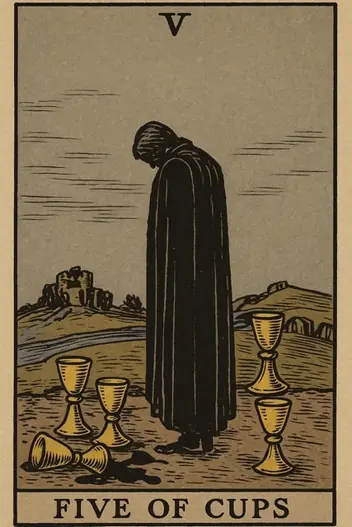
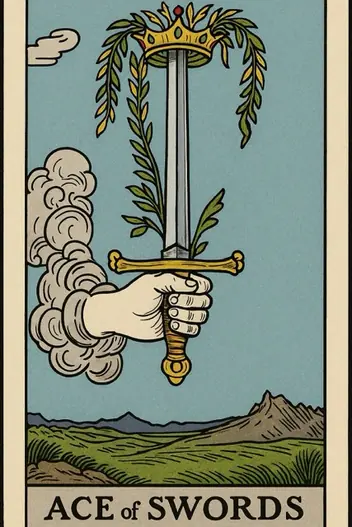
The Five of Cups represents a state of focused disappointment—a psychological fixation on what has been lost, spilled, or irrevocably changed. It is the archetype of mourning, not necessarily for a physical loss, but for a shattered expectation or a broken narrative about how life "should" be. In contrast, the Ace of Swords is the archetype of piercing clarity, intellectual breakthrough, and the will to cut through illusion with a single, decisive thought. When these two cards appear together, the collision is potent: a mind clouded by grief is suddenly handed the tool of pure, objective truth.
This combination signals a critical turning point. The emotional pain of the Five of Cups becomes the raw material for the Ace of Swords' surgical insight. The question is not whether the loss is real—it is. The question is whether you will remain in the emotional rubble or use the Ace's blade to dissect the situation, extract the lesson, and carve a new path forward. This is a moment of cognitive reframing, where understanding replaces sorrow as the dominant psychological driver.
Five of Cups and Ace of Swords: How These Energies Interact
The core dynamic here is the transition from emotional paralysis to intellectual action. The Five of Cups represents the limbic system—the seat of emotion, memory, and pain. The Ace of Swords represents the prefrontal cortex—logic, analysis, and executive function. When these energies merge, the seeker is forced to perform a difficult but necessary act of psychological integration: acknowledging the full weight of the loss while simultaneously refusing to be defined by it.
This is not a gentle healing. The Ace of Swords does not offer comfort; it offers clarity at a cost. You may experience a sudden, almost harsh realization about a past failure, a relationship, or a career misstep. The Five of Cups' tears are not wiped away—they are analyzed. The key insight is that holding onto grief is a cognitive choice, and the Ace provides the mental discipline to choose otherwise. The practical implication is a period of intense self-examination where you must answer: "What exactly did I lose, and what did I learn?" The answer will be brutally honest, but it will be the foundation for genuine recovery.
Your pair is already on the table. Ask your question and draw the clarifying card
or simply focus on it
Five of Cups and Ace of Swords: Career and Money
Strategic Opportunities:
Conduct a post-mortem on a recent failure or setback. Use the Ace of Swords to identify the single most important lesson. This is the seed of your next professional move.
Strategic Opportunities:
Negotiate from a position of clarity, not emotion. If you have been undervalued or passed over, gather objective data (salary benchmarks, project metrics) and present a fact-based case.
Calculated Risks:
Avoid making impulsive decisions driven by a desire to "prove" something to those who disappointed you. The Ace of Swords can become harsh and cutting if wielded from a place of unprocessed anger.
Professionally, this combination is a catalyst for strategic reinvention. The Five of Cups may represent a lost client, a failed project, a missed promotion, or a partnership that dissolved. The natural psychological response is to retreat into rumination. The Ace of Swords, however, demands you redirect that mental energy into analysis. Ask: "What was the root cause? Was it my strategy, my execution, or external factors beyond my control?" The key financial warning is against "sunk cost" thinking. Do not cling to a failing business line or a dead-end job because of the time or money already invested. The Ace of Swords is about cutting losses cleanly. The strategic tip is to draft a one-page "lessons learned" document and then immediately write a one-page "next steps" plan. This forces the transition from grief to action.
Your unique Tarot reading
See how these cards interact with your destiny. Start a free personal reading now.
Five of Cups and Ace of Swords as Feelings
If you are single:
This combination suggests you are carrying the emotional weight of a past relationship or rejection. The Ace of Swords demands you stop romanticizing the loss. Objectively list what went wrong and what you actually need moving forward, not what you miss.
If you are in a relationship:
A painful truth is about to surface. Do not suppress it. Whether it's a broken promise, a recurring conflict pattern, or a fundamental incompatibility, the Ace of Swords requires honest, direct communication—even if it feels like a confrontation.
In relationships, the Five of Cups and Ace of Swords together signal a moment of truth. The emotional atmosphere is heavy with regret, disappointment, or a sense of "what could have been." However, the Ace of Swords cuts through this fog. The primary psychological task is to separate the objective facts of the situation from the subjective story of pain you have built around them. For example, if you feel betrayed, the Ace asks: "Was the betrayal real, or was it a misunderstanding of expectations?" The most effective relationship advice here is to speak the unspeakable. Use the Ace's energy to have that difficult conversation you have been avoiding. The result may be a resolution that feels clean, or an ending that is honest—but either is healthier than the stagnant grief of the Five of Cups alone.
Negative Meaning of Five of Cups and Ace of Swords
The shadow of the Five of Cups and Ace of Swords combination is intellectual cruelty masked as honesty. When blocked or unbalanced, the seeker uses the Ace's sharpness not to heal, but to wound—themselves or others. This manifests as harsh self-criticism ("I should have known better") that deepens the depression of the Five of Cups rather than resolving it. Alternatively, it can appear as a cold, cutting dismissal of another person's feelings in a relationship, using "truth" as a weapon to avoid emotional vulnerability.
A significant cognitive bias at play is confirmation bias: the seeker may use the Ace of Swords to "prove" that their grief is justified, selectively analyzing only the evidence that supports their victimhood. This leads to a state of intellectualized depression—where you can explain your pain perfectly but cannot move past it. The pitfall is mistaking analysis for action. You can dissect a problem endlessly without ever making a decision. To avoid this, set a strict time limit on reflection. The goal is not to understand the pain forever, but to understand it just enough to make a single, clear choice and move forward.
Five of Cups and Ace of Swords Reversed Meaning
If the Five of Cups is reversed and the Ace of Swords is upright, the dynamic changes drastically. Instead of fixation on the past, we see reckless denial of pain. The person pretends everything is fine and grabs the Ace of Swords as a tool for aggressive attack. Warning: this leads to conflicts over nothing, as unresolved resentment lies behind the aggression.
If the Ace of Swords is reversed and the Five of Cups is upright, there is an internal resistance to the truth. You understand that you need to cut to the quick, but you cannot muster the courage. Clarity is present, but there is no will for action. Advice: in this state, any decision made under emotional pressure will be wrong. First, stabilize your emotional background.
If BOTH cards are reversed, we see a complete imbalance: chaotic longing without hope (Five of Cups) and a weak, indecisive mind (Ace of Swords). This is a state of apathy and self-deception. The logical way to correct it: start small—formulate one simple, objective truth about your situation and write it down. This will restore your grounding.
Five of Cups and Ace of Swords: Tarot Advice
To constructively harness the energy of the Five of Cups for balancing the Ace of Swords, it is necessary to transform grief into a strategic map. Do not attempt to suppress emotions — analyze them. Ask yourself: "What exactly am I saying goodbye to? What resources am I freeing up with this decision?" This turns blind pain into a conscious choice.
Strategic advice: use the "Two Doors" method. Imagine the Five of Cups as a door to the past, filled with regrets, and the Ace of Swords as a door to the future, behind which lies the unknown. Your task is not to choose between them, but to create a third door. This implies taking the lesson from the past (the insight of the Five) and using the clarity of the Swords to formulate a new contract with reality. For example: "I acknowledge that this project failed due to my indecisiveness (Five). Now I am implementing a system of weekly decision audits (Ace)."
This synthesis provides armament with clarity. You are not merely cutting off the past — you are creating a protocol for the future that will not allow this pain to repeat itself. The combination teaches that the harshest truth, spoken in time, is an act of the highest care for oneself and one's future.
Applying This to Your Situation
The Five of Cups and Ace of Swords together deliver a powerful message: your grief is a source of insight, not a prison. The core task is to use the clarity of the Ace to reframe your loss as data for a better decision. Whether you are ending a relationship, pivoting your career, or simply letting go of a self-defeating belief, the path forward requires both emotional honesty and intellectual rigor. This combination does not promise a quick fix, but it does promise a clean break from the past—if you have the courage to use the sword.
For a deeper, personalized interpretation of this exact combination applied to your specific question, use the Fortune Cards app. General archetypes provide the map, but your unique situation determines the destination. The app allows you to input your context—whether it's a relationship dilemma, a career crossroads, or a personal challenge—and receive a tailored reading that translates these symbols into actionable, psychologically sound advice for you, right now.
Interpretation by the Fortune Cards editorial team, based on the Rider–Waite tradition and Jungian archetypes. About our methodology · Updated: 2026-09-17
Other Combinations with Five of Cups
Other Combinations with Ace of Swords
Explore Individual Card Meanings
Table of Contents
- Five of Cups and Ace of Swords: How These Energies Interact
- Five of Cups and Ace of Swords: Career and Money
- Five of Cups and Ace of Swords as Feelings
- Negative Meaning of Five of Cups and Ace of Swords
- Five of Cups and Ace of Swords Reversed Meaning
- Five of Cups and Ace of Swords: Tarot Advice
- Applying This to Your Situation
Ready to find answers to your questions?
Start your first reading now and look at your situation with fresh clarity. The cards are ready to reveal deeper meaning.