Temperance and Five of Cups Reversed in Tarot


- Arcana
- Temperance — Major Arcana; Five of Cups — Minor Arcana, Cups
- Elements
- Temperance — Fire; Five of Cups — Water
- Elemental interaction
- Opposing elements — energies create tension
- Numerology
- 14 + 5 = 19 → 1
When the Temperance card’s call for equilibrium, patience, and integration meets the Five of Cups’ raw emotional pain, disappointment, and focus on loss, the result is a profound psychological crossroads. This combination rarely signals a sudden, dramatic breakthrough. Instead, it describes a slow, deliberate process of healing where you must consciously choose to stop fixating on what has been irrevocably spilled and begin the painstaking work of blending the remaining resources into a new, sustainable reality.
Psychologically, this pairing represents the tension between the alchemical archetype of transformation and the shadow of unresolved grief. Temperance urges you to transmute sorrow into wisdom, not by ignoring the loss, but by integrating it into a larger narrative. The Five of Cups, when unmanaged, keeps you locked in a cognitive loop of regret. Together, they demand a strategic shift: acknowledge the pain without letting it define your next move. This is not about quick fixes; it is about building a foundation of emotional resilience through disciplined patience.
Temperance and Five of Cups: How These Energies Interact
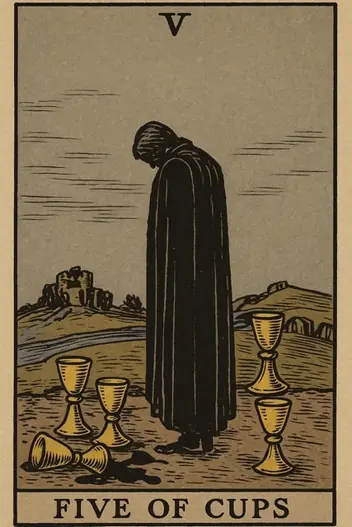
The core dynamic of Temperance and the Five of Cups is the management of emotional entropy. The Five of Cups represents a specific kind of psychological trap: the tendency to overweight negative outcomes and ignore remaining assets (the two upright cups behind the figure). Temperance acts as the counterbalance, forcing a recalibration of perspective. It asks, “What resources—time, energy, relationships—are still intact, and how can you combine them to create a stable path forward?”
In practical terms, this combination often appears when you are caught between grieving a past failure and the pressure to ‘move on’ too quickly. The healthy response is to create a structured, time-bound mourning period—a deliberate “container” for the loss—while simultaneously taking small, measured actions toward recovery. The danger is premature closure, where you suppress the grief only to have it resurface as anxiety or cynicism. The insight here is that true healing is not a single event but a daily practice of blending acceptance with proactive self-care. The most important strategic takeaway is to treat emotional recovery as a project with phases, not an emotional state you must achieve instantly.
Your pair is already on the table. Ask your question and draw the clarifying card
or simply focus on it
Temperance and Five of Cups as Feelings
If you are single:
This pair suggests you may be evaluating a new connection through the filter of a recent heartbreak. Temperance advises you to take a slow, patient approach—do not rush into commitment, but do not dismiss potential partners due to past disappointments. Focus on building trust through consistent, small actions rather than grand gestures.
If you are in a relationship:
The combination indicates a period of emotional repair after a significant disappointment or betrayal. One partner may feel stuck in grief (Five of Cups), while the other is pushing for resolution (Temperance). The key is to negotiate a shared timeline for healing that respects both the need to process and the need to move forward.
In relationship dynamics, this combination highlights the critical role of emotional intelligence and boundary-setting. The Five of Cups can manifest as repetitive complaining about past hurts or a fear of vulnerability that blocks intimacy. Temperance provides the antidote: active listening without absorbing the other’s pain, and compassionate confrontation of patterns that keep the relationship stuck. The most important relationship advice is to avoid the trap of ‘fixing’ your partner’s grief. Instead, create a safe space for expression while maintaining your own emotional equilibrium. This balance prevents codependency and fosters genuine, resilient connection. Bold actions like scheduling regular check-ins or using a “feelings log” can help transform abstract grief into manageable conversations.
Temperance and Five of Cups: Career and Money
Strategic Opportunities:
Integrate past failures into your professional narrative—use a setback as a case study for resilience in a job interview or business proposal. Diversify income streams slowly, blending a stable primary job with a low-risk side project.
Strategic Opportunities:
Negotiate a phased return to work after a career setback, or propose a trial period for a new role to test fit without full commitment. Leverage your network for emotional support and practical advice rather than isolating.
Calculated Risks:
Avoid making major financial decisions under emotional duress—the Five of Cups can trigger impulsive “revenge spending” or quitting a job rashly. Do not over-invest in ‘salvaging’ a failed project out of sunk-cost fallacy.
In career and financial contexts, this combination demands pragmatic emotional accounting. The Five of Cups warns of a cognitive bias toward loss aversion, where you overvalue what you’ve lost (a promotion, a client, a bonus) and undervalue what remains (your skills, your network, your savings). Temperance counters this by prompting a systematic review of your assets: create a simple spreadsheet of your professional strengths, financial reserves, and available opportunities. Bold financial warning: do not let grief drive you into debt by trying to “buy” a solution or escape. Instead, implement a 30-day rule before any significant career or financial move. The strategic path forward is to use this period for upskilling or networking—small, consistent investments that compound over time, rather than chasing a quick recovery.
Ask your specific question
Don't rely on generic meanings. Get a customized reading tailored specifically to your energies.
When Temperance and Five of Cups Signal Trouble
The shadow manifestation of this pairing is a dangerous form of emotional paralysis disguised as patience. When the energies are blocked, the seeker may rationalize their grief as ‘necessary processing’ while actually avoiding any real change. This leads to chronic indecision in relationships and career, where you wait for the “perfect time” that never comes. Cognitive biases like rumination (endlessly replaying the loss) and learned helplessness (believing you can’t influence outcomes) are common traps. Alternatively, the shadow can manifest as forced positivity—using Temperance’s “balance” as an excuse to suppress emotions, leading to a sudden, explosive breakdown. Self-sabotage appears when you subconsciously choose situations that replicate the original loss, staying in dead-end jobs or toxic relationships because the familiar pain feels safer than the uncertainty of healing. The core pitfall is confusing acceptance with inaction; true Temperance requires movement, not stagnation.
Temperance and Five of Cups Reversed: How to Read It
Reversed cards in this pair indicate a disruption of the balance between grief and healing.
Reversed Temperance + Upright Five of Cups:
Blocked Potential. The person becomes "stuck" in grief, lacking an internal mechanism to process it. They may refuse help, therapy, or new opportunities, believing that "nothing will help." Advice: Acknowledge that your strategy of "toughing it out" isn't working. An external impetus is needed—a mentor, a coach, or a change of scenery.
Upright Temperance + Reversed Five of Cups:
Internal Resistance to Healing. The person knows what needs to be done (Temperance) but cannot let go of the past. They cling to resentment or guilt because it gives them a sense of control. Warning: This is a path to emotional exhaustion and cynicism.
Both Reversed:
Complete Imbalance. Chaotic switching between "all is lost" and "everything will be fine." The person either falls into apathy or makes impulsive "rescue" attempts. Corrective Action: Return to basic rituals. Physical activity, a fixed sleep schedule, and minimal but stable commitments to yourself.
Temperance and Five of Cups: The Combined Message
Constructive use of this pair's energy requires a "two-path" strategy. The first path is ritualized acceptance of loss. Set aside a specific time and place for grief (e.g., an hour a week with a journal or on a walk). The second path is consistent, minimal action. Don't try to "heal" globally. Ask yourself: "What one small action can I take today to make my life 1% more stable?" This could be clearing your desk, cooking a healthy dinner, or taking a short walk.
Deep strategic advice:
Abandon the idea of "closing the gestalt." Instead, create an "experience archive". Write down what this loss taught you. What beliefs or behavioral patterns led to it? Transform the Five of Cups from a source of pain into a tool for calibrating your decisions. Temperance in this context is not about "calming down," but about resilience. You are not obligated to forget the past, but you are obligated to build a present that does not repeat it.
Your Next Step: Personal Context Matters
The Temperance and Five of Cups combination ultimately teaches that healing is not a destination but a process of continuous recalibration. Your specific context—the nature of your loss, your personality, your support system—determines how to best blend grief with growth. This article provides the archetypal framework, but the real power lies in applying it to your unique situation. To get a deep, personalized interpretation of this exact combination for your specific question, use the Fortune Cards app on the web or download it now. The true magic of Tarot is not in the cards themselves, but in how they illuminate your own story.
Interpretation by the Fortune Cards editorial team, based on the Rider–Waite tradition and Jungian archetypes. About our methodology · Updated: 2026-08-26
Other Combinations with Temperance
Other Combinations with Five of Cups
Explore Individual Card Meanings
Table of Contents
- Temperance and Five of Cups: How These Energies Interact
- Temperance and Five of Cups as Feelings
- Temperance and Five of Cups: Career and Money
- When Temperance and Five of Cups Signal Trouble
- Temperance and Five of Cups Reversed: How to Read It
- Temperance and Five of Cups: The Combined Message
- Your Next Step: Personal Context Matters
Ready to find answers to your questions?
Start your first reading now and look at your situation with fresh clarity. The cards are ready to reveal deeper meaning.