Five of Cups
- Arcana
- Minor Arcana, Suit of Cups
- Element
- Water
- Decan
- Mars in Scorpio
- Numerology
- 5
The Five of Cups represents a profound psychological state of selective attention—a cognitive bias where an individual fixates on loss, failure, or absence while actively ignoring remaining resources and opportunities. In Jungian terms, this card embodies the archetype of the Mourner, a figure overwhelmed by the shadow of disappointment, yet standing at the precipice of integration. The core challenge is not the loss itself, but the perceptual distortion that magnifies what is gone while diminishing what remains.
This card signals a critical decision point: will you remain in the rumination loop of past failures, or will you redirect cognitive energy toward salvageable assets? The Five of Cups does not indicate objective catastrophe, but rather a subjective evaluation error—a mind trapped in a negativity bias that must be corrected through deliberate reframing.
Five of Cups: Core Meaning and Interpretation
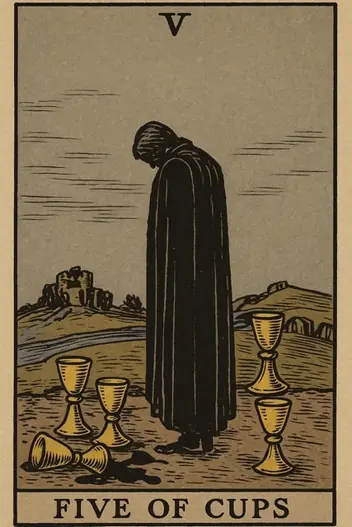
The upright Five of Cups depicts a figure staring at three spilled cups, their contents wasted on the ground, while two upright cups stand behind them, unnoticed. This visual metaphor maps directly onto attentional blindness in decision-making: the brain prioritizes negative stimuli (loss) over neutral or positive stimuli (remaining potential). Psychologically, this is a state of learned helplessness—a temporary paralysis where the individual believes further effort is futile.
In practical terms, this card manifests as resource hoarding of grief. You may be over-investing emotional capital in a project, relationship, or identity that has already ended, while neglecting existing assets that could be leveraged for recovery. The strategic error here is mistaking emotional closure for failure. The key insight is that the spilled cups represent sunk costs—irrecoverable investments that should be written off, not mourned indefinitely. The two remaining cups are real, tangible resources waiting for redeployment.
To move through this state requires cognitive reappraisal: actively listing what remains intact, rather than cataloging what is lost. The Five of Cups demands a shift from retrospective grief to prospective planning.
Ask your question and flip the cards
or simply focus on it
Is Five of Cups a Yes or a No?
No.. The Five of Cups signals loss, disappointment, and emotional withdrawal—energies that block forward momentum and affirmative outcomes. In the upright position, the figure stares at three spilled cups while two remain standing behind them, indicating a fixation on what has been lost rather than what is still available. This card’s archetype is grief’s paralysis: the psyche refuses to turn around, trapping you in a past wound. In the reversed position, the answer shifts to Leaning Yes, as the figure begins to turn toward the remaining cups, signaling acceptance and emotional recovery. The critical condition: the outcome depends entirely on whether you can consciously shift your attention from the spilled cups to the ones still upright—if you cannot reframe the loss, the answer remains a firm No.
Your unique Tarot reading
See how these cards interact with your destiny. Start a free personal reading now.
Card of the Day
The main vector of today is emotional reckoning—you are being asked to sit with a disappointment or regret without immediately trying to fix it. Focus on acknowledging what you have lost, but also actively scanning for what remains; the two upright cups represent resources, relationships, or self-knowledge you are overlooking. Take the specific action of journaling what is “still standing” in your life, no matter how trivial it seems. The trap to avoid is spiraling into self-pity or blaming others for the spill, as this reinforces the card’s addictive pull toward victimhood. Also guard against numbing the feeling—alcohol, overwork, or compulsive scrolling will only deepen the trance of loss.
Five of Cups in Love and Relationships
If you are not in a relationship:
You may be filtering potential partners through the lens of past disappointments, unconsciously seeking evidence that new connections will fail. This creates a self-fulfilling prophecy where your guardedness repels intimacy.
If you are in a relationship:
Power dynamics are skewed by unprocessed resentment. One partner may be "keeping score" of past hurts, using them as justification for emotional withdrawal or passive-aggressive control.
The primary relationship advice here is to audit your emotional ledger. Identify what specific loss you are still mourning—was it a betrayal, a broken promise, or a lost ideal? Then, consciously separate that historical event from your current partner's behavior. The Five of Cups in love warns against generalizing one wound into a narrative of perpetual disappointment. Bold action: schedule a structured conversation where you state, "I am grieving X from our past, and I need to stop letting it color our present." This externalizes the pattern and creates a boundary between history and reality.
Emotional intelligence requires distinguishing between grief that needs processing and grief that has become an identity. If you find yourself rehearsing old arguments internally, you are using the past as a shield against vulnerability. The strategic move is to accept the loss as complete and redirect that emotional energy toward rebuilding trust.
What Does Five of Cups Say About Their Feelings?
This person perceives you through the lens of a wound they are still carrying—you may represent either the cause of their grief or a reminder of what they have lost. They associate you with a feeling of incompleteness, as if your presence stirs up an ache they haven’t processed; they see you as someone who is “behind them” (like the two untouched cups), but they cannot yet turn around to face you fully. Their hidden hope is that you will offer emotional rescue or validation, yet their fear is that you will simply confirm their sense of failure. There is a strong internal conflict: they are drawn to what you represent (the potential for renewal) but are blocked by the shame or sadness of the past. Psychologically, they are projecting their own unresolved grief onto you, so their perception of you is less about who you are and more about what they need to heal.
Career and Finance
Strategic Opportunities:
The two remaining cups represent underutilized assets—a skill set you have ignored, a network contact you haven't contacted, or a revenue stream you abandoned prematurely. Audit your current resources with brutal honesty.
Resource Management:
This card signals a pivot point: the moment to cut losses on a failing project and reallocate capital (time, money, attention) to a viable alternative. Treat sunk costs as tuition for a lesson learned.
Calculated Risks:
The primary danger is paralysis by analysis—spending excessive time mourning a missed promotion or failed deal while competitors act. Do not confuse reflection with inaction.
Financial warning: avoid the "gambler's fallacy" of doubling down on a losing strategy to recoup losses. The Five of Cups in career context indicates a need for portfolio rebalancing—diversify your income streams or skill investments to reduce dependence on one volatile source. Strategic advice: conduct a "loss audit"—list three things you lost this quarter, then list three things you still control that could generate equivalent value. This reframes the narrative from victimhood to agency.
Leadership under this card requires modeling resilience: acknowledge the setback openly (to build trust), then immediately pivot to discussing contingency plans. Do not allow the team to enter a collective rumination cycle.
Five of Cups Reversed: What Changes
When the Five of Cups appears reversed, the psychological blockage shifts from over-mourning to denial and avoidance. The individual has not processed the loss at all—they have suppressed it, rationalized it, or prematurely declared themselves "over it." This is a state of emotional bypassing, where the mind refuses to acknowledge the significance of a failure to avoid the pain of integration.
Warning: reversed positions often indicate a false recovery. The client may appear functional, but the unprocessed grief leaks out as irritability, cynicism, or passive sabotage. In relationships, this manifests as cold detachment—a partner who claims to have "moved on" but cannot engage with vulnerability. The correction requires controlled grief work: deliberately schedule time to feel the disappointment, write a closure letter, or ritualize the ending. Do not mistake suppression for strength.
The reversed card also warns against premature optimism. If you are rushing to "positive thinking" without acknowledging the loss, you are building a house on sand. The logical path is to integrate the shadow of failure by asking: "What did I lose, and what did I learn?" Only then can the two remaining cups be genuinely utilized.
What Are the Pitfalls of Five of Cups?
The shadow of the Five of Cups is masochistic martyrdom—the unconscious choice to remain in grief because the identity of "the one who lost" feels safer than the uncertainty of rebuilding. This manifests as cognitive biases: the negativity bias (overweighting bad outcomes), the spotlight effect (believing everyone is watching your failure), and catastrophizing (assuming this loss defines all future outcomes).
Self-sabotage patterns include: refusing new opportunities because "they won't work out anyway," isolating from support networks, and using past failure as an excuse for present inaction. The shadow also includes perfectionism—the belief that if the outcome wasn't perfect, it is a total loss. This binary thinking is a defense mechanism against the complexity of partial success.
The critical error in judgment is treating grief as a permanent state rather than a temporary process. If you find yourself rehearsing the same narrative of loss for months, you are no longer processing—you are addicted to the story. The shadow demands a ruthless break from the identity of the victim.
Synthesis: Strategic Conclusion
The Five of Cups is not a card of doom, but a psychological diagnostic tool that reveals where your attention is misallocated. The constructive use of this energy is to perform a radical resource inventory: what exactly have you lost, and what exactly remains? The answer is almost always more complex than your emotional brain reports. The strategic imperative is to treat grief as a finite project, not an infinite identity.
To move forward, adopt the Pragmatic Mourner Framework: (1) Acknowledge the loss fully—name it, write it down, accept its finality. (2) Calculate the salvageable—list the two upright cups (skills, relationships, capital, time) that remain intact. (3) Reallocate with precision—take one action within 48 hours that utilizes a remaining resource. This sequence breaks the rumination loop and restores agency.
The ultimate insight is that the Five of Cups measures your relationship with reality. Reality includes both loss and remaining potential. The card asks: are you willing to see both? The answer determines whether you remain in the past or step into the present. The two upright cups are not a consolation prize—they are the foundation for the next phase. Use them.
Applying This to Your Situation
This psychological and strategic breakdown provides a deep understanding of archetypes. However, Tarot is never universal for everyone. To understand exactly how this dynamic applies to your specific situation, a reading tailored exclusively to you is necessary.
Download the Fortune Cards app or visit our platform to get a deep AI interpretation of your unique spread. Don't just read about the cards—use Fortune Cards to find out exactly what step you need to take next.
Try Tarot Spreads with Five of Cups
Interpretation by the Fortune Cards editorial team, based on the Rider–Waite tradition and Jungian archetypes. About our methodology · Updated: 2026-08-26
Top Combinations with Five of Cups
Discover how Five of Cups interacts with other major cards in the deck to form powerful messages.
All 77 Combinations with Five of Cups
Discover how this card interacts with every other card in the Tarot deck and reveal hidden meanings.
Table of Contents
- Five of Cups: Core Meaning and Interpretation
- Is Five of Cups a Yes or a No?
- Card of the Day
- Five of Cups in Love and Relationships
- What Does Five of Cups Say About Their Feelings?
- Career and Finance
- Five of Cups Reversed: What Changes
- What Are the Pitfalls of Five of Cups?
- Synthesis: Strategic Conclusion
- Applying This to Your Situation
Explore Tarot Universe
Ready to find answers to your questions?
Start your first reading now and look at your situation with fresh clarity. The cards are ready to reveal deeper meaning.