The Chariot and Five of Cups Meaning in Tarot
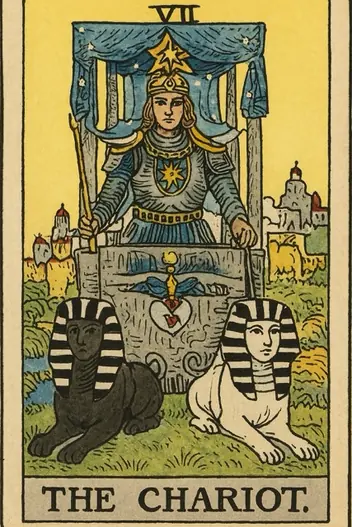

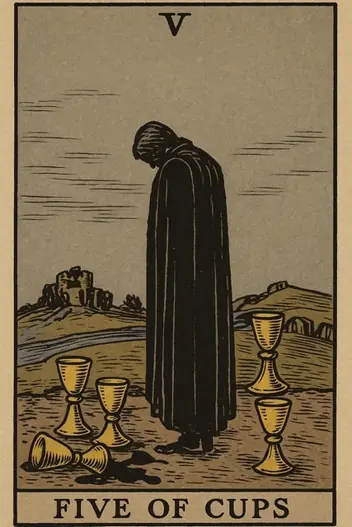
- Arcana
- The Chariot — Major Arcana; Five of Cups — Minor Arcana, Cups
- Elements
- The Chariot — Water; Five of Cups — Water
- Elemental interaction
- Same element — energies intensify each other
- Numerology
- 7 + 5 = 12 → 3
The intersection of The Chariot and the Five of Cups creates a powerful psychological tension. The Chariot represents willpower, determination, and the drive to conquer obstacles, while the Five of Cups embodies grief, disappointment, and a focus on what has been lost. This pairing often appears when a person is trying to push forward with a goal but is simultaneously processing a significant emotional setback.
In practical terms, this combination signals a critical decision point. You are being asked to acknowledge your emotional pain without letting it paralyze your forward momentum. The Chariot’s energy demands action, but the Five of Cups insists on introspection. The key is strategic emotional processing—you must grieve what is gone, but not at the expense of what remains to be achieved.
The Chariot and Five of Cups Card Meaning Explained
The core dynamic here is a conflict between emotional processing and strategic action. The Five of Cups represents the psychological state of rumination and selective attention, where the seeker focuses only on the overturned cups (losses) while ignoring the two upright cups behind them (potential and opportunity). The Chariot, however, demands that you harness this emotional energy as fuel for movement.
When these two archetypes merge, the seeker often experiences a cognitive dissonance: the mind knows it must move forward, but the heart is still anchored in regret. The practical implication is that progress will require a conscious choice to redirect focus. You cannot afford to ignore the grief, but you also cannot afford to dwell in it indefinitely. The most effective strategy is to set a time limit for emotional processing, then deliberately shift your attention to the remaining resources and strengths.
This pairing also suggests a risk of overcompensation. The Chariot’s willpower can be misused to suppress emotions entirely, leading to burnout or a hollow victory. Conversely, the Five of Cups can trap you in a cycle of self-pity that sabotages your determination. The psychological maturity required here is integrating loss into your narrative without letting it define your identity.
The Chariot and Five of Cups in Love and Relationships
If you are single:
This combination suggests you may be carrying unresolved feelings from a past relationship into new connections. Evaluate whether you are projecting old disappointments onto potential partners.
If you are in a relationship:
You and your partner may be stuck in a cycle of revisiting past grievances instead of building toward a shared future. The conflict is not about what happened, but about whether you both choose to move forward together.
In relationships, The Chariot and Five of Cups often indicate a power struggle fueled by unprocessed grief. One partner may be pushing for progress or change, while the other is still mourning a previous version of the relationship. This creates a dynamic of frustration and withdrawal. The key relationship advice is to acknowledge the loss without using it as a weapon. Instead of arguing about who is right, focus on rebuilding trust through small, consistent actions. Bold communication about emotional needs is essential, but it must be paired with a shared commitment to move forward.
For those in a partnership, this combination warns against using past betrayals as justification for current control or dominance. The Chariot’s willpower, when misdirected, can become a tool for manipulation. The healthier path is to treat the relationship as a team effort where both partners agree to leave the overturned cups behind and focus on the resources they still have together.
Your pair is already on the table. Ask your question and draw the clarifying card
or simply focus on it
The Chariot and Five of Cups: Career and Money
Strategic Opportunities:
Reassess your current goals in light of recent setbacks. What you lost may have opened a more viable path forward.
Strategic Opportunities:
Leverage your determination to rebuild from a position of clarity. The Chariot’s energy is ideal for restructuring your approach.
Calculated Risks:
Avoid making major financial decisions while still in the emotional aftermath of a loss. Grief impairs judgment and can lead to impulsive moves.
In a professional context, this pairing often appears after a failed project, a missed promotion, or a financial loss. The Chariot’s drive can help you regain momentum, but only if you first conduct an objective post-mortem on what went wrong. The Five of Cups warns against letting one failure define your entire career trajectory. Bold financial warning: Do not throw good money after bad. The overturned cups represent sunk costs; the remaining cups are your actual resources. Focus on what you can still control, not on what you have already lost.
For entrepreneurs or those in competitive fields, this combination suggests a need for strategic pivoting. The Chariot’s willpower is best applied to new initiatives rather than trying to resurrect a failed venture. Calculated risks involve acknowledging the emotional toll of the setback and giving yourself permission to grieve, but then using that emotional energy as motivation to execute a revised plan with precision.
The Shadow Side of The Chariot and Five of Cups
The shadow manifestation of this pairing is emotional paralysis masked as determination. The seeker may appear to be pushing forward, but is actually running away from their grief, only to have it resurface later with greater intensity. This leads to repetitive cycles of failure where the same emotional triggers sabotage progress.
Another pitfall is cognitive bias toward negativity. The Five of Cups amplifies the negativity bias, making the seeker overestimate the magnitude of their loss and underestimate their remaining resources. This can lead to poor judgment in negotiations or career moves, as the seeker acts from a place of scarcity mindset rather than strategic assessment. The Chariot’s energy, when corrupted by this bias, becomes reckless aggression rather than focused willpower.
Self-sabotage is a high risk here. The seeker may unconsciously create new obstacles to avoid facing their emotional pain, or they may sabotage a promising opportunity because they believe they do not deserve success after their loss. The psychological key is to recognize that grief does not invalidate your capability.
Uncover hidden insights
Let our advanced Tarot system interpret these archetypes specifically for your personal path.
The Chariot and Five of Cups Reversed: What Changes?
If The Chariot is Reversed:
The will is paralyzed. This is not just sadness (Five of Cups), but a complete loss of control. The person is stuck in the past, lacking the strength even for formal actions. Advice: It is necessary to delegate decision-making. Ask a friend or mentor to act as an "external dispatcher" to force you to take the first step.
If the Five of Cups is Reversed:
Internal resistance turns into aggressive denial. The person is not just sad; they are angry at the world for their loss. This is a dangerous combination, as The Chariot can direct that anger toward destruction. Advice: Channel the aggression into physical activity or sports, but do not make important decisions while angry.
If BOTH are Reversed:
Complete imbalance — chaos and apathy. There is neither a goal nor the desire to achieve one. This is a state of deep depression or loss of meaning. The "Micro-Step" Strategy: Set a task for 5 minutes (wash your face, drink water, reply to one email). Restore control through the smallest actions, without trying to grasp the entire picture at once.
The Chariot and Five of Cups: The Combined Message
Constructive use of this combination requires iron discipline and self-empathy. The energy of the Chariot must be directed not at suppressing emotions, but at creating a structure within which these emotions can be safely experienced. Imagine you are driving a car with a crying passenger inside. Your task is not to silence them, but to reach the destination despite their tears. The Five of Cups is not an enemy, but an indicator that you are heading in the right direction—if it hurts to leave what is behind.
Strategically, you need to divide the process into two stages. The first stage is "evacuation": use the will of the Chariot to exit the crisis situation (breakup, firing, relocation). There is no room for reflection here—only action. The second stage is "rehabilitation": once you are safe, allow yourself time for the Five of Cups. Permit yourself to grieve, but strictly on a schedule (e.g., one hour a day or one day a week).
Deep advice: use past losses as a compass, not an anchor. Ask yourself: "What did this pain teach me? What boundaries will I no longer allow to be crossed?" The answers to these questions will transform the Five of Cups from a source of suffering into a source of wisdom. And the Chariot will give you the strength to implement these lessons in life. Your victory will not lie in forgetting the past, but in building a future where this pain will never repeat itself.
Applying This to Your Situation
The core message of The Chariot and Five of Cups is that you can honor your loss without being defined by it. Your willpower is a tool, not a cure. The path forward requires strategic emotional processing followed by deliberate action. You have more resources than you currently see.
While this article provides a general framework for these archetypes, the true power of Tarot lies in its application to your unique situation. Your specific question, your personal history, and the other cards in your spread will refine this meaning dramatically. To get a deep, personalized interpretation of this exact combination for your specific question right now, use the Fortune Cards app. Available on the web and for download, it applies sophisticated psychological analysis to your unique context, helping you turn insight into action.
Interpretation by the Fortune Cards editorial team, based on the Rider–Waite tradition and Jungian archetypes. About our methodology · Updated: 2026-08-26
Other Combinations with The Chariot
Other Combinations with Five of Cups
Explore Individual Card Meanings
Table of Contents
- The Chariot and Five of Cups Card Meaning Explained
- The Chariot and Five of Cups in Love and Relationships
- The Chariot and Five of Cups: Career and Money
- The Shadow Side of The Chariot and Five of Cups
- The Chariot and Five of Cups Reversed: What Changes?
- The Chariot and Five of Cups: The Combined Message
- Applying This to Your Situation
Ready to find answers to your questions?
Start your first reading now and look at your situation with fresh clarity. The cards are ready to reveal deeper meaning.