Five of Cups and Eight of Swords Meaning in Tarot
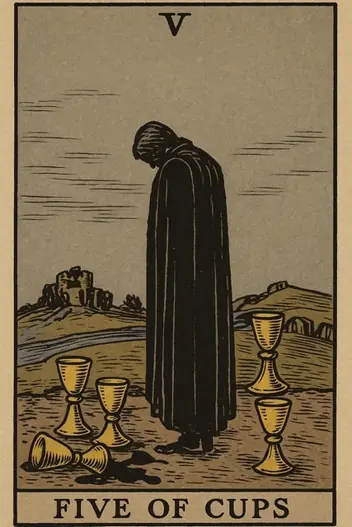

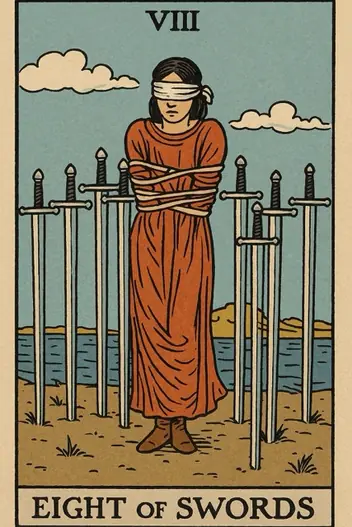
- Arcana
- Five of Cups — Minor Arcana, Cups; Eight of Swords — Minor Arcana, Swords
- Elements
- Five of Cups — Water; Eight of Swords — Air
- Elemental interaction
- Neutral elements — energies coexist without conflict
- Numerology
- 5 + 8 = 13 → 4
Five Of Cups mourns what is lost—spilled milk, broken trust, or missed opportunities—while Eight Of Swords traps you in a mental cage of self-doubt and perceived helplessness. When these two archetypes collide, the emotional weight of past disappointment becomes a barrier to clear thinking. You are not just sad; you are convinced that movement is futile. This combination signals a cognitive distortion where grief masquerades as truth, and learned helplessness prevents you from seeing the exits that still exist.
The psychological intersection is a feedback loop: the loss (Five of Cups) reinforces the belief that you are powerless (Eight of Swords), and the powerlessness deepens the mourning. The result is a stasis that feels permanent but is actually a choice you are making unconsciously. The strategic challenge is to break this loop by separating objective reality from subjective interpretation.
Five of Cups and Eight of Swords: How These Energies Interact
When the Five Of Cups (water element) meets the Eight Of Swords (air element), emotion clouds cognition. The water represents the raw feeling of disappointment—a specific loss, a betrayal, or a failure. The air represents the mental framework you build around that loss. Together, they create a self-fulfilling prophecy: because you lost something important, you assume all future efforts will fail. This is not a prediction of the future; it is a projection of past pain onto present possibilities.
The key psychological concept here is rumination. You are not just processing grief; you are replaying the loss on a loop, searching for blame or alternate outcomes. The Eight of Swords adds the layer of confirmation bias—you selectively notice evidence that supports your helplessness while ignoring the paths forward. For example, a missed promotion (Five of Cups) might lead you to believe you are unqualified for any leadership role (Eight of Swords), even though your skills remain intact.
The core dynamic is a crisis of agency. The Five of Cups asks you to grieve, but the Eight of Swords demands you take action. The tension between these two creates paralysis. The pragmatic solution is to schedule your grief—allow yourself a set time to mourn the loss, then shift into problem-solving mode. This combination is a warning that passive sorrow is becoming an active trap.
Your pair is already on the table. Ask your question and draw the clarifying card
or simply focus on it
Five of Cups and Eight of Swords as Feelings
If you are single:
This pair suggests you are over-analyzing a past rejection (Five of Cups) and using it as evidence that you are unlovable or incapable of connecting (Eight of Swords). You may be avoiding new opportunities because you assume the outcome will mirror the past.
If you are in a relationship:
You or your partner are holding onto a specific grievance (Five of Cups) that has created a mental barrier to intimacy (Eight of Swords). The issue is not the original conflict, but the story you are telling yourself about it.
In relationships, this combination often appears when one partner feels emotionally abandoned after a fight or betrayal. The Five of Cups represents the specific wound—a broken promise, a harsh word, or a missed anniversary. The Eight of Swords represents the defensive narrative built around that wound: "They don't care about me, so I cannot trust them again." This is a cognitive trap because it assumes the partner's intentions are fixed and negative.
The key relationship advice is to challenge the narrative. Ask yourself: "Is my partner truly incapable of change, or am I refusing to see their efforts because I am focused on the loss?" Bold communication is required—express the grief directly ("I am still hurt by what happened") without letting it dictate the future ("Therefore, we are doomed"). If you are single, reframe rejection as data, not identity. A past "no" does not mean you are fundamentally flawed; it means that specific situation did not work.
Five of Cups and Eight of Swords in Career Readings
Strategic Opportunities:
Identify the specific loss you are mourning (e.g., a failed project, a missed client, a budget cut) and separate it from your overall competence. The loss is an event, not a verdict on your career.
Strategic Opportunities:
Use the Eight of Swords energy to map constraints. List the actual obstacles you face (e.g., lack of time, limited resources) versus the imagined ones (e.g., "I am not good enough"). This clarity will reveal a path forward.
Calculated Risks:
Avoid making major financial decisions from a place of grief or fear. The Five of Cups may tempt you to "cut your losses" prematurely, while the Eight of Swords may convince you that no option is safe. Refuse to act until you have objectively evaluated the numbers.
In a professional context, this combination warns against catastrophic thinking after a setback. For example, losing a key client (Five of Cups) might lead you to believe your business is failing (Eight of Swords), when in reality you have other revenue streams. The financial warning is clear: do not let one loss dictate your entire strategy. Instead, treat the loss as a data point for risk management. What went wrong? What can you control? What is outside your control?
The strategic move is to shift from mourning to auditing. List the resources you still have—skills, relationships, cash reserves—and compare them to the constraints. Most of the "swords" (mental barriers) will dissolve under objective scrutiny. Bold action tip: Schedule a 30-minute "reality check" meeting with a trusted colleague or mentor to pressure-test your assumptions about your career trajectory.
Uncover hidden insights
Let our advanced Tarot system interpret these archetypes specifically for your personal path.
Negative Meaning of Five of Cups and Eight of Swords
The shadow of the Five Of Cups and Eight Of Swords combination is victimhood as identity. The seeker may unconsciously prefer the comfort of grief over the risk of trying again. This manifests as learned helplessness—a belief that no action will change the outcome, so why bother? The cognitive bias at play is emotional reasoning: "I feel trapped, therefore I am trapped." This is a dangerous fallacy because it conflates emotion with fact.
Another shadow manifestation is blaming the past for the present. The seeker may use the original loss (Five of Cups) as a permanent excuse for inaction (Eight of Swords). For example, "I cannot trust anyone because I was betrayed once" becomes a self-imposed prison. The pitfall is that this mindset prevents growth by treating a single event as an immutable law of reality. The risk is that you will miss real opportunities because you are too focused on the ones that slipped away.
Five of Cups and Eight of Swords Reversed: What Changes?
Reversed cards in this pair often indicate the beginning of an exit from the crisis, but with caveats.
If the Five of Cups is reversed:
This speaks to a blocked potential for healing. The person refuses to feel the pain, suppressing emotions. This is not strength, but a dangerous strategy. Warning: suppressed grief does not disappear; it transforms into psychosomatic issues or sudden outbursts of aggression. Instead of "keeping up appearances," allow yourself a ritual of farewell to the loss.
If the Eight of Swords is reversed:
Internal resistance is subsiding. The person begins to see that the blindfold was an illusion. They remove it but still hesitate to take a step. Advice: this is a moment of "insight." Use it for planning, but do not wait for the fear to disappear completely. Act despite the residual anxiety.
If BOTH are reversed:
This is a complete imbalance, but with a positive vector. Past pain has stopped dominating, and fears have lost their power. The logical way to rectify the situation: shift from analysis to action. You have left the prison; now you need to learn to walk. Focus on creating new, positive "anchors" in reality.
Five of Cups and Eight of Swords: The Combined Message
How can the energy of this pair be used constructively? The Five of Cups is the fuel, and the Eight of Swords is the brake. Your task is not to remove the fuel (not to suppress emotions), but to release the brakes. The deep strategic advice is to use the pain as a navigator. Ask yourself: "What exactly am I afraid of, looking back at this past failure?" The answer to this question will point you toward a specific fear (e.g., fear of public judgment). Now, your goal is not to conquer this fear, but to prove to yourself that you can handle it.
Start with micro-steps. Do not try to "fix" your entire life. Take one aspect of the Eight of Swords (e.g., fear of making phone calls) and one aspect of the Five of Cups (regret over a lost contract). Make one call related to a new, similar contract. This is not magic; it is cognitive-behavioral therapy in action. You cannot retrieve what has been spilled, but you can fill a new cup. The key clarity for decision-making: your prison is built from thoughts, not from reality. Once you understand this, the swords will transform from an obstacle into a tool for cutting through the knot of problems.
Where to Go From Here
The Five Of Cups and Eight Of Swords together deliver a stark message: your grief is valid, but your prison is self-made. The path forward requires acknowledging the loss without letting it define your future. You have more agency than you feel. The question is whether you will choose to see the exits or remain focused on the spilled cups. The core message is one of psychological liberation—you must break the link between past disappointment and present helplessness.
To get a deep, personalized interpretation of this exact combination for your specific question, use the Fortune Cards app. While this article provides the general archetype, the true magic happens when Tarot is applied to your unique situation. The app analyzes your specific context—whether it's a career crisis, a relationship struggle, or a personal crossroads—and delivers practical, psychological insights tailored to you. Download Fortune Cards now on the web or your app store to turn this insight into action.
Interpretation by the Fortune Cards editorial team, based on the Rider–Waite tradition and Jungian archetypes. About our methodology · Updated: 2026-08-26
Other Combinations with Five of Cups
Other Combinations with Eight of Swords
Explore Individual Card Meanings
Table of Contents
- Five of Cups and Eight of Swords: How These Energies Interact
- Five of Cups and Eight of Swords as Feelings
- Five of Cups and Eight of Swords in Career Readings
- Negative Meaning of Five of Cups and Eight of Swords
- Five of Cups and Eight of Swords Reversed: What Changes?
- Five of Cups and Eight of Swords: The Combined Message
- Where to Go From Here
Ready to find answers to your questions?
Start your first reading now and look at your situation with fresh clarity. The cards are ready to reveal deeper meaning.