The Tower and Eight of Cups Tarot Combination
- Arcana
- The Tower — Major Arcana; Eight of Cups — Minor Arcana, Cups
- Elements
- The Tower — Fire; Eight of Cups — Water
- Elemental interaction
- Opposing elements — energies create tension
- Numerology
- 16 + 8 = 24 → 6
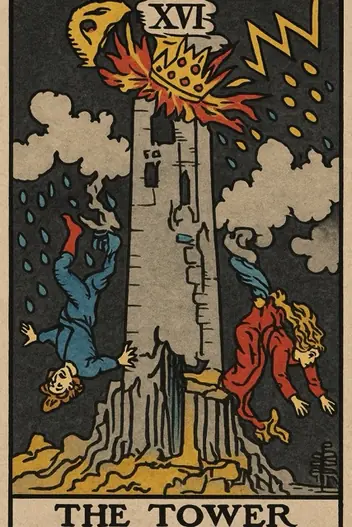
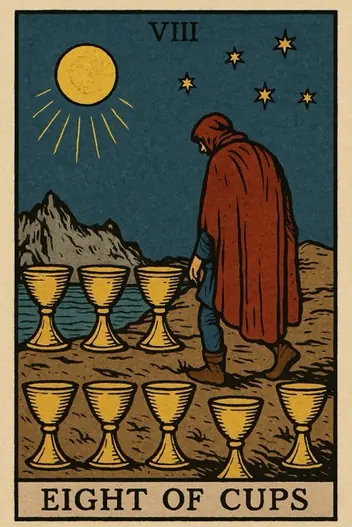
When The Tower collapses—stripping away illusions, security, or structures you once relied on—it often leaves a landscape of emotional debris. The Eight of Cups enters not as a rescuer, but as a deliberate walker. This combination signals a moment where catastrophe meets conscious withdrawal. It’s not about being forced out; it’s about choosing to leave what’s already broken, even if the break was sudden.
Psychologically, this pairing represents the rupture of a false self (The Tower) followed by the initiation of a mourning process (Eight of Cups). The seeker must navigate the raw shock of loss while simultaneously recognizing that staying in the ruins is not an option. This is a pragmatic, albeit painful, pivot from victimhood to agency.
The Tower and Eight of Cups: How These Energies Interact
The core dynamic here is controlled disengagement after an uncontrollable event. The Tower delivers the blow—a job loss, betrayal, health crisis, or sudden realization that a belief system is flawed. The Eight of Cups then asks: What do you do with the rubble? The answer is not rebuild immediately, but to walk away from the site entirely. This is strategic retreat, not cowardice.
This combination reveals a psychological state of cognitive dissonance resolution. The Tower shatters the old narrative (e.g., “This relationship was stable,” “This career was secure”). The Eight of Cups provides the emotional distance to process the dissonance. The seeker must resist the urge to fix, explain, or salvage. Instead, they must accept that some endings are final, and the only healthy response is to move toward unknown terrain. Bold: The key insight is that clinging to the wreckage prolongs the trauma; this duo demands a clean break for psychological survival.
In practical terms, this energy manifests as a decision made under duress but executed with clarity. You may feel the ground shake, but your feet are already walking. The challenge is to trust the impulse to leave even when you don’t know where you’re going. This is not a time for analysis paralysis; it’s a time for action rooted in self-preservation.
The Tower and Eight of Cups in Love and Relationships
If you are single:
This combination suggests you may be attracted to someone who represents a “rebound” from a recent collapse, but the Eight of Cups warns you to avoid using new connections as a distraction. Focus on emotional closure before seeking intimacy.
If you are in a relationship:
Expect a period where one partner experiences a sudden crisis (The Tower) that forces a reassessment of the relationship’s foundation. The Eight of Cups indicates a need for temporary emotional space to process independently, not a permanent breakup.
In relationships, this pairing often signals a catastrophic event that reveals the relationship’s true fragility. It could be an infidelity, a financial disaster, or a deep betrayal of trust. The Eight of Cups here is not abandonment but conscious differentiation. One or both partners may need to physically or emotionally step back to avoid being consumed by the chaos. Bold: The healthiest path is to acknowledge the rupture without rushing to repair it. Attempting to “fix” things too quickly can lead to a hollow reconciliation. Instead, use this time to evaluate whether the relationship’s core values are compatible with your new reality.
Key relationship advice in bold:
Do not use the crisis as a reason to stay out of guilt or obligation. The Eight of Cups asks you to honor your own need for distance, even if it feels selfish. If the relationship can withstand the space, it may rebuild stronger; if not, it was already crumbling.
Your pair is already on the table. Ask your question and draw the clarifying card
or simply focus on it
The Tower and Eight of Cups in Career Readings
Strategic Opportunities:
Use the disruption to reassess your career identity—what you do versus who you are. This is a chance to pivot toward work that aligns with your post-crisis values.
Strategic Opportunities:
Leverage the network you built before the collapse. Reach out to contacts with a clear, concise request for guidance or introductions. The Eight of Cups rewards calculated networking, not begging.
Calculated Risks:
Avoid making impulsive financial decisions to “fix” the situation. Do not take out loans, drain savings, or accept a job you’ll hate just to stop the bleeding. The Tower’s damage is real, but the Eight of Cups warns against throwing good money after bad.
Professionally, this combination often appears during layoffs, business failures, or the collapse of a major project. The psychological imperative is to resist the urge to salvage your reputation or position at all costs. Instead, focus on preserving your core skills and emotional capital. Bold: A key financial warning: Do not confuse the collapse of a specific role with the collapse of your career. The Eight of Cups encourages you to walk away from the company, industry, or even the city that housed the failure. This is a strategic relocation of your professional energy.
The actionable mindset here is “cut losses, not corners.” Evaluate your severance, savings, and unemployment benefits with cold logic. Then, create a 90-day plan for exploration—not for immediate employment, but for recalibrating your professional compass. Bold: The most dangerous move is to accept the first opportunity that comes out of fear.
The Tower and Eight of Cups Reversed Meaning
If The Tower is Reversed:
You are resisting inevitable destruction. You are trying to hold onto what has already collapsed. This creates chronic stress and internal tension. Advice: stop trying to fix what is broken. Your stubbornness only prolongs the agony and increases the losses.
If the Eight of Cups is Reversed:
You cannot leave, even though everything is obvious. This is a state of paralysis of the will. You are aware of the destruction (The Tower), but you fear loneliness and the unknown. Warning: by staying among the ruins, you risk being buried beneath them. You need external support (therapy, a coach) to take this step.
If BOTH are Reversed:
Complete imbalance — apathy and denial. You see neither the crisis nor the need to leave. This is a dangerous illusion of stability. Way to correct it: artificially create an "alarm signal" for yourself. Ask a friend or consultant to give you harsh feedback. You need to come out of "ostrich mode" to avoid catastrophe.
Deepen your understanding
Find out exactly what this reading means for your current life situation with our oracle.
When The Tower and Eight of Cups Signal Trouble
The shadow of The Tower and Eight of Cups manifests as trauma-induced avoidance or reckless self-destruction. A common cognitive bias is catastrophizing: assuming the collapse defines your entire future, leading to despair. Alternatively, the seeker may idealize the “walking away” as a noble act, ignoring that they are fleeing from unresolved grief.
Self-sabotage appears when you use the Tower’s chaos as an excuse to burn bridges you should have maintained—quitting without notice, ending friendships in anger, or abandoning financial responsibilities. The Eight of Cups, in its shadow, becomes emotional escapism: traveling, changing jobs, or moving cities without addressing the underlying psychological wounds.
Another pitfall is analysis paralysis disguised as introspection. The seeker may endlessly “process” the Tower event without taking the practical steps the Eight of Cups demands. Bold: Avoid the trap of romanticizing the collapse—it was not a “necessary destruction” but a failure of systems. The goal is not to find meaning in the wreckage, but to learn enough to avoid repeating the pattern.
The Tower and Eight of Cups: Tarot Advice
Constructive use of this combination requires paradoxical thinking. You must simultaneously embrace the destructive energy of the Tower and harness the withdrawal energy of the Eight of Cups as an act of creating new space. Do not perceive the departure as defeat. See it as a surgical operation, where you remove a malignant tumor in order to survive.
The strategic advice: use the crisis to audit your values. The Tower destroys form, but not essence. Ask yourself: "What exactly did I lose? And what did I gain?" The Eight of Cups gives you the chance to leave not empty-handed, but with experience and clarity. You will no longer invest in what has not passed the test of endurance.
Your task is to transform the trauma into a filter for future decisions. Now you know the signs of unstable structures. You have learned to leave on time. This is not weakness, but the highest mastery of emotional maturity. Key takeaway: The Tower + Eight of Cups is not the end of the story, but the closing of a chapter. You have not just survived; you have become the strategist of your own life, who will no longer waste time on what is doomed.
Your Next Step: Personal Context Matters
The Tower and Eight of Cups together deliver a stark message: You cannot both stay and heal. The collapse is real, and the only productive response is to leave the site of the disaster with intention. This is not about losing everything—it’s about choosing what you carry forward. The pain is temporary; the wisdom of knowing when to walk away is permanent. Your next step is to identify one structure you’ve been clinging to out of fear, and take one concrete action to detach from it today.
While this article offers a general archetype, the true power of Tarot lies in its application to your unique situation. The meaning of The Tower and Eight of Cups shifts dramatically based on whether you’re asking about a relationship, career, or personal growth. Don’t guess—get clarity. Use the Fortune Cards app on the web or download it to receive a deep, personalized interpretation of this exact combination for your specific question. Your future self will thank you for the precision.
Interpretation by the Fortune Cards editorial team, based on the Rider–Waite tradition and Jungian archetypes. About our methodology · Updated: 2026-08-26
Other Combinations with The Tower
Other Combinations with Eight of Cups
Explore Individual Card Meanings
Table of Contents
- The Tower and Eight of Cups: How These Energies Interact
- The Tower and Eight of Cups in Love and Relationships
- The Tower and Eight of Cups in Career Readings
- The Tower and Eight of Cups Reversed Meaning
- When The Tower and Eight of Cups Signal Trouble
- The Tower and Eight of Cups: Tarot Advice
- Your Next Step: Personal Context Matters
Ready to find answers to your questions?
Start your first reading now and look at your situation with fresh clarity. The cards are ready to reveal deeper meaning.