The Tower and Five of Pentacles Tarot as Feelings
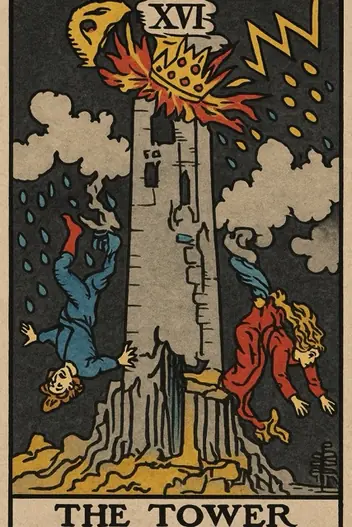

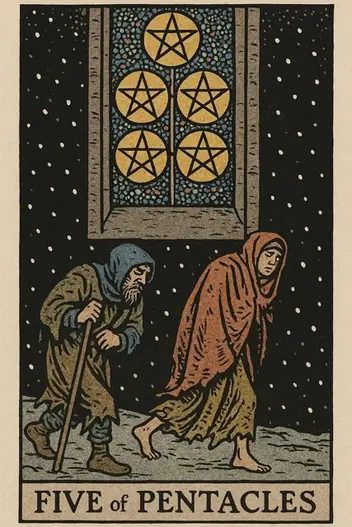
- Arcana
- The Tower — Major Arcana; Five of Pentacles — Minor Arcana, Pentacles
- Elements
- The Tower — Fire; Five of Pentacles — Earth
- Elemental interaction
- Neutral elements — energies coexist without conflict
- Numerology
- 16 + 5 = 21 → 3
When The Tower—representing sudden collapse, revelation, and structural upheaval—collides with the Five of Pentacles—symbolizing material lack, isolation, and spiritual poverty—the result is a psychological crucible. This pairing forces you to confront the raw reality of what you’ve lost, but it also reveals the hidden strength you never knew you had. Psychologically, this is the moment when ego defenses shatter, and you must either rebuild from a more authentic foundation or remain stuck in a narrative of victimhood.
Strategically, this combination warns against clinging to broken systems or denying the severity of a crisis. The Tower demands you see the truth, while the Five of Pentacles asks: Will you let this hardship define you, or will you use it to redefine your priorities? The intersection is not about doom; it’s about the strategic necessity of accepting loss to clear the ground for genuine stability.
What Do The Tower and Five of Pentacles Mean Together?
The core dynamic here is a forced confrontation with scarcity—both external and internal. The Tower rips away the illusion of security (a job, a relationship, a belief system), while the Five of Pentacles amplifies the feeling of being abandoned, impoverished, or unsupported. This is not a gentle transition; it’s a psychological shock that triggers a survival response. The key insight is that this pain is not punishment, but a recalibration of your values. You are being stripped of what no longer serves you, even if it feels like destruction.
From a Jungian perspective, this pairing represents the Shadow of the Self—the parts of your life you’ve neglected or avoided. The Five of Pentacles often points to a fear of being unworthy or unlovable, while The Tower forces you to witness that fear in real time. The mindset required here is radical acceptance: acknowledging that the old structure is gone, that resources are temporarily scarce, and that you must operate from a place of disciplined pragmatism rather than panic. The real-world implication is clear: Do not waste energy mourning the loss; instead, inventory what remains—your skills, your resilience, your network—and create a step-by-step plan for survival and eventual growth.
Your pair is already on the table. Ask your question and draw the clarifying card
or simply focus on it
What Do The Tower and Five of Pentacles Indicate for Your Career?
Strategic Opportunities:
Inventory your core skills and network immediately. The Tower often ends a job or revenue stream, but your expertise remains. Use this moment to pivot to a role or project that better aligns with your long-term values.
Strategic Opportunities:
Seek community resources or temporary support. The Five of Pentacles warns against pride-driven isolation. Apply for unemployment, ask for help, or join a professional group—this is not weakness; it’s smart resource management.
Calculated Risks:
Avoid making major financial commitments out of panic. Do not take on high-interest debt, invest in “get rich quick” schemes, or accept a job that exploits your desperation. The risk here is trading short-term relief for long-term instability.
In a career context, this pairing is a brutal but effective reality check. You may have been over-reliant on a single source of income, a toxic workplace, or a business model that was already failing. The strategic move is to conduct a ruthless audit of your finances: cut all non-essential spending, negotiate payment plans, and create a 90-day survival budget. Bold financial warning: Do not ignore the signs of impending collapse. If your business is struggling, The Tower says it’s better to restructure or close now than to sink deeper. The Five of Pentacles reminds you that your worth is not measured by your bank account; your ability to adapt and learn new skills is your true asset. Focus on income diversification, even if it means taking a temporary pay cut. This is a time for calculated survival, not heroic risk-taking.
What Do The Tower and Five of Pentacles Say About Love?
If you are single:
This combination suggests that a sudden ending or a painful realization about a past relationship is clearing the way for a more authentic connection. Do not rush into a new relationship to fill the void; focus on rebuilding your sense of self-worth first.
If you are in a relationship:
A crisis is testing the foundation of your partnership. If the relationship is built on codependence or false security, it may collapse. If it is genuine, this crisis will force honest communication about finances, values, or unmet emotional needs.
In relationships, The Tower and Five of Pentacles often signal a painful but necessary unmasking. One partner may feel abandoned or financially insecure, while the other may be blindsided by a hidden issue. The psychological task here is to avoid blame and instead ask: “What is this crisis revealing about our shared values and our individual fears?” Bold relationship advice: Do not use scarcity (emotional or financial) as a weapon to control the other person. Instead, treat this as a strategic negotiation: What resources—time, money, emotional support—can you both realistically offer right now? If the relationship is salvageable, it will require radical honesty about boundaries and a mutual commitment to rebuilding from a more resilient place. If it ends, accept that the Tower has cleared space for a partnership that aligns with your true needs.
Uncover hidden insights
Let our advanced Tarot system interpret these archetypes specifically for your personal path.
Reversed The Tower and Five of Pentacles Explained
The reversed position of the cards softens the acuteness but does not cancel the problem; instead, it shifts it to an internal plane.
If The Tower is Reversed:
The collapse is blocked, but tension is building. You are desperately clinging to a crumbling structure (a relationship, a business), ignoring the obvious cracks. This leads to chronic stress and psychosomatic issues. Advice: stop "repairing" what is meant to collapse. Artificially holding together what is already broken only drains the last resources of the Five of Pentacles. Allow the crisis to happen in a controlled manner to avoid a catastrophe.
If the Five of Pentacles is Reversed:
Isolation becomes voluntary. The person does not seek help, despite an obvious lack. This is a form of pride or learned helplessness. You would rather freeze than ask for assistance. Warning: this is a path to depression. You need to realize that asking for support is a strategic move, not a weakness.
If BOTH are Reversed:
Complete imbalance and denial. You are in a state where the crisis is denied ("everything is fine"), and your isolation is perceived as "independence." This is a dangerous illusion. A logical way to correct this: start by acknowledging the fact of the crisis. Find one person (a psychologist, a mentor) to whom you will honestly describe your situation. This will be the first step towards breaking the vicious cycle.
The Tower and Five of Pentacles: Warning Signs
The shadow side of this combination is a dangerous spiral of self-pity, blame, and learned helplessness. When The Tower strikes, the ego’s first instinct is to find a scapegoat—your boss, your partner, the economy—while the Five of Pentacles amplifies the narrative of “I am a victim of fate.” This cognitive bias, known as the fundamental attribution error, leads you to attribute your misfortune to external forces while ignoring your own role in the situation. The result is paralysis: you feel too poor, too broken, or too unlucky to take action.
Another pitfall is masochistic endurance—staying in a destructive situation because you believe you deserve the pain or that “this is just how life is.” This is a form of self-sabotage where you unconsciously replicate the emotional poverty of the Five of Pentacles. To avoid this, you must reframe the crisis as a diagnostic tool: What specific belief or behavior led to this collapse? Was it overconfidence? Ignoring red flags? Financial denial? The shadow demands you take ownership of your part in the story, without falling into shame. The path forward is pragmatic accountability: “I made a mistake; now I will learn from it and act differently.”
The Tower and Five of Pentacles Combined Message
How to constructively use the energy of this pair? Embrace the paradox: destruction is the only way to gain access to new resources. The Tower demolishes the old, inefficient "house," and the Five of Pentacles forces you out into the cold to find shelter. Instead of mourning your losses, use the crisis as a tool for radical simplification. Ask yourself: "What have I lost that was actually holding me back?"
A deep strategic piece of advice: act as an "architect of crisis." Do not wait for the blow to come from outside. If you feel you are in the Five of Pentacles (isolation, lack), initiate your own "little Tower." Quit the toxic job, end the dead-end relationship, sell the asset that is dragging you down. Controlled destruction is always less painful than chaotic destruction. You are not a victim of circumstance—you are the manager of your own collapse, clearing the ground for new construction. Remember: behind the "cold" of the Five of Pentacles, spring always follows—but only if you survive the winter, not freeze in it.
Your Next Step: Personal Context Matters
The core message of The Tower and Five of Pentacles is that collapse is not the end—it is the necessary demolition of a structure that was never truly secure. Your next step is to accept the loss, grieve what is gone, and then methodically rebuild from a place of grounded reality. This is not a time for magical thinking or waiting for rescue; it is a time for disciplined action, resourcefulness, and honest self-assessment.
While this article provides a powerful framework for understanding these archetypes, the true magic of Tarot lies in how it applies to your unique situation. The exact meaning of The Tower and Five of Pentacles shifts depending on your question, your current life stage, and the other cards in your spread. To get a deep, personalized interpretation of this combination for your specific question—whether about love, career, or personal growth—use the Fortune Cards app. You can access it on the web or download it now to receive a tailored reading that speaks directly to your circumstances. Don’t just read about the archetypes; let them guide your next move.
Interpretation by the Fortune Cards editorial team, based on the Rider–Waite tradition and Jungian archetypes. About our methodology · Updated: 2026-08-26
Other Combinations with The Tower
Other Combinations with Five of Pentacles
Explore Individual Card Meanings
Table of Contents
- What Do The Tower and Five of Pentacles Mean Together?
- What Do The Tower and Five of Pentacles Indicate for Your Career?
- What Do The Tower and Five of Pentacles Say About Love?
- Reversed The Tower and Five of Pentacles Explained
- The Tower and Five of Pentacles: Warning Signs
- The Tower and Five of Pentacles Combined Message
- Your Next Step: Personal Context Matters
Ready to find answers to your questions?
Start your first reading now and look at your situation with fresh clarity. The cards are ready to reveal deeper meaning.