The Hanged Man and Three of Pentacles Meaning in Tarot
- Arcana
- The Hanged Man — Major Arcana; Three of Pentacles — Minor Arcana, Pentacles
- Elements
- The Hanged Man — Water; Three of Pentacles — Earth
- Elemental interaction
- Friendly elements — energies support each other
- Numerology
- 12 + 3 = 15 → 6
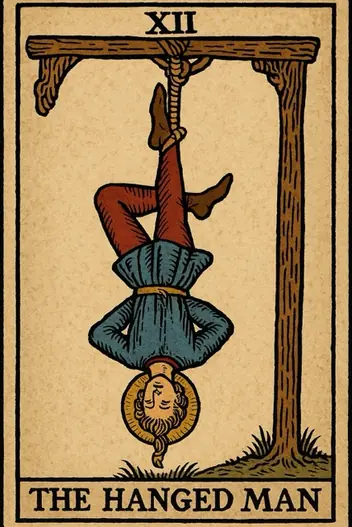
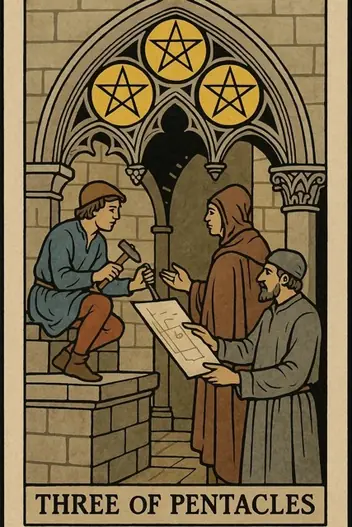
When the Hanged Man—a card of suspension, sacrifice, and altered perspective—meets the Three of Pentacles—a card of teamwork, craftsmanship, and deliberate skill-building—you are looking at a paradox. How can you be still and actively building at the same time? This combination suggests a period where external progress requires internal surrender. You may need to step back from a current project or relationship dynamic to see it more clearly, then return with a refined, collaborative approach. The core tension here is between patience and productivity: the Hanged Man asks you to stop forcing outcomes, while the Three of Pentacles demands disciplined, consistent effort.
In practice, this pairing often appears when a seeker is stuck in a cycle of "busy work"—doing tasks without real progress. The psychological insight is that your current strategy may be the very thing blocking you. The Hanged Man invites you to flip your perspective, perhaps by delegating, learning a new skill, or accepting a temporary loss of control. The Three of Pentacles then provides the structure to turn that new insight into tangible results. This is not a time for impulsive action, but for calculated collaboration and patient craftsmanship.
The Hanged Man and Three of Pentacles Together: Meaning
The core dynamic is a creative tension between reflection and execution. The Hanged Man represents a psychological suspension of the ego's usual need to control—a state of active waiting where you observe patterns without immediate reaction. The Three of Pentacles grounds this energy into a concrete plan. Together, they produce a mindset of "strategic apprenticeship": you are learning by doing, but only after you have stopped trying to force the outcome. This is especially powerful for problem-solving in complex systems, such as team dynamics, long-term projects, or creative collaborations.
The psychological state here is one of humble competence. You know you have skills (Three of Pentacles), but you also recognize that your current perspective is limited (Hanged Man). This combination often signals a need to seek mentorship or feedback from someone more experienced. The risk is falling into analysis paralysis—using the Hanged Man's suspension as an excuse to avoid the difficult, hands-on work of the Three of Pentacles. The key is to set a deadline for your pause and then commit to the next small, collaborative step.
The Hanged Man and Three of Pentacles as Feelings
If you are single:
This combination suggests that rushing into a new connection will backfire. Instead, focus on understanding your own patterns of attraction. You may need to take a break from actively dating to gain clarity on what you truly need from a partner. Use this time to refine your social skills or join a group where you can learn about relationships through observation.
If you are in a relationship:
This pairing points to a power imbalance in effort or decision-making. One partner may be over-functioning while the other is emotionally withdrawn. The Hanged Man suggests you pause and examine who is sacrificing what for the relationship. The Three of Pentacles calls for a collaborative agreement on roles and responsibilities.
In relationships, this combination highlights the need for emotional intelligence over romantic gestures. The Hanged Man asks you to suspend judgment about your partner's behavior and see it from their perspective. The Three of Pentacles then requires you to communicate that understanding through deliberate action. For example, if you feel your partner is not contributing enough, the Hanged Man energy says: "Wait and observe without accusation." The Three of Pentacles says: "Then propose a specific division of labor." The most important relationship advice here is to avoid martyrdom. Do not sacrifice your needs for the sake of "teamwork"—true collaboration requires mutual respect, not one-sided endurance.
Your pair is already on the table. Ask your question and draw the clarifying card
or simply focus on it
The Hanged Man and Three of Pentacles in Career Readings
Strategic Opportunities:
Pause a major project to gather feedback from a mentor or team member before proceeding. This can prevent costly rework and reveal blind spots in your approach.
Strategic Opportunities:
Invest in skill development that directly supports a long-term goal. Consider a certification, workshop, or collaborative learning environment.
Calculated Risks:
Avoid taking on new responsibilities that require immediate leadership. Your energy is better spent refining existing processes than launching untested initiatives. Do not sign contracts or make financial commitments under pressure.
In career and finances, this combination is a blueprint for sustainable growth. The Hanged Man warns against over-committing to a single vision without testing it. The Three of Pentacles advises you to break your goal into measurable, collaborative steps. For financial planning, this means delaying large purchases or investments until you have a clearer picture of market conditions or your own cash flow. The best professional strategy is to act as a consultant to yourself: step back, analyze the data, then execute with precision. Bold financial warning: Do not let the Hanged Man's suspension become a reason to avoid budgeting. Use this time to audit your expenses and build a buffer before making any moves.
Deepen your understanding
Find out exactly what this reading means for your current life situation with our oracle.
When The Hanged Man and Three of Pentacles Signal Trouble
The shadow side of this combination emerges as passive-aggressive perfectionism. You may use the Hanged Man's "need for perspective" as a justification to delay action indefinitely, while the Three of Pentacles' focus on quality becomes a rationalization for micromanaging others. This creates a toxic cycle: you feel stuck because you won't delegate, and you won't delegate because you believe only you can do the work correctly. Another pitfall is cognitive dissonance—convincing yourself that you are being patient and collaborative when you are actually avoiding a difficult decision or confrontation. Watch for signs of resentment building in your team or partnership. If you feel you are "sacrificing" for the greater good, check if that sacrifice is truly necessary or if it is a way to maintain control. The healthiest path is to name the trade-off explicitly: "I am choosing to delay X so we can learn Y. This is a strategic pause, not a surrender."
The Hanged Man and Three of Pentacles Reversed: How to Read It
When cards appear in a reversed position, the constructive dynamic breaks down, and cognitive distortions come to the forefront.
If The Hanged Man is reversed:
The sacrifice becomes meaningless. You are not voluntarily suspending activity, but rather becoming a victim of circumstances (layoff, illness, procrastination). Warning: you risk waiting endlessly for a "special sign" or "miracle" instead of starting to act. This state blocks access to learning (Three of Pentacles), as you cannot accept a new perspective.
If the Three of Pentacles is reversed:
Teamwork is sabotaged. Instead of learning from others, you display pride or, conversely, feel incapable of collaboration. Advice: check whether you are trying to "bite off more than you can chew" by rejecting a mentor's help. Your "suspension" (The Hanged Man) may be an excuse to avoid responsibility within the group.
If BOTH are reversed:
Complete imbalance. This points to a deep internal conflict: you are simultaneously sacrificing something in vain and refusing to learn. You may feel isolated but blame everyone around you. Corrective measure: consciously reclaim control over your "sacrifice" (decide what you are giving up deliberately) and start small—ask for advice from one expert, rather than trying to master everything at once.
The Hanged Man and Three of Pentacles: Tarot Advice
The Hanged Man and the Three of Pentacles are not a sentence to passivity, but a strategy of purposeful deceleration. To constructively use this energy, you need to perceive the "suspended" state as an active phase of the project. You are not merely waiting — you are rebooting your coordinate system.
Your task is to connect the insights gained in solitude (The Hanged Man) with the practical skills you are developing within a team (Three of Pentacles). The deep strategic advice: find a "workshop" — a community, school, or project where your temporary sacrifice will have concrete value. For example, if you left your job to write a book, join a writers' group or hire an editor. This will transform your isolation into a productive dialogue.
Remember: the goal of this combination is not endless contemplation, but a qualitative leap in your competence. You must clearly define what you are giving up (comfort, status, money) and what exactly you want in return (a skill, a diploma, a new vision). Once you articulate this, the period of "suspension" will become the most productive time in your career or personal life.
Your Next Step: Personal Context Matters
The Hanged Man and Three of Pentacles together offer a powerful lesson: true mastery requires both the courage to pause and the discipline to build. Your next step is to identify one area in your life where you are either rushing without reflection or reflecting without action. Then, set a specific time frame (e.g., 3 days) to gather input or learn a new skill, and commit to your first collaborative step after that deadline.
Ready to apply this to your unique situation? The Fortune Cards app can give you a deep, personalized interpretation of this exact combination for your specific question—whether it's about a relationship, career move, or financial decision. Use the app on the web or download it now to unlock a tailored reading that accounts for your exact context, mindset, and timing. Your pause has purpose—let the cards show you the next step.
Interpretation by the Fortune Cards editorial team, based on the Rider–Waite tradition and Jungian archetypes. About our methodology · Updated: 2026-08-26
Other Combinations with The Hanged Man
Other Combinations with Three of Pentacles
Explore Individual Card Meanings
Table of Contents
- The Hanged Man and Three of Pentacles Together: Meaning
- The Hanged Man and Three of Pentacles as Feelings
- The Hanged Man and Three of Pentacles in Career Readings
- When The Hanged Man and Three of Pentacles Signal Trouble
- The Hanged Man and Three of Pentacles Reversed: How to Read It
- The Hanged Man and Three of Pentacles: Tarot Advice
- Your Next Step: Personal Context Matters
Ready to find answers to your questions?
Start your first reading now and look at your situation with fresh clarity. The cards are ready to reveal deeper meaning.