Eight of Swords and Page of Swords Meaning in Tarot
- Arcana
- Eight of Swords — Minor Arcana, Swords; Page of Swords — Minor Arcana, Swords
- Elements
- Eight of Swords — Air; Page of Swords — Air
- Elemental interaction
- Same element — energies intensify each other
- Numerology
- 8 + 11 = 19 → 1
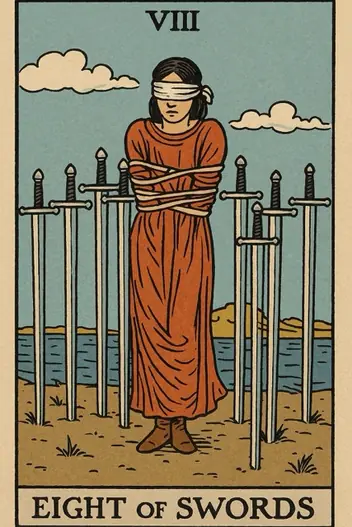
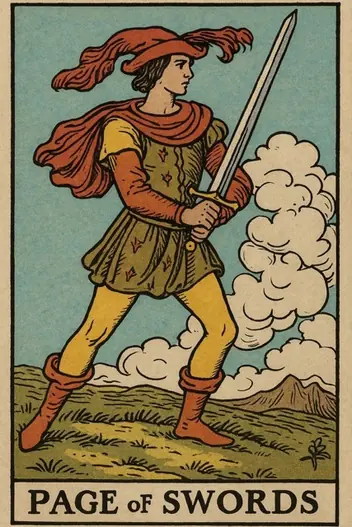
When the Eight of Swords—a card of mental paralysis, self-imposed restrictions, and victimhood—collides with the Page of Swords—a card of curiosity, logic, and sharp communication—the result is a powerful psychological tension. You feel trapped, yet the tools to escape are already in your hands. This combination represents a pivotal moment where analysis paralysis meets the spark of intellectual breakthrough. It’s the mind tying itself in knots, then suddenly glimpsing the scissors needed to cut the rope.
This pairing often appears when you are stuck in a loop of overthinking, but a new idea or a blunt question from someone else is poised to break the spell. The Page of Swords is the voice of reason—or the uncomfortable truth—that can dismantle the illusion of helplessness created by the Eight. The key is to distinguish between real constraints and the stories you’ve told yourself.
Eight of Swords and Page of Swords Card Meaning Explained
The core dynamic here is a battle between perceived limitation and nascent intellectual power. The Eight of Swords represents a state of learned helplessness: you feel bound by circumstances, blinded by fear, and unable to see the obvious path forward. Psychologically, this is the cognitive distortion of catastrophizing—believing the worst-case scenario is inevitable. In contrast, the Page of Swords is the archetype of the detached observer—the part of your mind that can step back, analyze the situation coldly, and ask, “Is this belief actually true?”
When these cards combine, the Page of Swords acts as a reality check. It doesn’t offer emotional comfort; it offers a sharp, logical perspective. You may receive a piece of information—a comment, a fact, or a new idea—that suddenly makes your cage look like a collection of easily moved sticks. The challenge is not to dismiss this insight out of fear. The Page’s energy is quick and sometimes blunt, but it is exactly what you need to stop spinning your wheels. The practical implication is clear: stop waiting for rescue. Start questioning your assumptions with ruthless honesty.
The psychological risk here is that the Page’s logic can also be used to justify the Eight’s paralysis. You might use your sharp mind to construct even more elaborate reasons why you cannot act. This is the shadow of this combination: intellectualizing your fear instead of using intellect to overcome it. The healthy path is to use the Page’s energy to map out the actual boundaries of your situation and then take one small, concrete step toward them.
Your pair is already on the table. Ask your question and draw the clarifying card
or simply focus on it
Eight of Swords and Page of Swords as Feelings
If you are single:
This combination suggests you are overthinking a potential connection. You may feel trapped by past rejections or social anxiety. The Page of Swords urges you to gather objective data rather than inventing stories. Send a direct message or ask a clarifying question. The answer is likely less scary than your imagination.
If you are in a relationship:
There is a communication breakdown fueled by unspoken assumptions. One partner feels silenced or restricted (Eight of Swords), while the other wants to talk things through logically (Page of Swords). The danger is that logic is used to dismiss feelings, or feelings are used to block reason.
In relationships, the Eight of Swords and Page of Swords point to a dynamic of intellectual and emotional gridlock. The Eight partner may feel misunderstood, victimized by the relationship’s rules, or unable to express their needs. The Page partner may become frustrated and resort to cold analysis, listing reasons why the other person “should” feel differently. This is a recipe for resentment unless both sides meet in the middle. The key relationship advice is to use the Page’s clarity to name the specific fear, not to win an argument. For example, instead of saying “You’re overreacting,” the Page energy can say, “I notice you feel trapped. Is it because of my schedule, or is it something else?” This turns a debate into a collaborative problem-solving session. The Eight’s energy requires validation before it can accept a logical solution.
Your unique Tarot reading
See how these cards interact with your destiny. Start a free personal reading now.
Eight of Swords and Page of Swords in Career Readings
Strategic Opportunities:
Identify one specific bottleneck in a current project that you have been avoiding. The Page of Swords gives you the mental clarity to solve it.
Strategic Opportunities:
Gather competitive intelligence. This is an excellent time to research, audit, or fact-check before making a major move. Your curiosity is an asset.
Calculated Risks:
Avoid impulsive decisions based on incomplete data. The Page of Swords can be impatient. Double-check your sources before sending that email or making that investment.
Professionally, this combination signals a moment of mental breakthrough trapped inside a feeling of stagnation. You may feel stuck in a role, a project, or a negotiation (Eight of Swords), but the Page of Swords indicates that the solution lies in asking the right questions. Do not wait for a grand revelation. Instead, schedule a meeting to clarify expectations, review a contract with fresh eyes, or ask a colleague for a blunt opinion. Financially, the Eight warns against paralysis by analysis—do not avoid making a decision because you are afraid of making the wrong one. The Page advises you to take a calculated, small step forward rather than staying frozen. A key financial warning: do not let fear of a bad investment stop you from making a good one. Use the Page’s analytical skills to set clear criteria for risk, then act within those boundaries.
Eight of Swords and Page of Swords Reversed: How to Read It
Eight of Swords Reversed:
The blockage is lifted, but not completely. This is a state where you can already see the way out, but are afraid to take the first step. The Page of Swords in its upright position becomes your ally here, but demands immediate action. Advice: Don't wait for total certainty. Make one small move towards the fear — it will shatter the illusion.
Page of Swords Reversed:
A dangerous combination. Instead of constructive analysis, we get malicious gossip, cynicism, or passive aggression. The Eight of Swords becomes even more toxic in this context, as the fear is now reinforced not by facts, but by distorted, harmful information. Warning: Verify your sources. Those around you may be manipulating you by exploiting your vulnerability.
BOTH Reversed:
Total imbalance. This is a state of deep mental confusion, where you don't know what to believe and cannot distinguish a real threat from an imagined one. Logic (the Page) is distorted, fear (the Eight) is irrational. Remedy: A complete "digital diet" and a refusal to make any important decisions for 48 hours. You need to clear the information noise to hear your own intuition.
Negative Meaning of Eight of Swords and Page of Swords
The shadow of the Eight of Swords and Page of Swords is self-sabotage through clever rationalization. Here, the seeker uses their sharp intellect to justify staying stuck. You might say, “I’ve analyzed every angle, and there’s no way out,” when in truth, you have not considered one new angle. This is the cognitive bias of confirmation bias—you only look for evidence that supports your feeling of helplessness. Another pitfall is using information as a weapon. The Page’s energy can become cruel or dismissive, cutting down others (or yourself) with harsh truths instead of building a path forward. In this shadow state, the combination creates a cycle of anxiety and cynicism: you feel trapped, so you criticize everything, which makes you feel more trapped. The antidote is to use the Page’s curiosity to explore possibilities, not to close them down. Ask: “What if I am wrong about being trapped? What is one small piece of evidence that contradicts my fear?”
Eight of Swords and Page of Swords: The Combined Message
How to use the Eight of Swords to activate the Page? Paradoxically, it is the very awareness of your fear that becomes fuel for analysis. The Eight is not an enemy; it is a signaling system. It shows where your "blind spot" lies. The Page of Swords is the tool to illuminate it. Your task is not to get rid of fear (that is impossible), but to make it an object of study.
The "Rational Unpacking" strategy works like this: take your strongest fear (e.g., "I will fail the project"). Write it down. Now, using the Page's energy, ask yourself three questions: 1) What specific facts confirm this fear? 2) What facts refute it? 3) What can I do in 15 minutes right now to reduce the likelihood of this fear? This process transforms an abstract threat (the Eight) into a concrete task (the Page).
Deep strategic advice:
Do not try to "kill" the Eight of Swords. This will lead to suppression and relapse. Instead, learn to negotiate with it. Use the Page of Swords as a negotiator. Every time you feel cornered, say to yourself: "Stop. This is my Eight. Where is my Page?". This inner dialogue is the only way to turn a mental prison into an observation post. Clarity comes not when fear disappears, but when you stop identifying with it.
Where to Go From Here
The core message of the Eight of Swords and Page of Swords is that your mind is both the prison and the map out of it. You are not as trapped as you feel, and the key to escape is a new, honest perspective. The challenge is to stop overthinking and start observing. Take one concrete step towards clarity today.
While this article gives you the general archetype, the true power of Tarot lies in how these cards apply to your specific situation. What is the exact thought that binds you? What is the precise question you need to ask? The Fortune Cards app can deliver a deep, personalized interpretation of this exact combination for your unique question—right now. Use it on the web or download it to get the clarity you need to cut through the noise and act with confidence.
Interpretation by the Fortune Cards editorial team, based on the Rider–Waite tradition and Jungian archetypes. About our methodology · Updated: 2026-08-26
Other Combinations with Eight of Swords
Other Combinations with Page of Swords
Explore Individual Card Meanings
Table of Contents
- Eight of Swords and Page of Swords Card Meaning Explained
- Eight of Swords and Page of Swords as Feelings
- Eight of Swords and Page of Swords in Career Readings
- Eight of Swords and Page of Swords Reversed: How to Read It
- Negative Meaning of Eight of Swords and Page of Swords
- Eight of Swords and Page of Swords: The Combined Message
- Where to Go From Here
Ready to find answers to your questions?
Start your first reading now and look at your situation with fresh clarity. The cards are ready to reveal deeper meaning.