Eight of Cups and Eight of Swords Together in Tarot
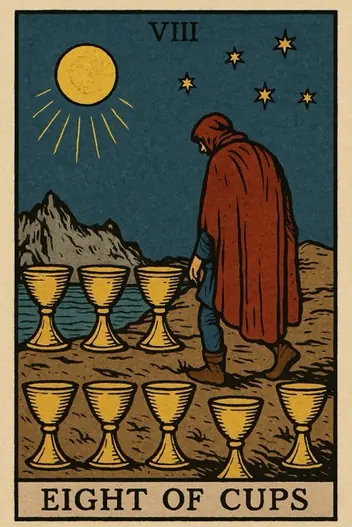
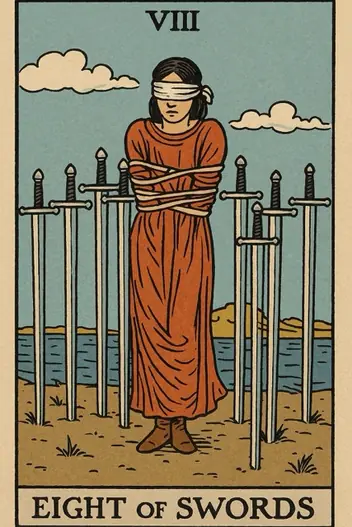
- Arcana
- Eight of Cups — Minor Arcana, Cups; Eight of Swords — Minor Arcana, Swords
- Elements
- Eight of Cups — Water; Eight of Swords — Air
- Elemental interaction
- Neutral elements — energies coexist without conflict
- Numerology
- 8 + 8 = 16 → 7
This combination represents a profound psychological paradox: the simultaneous urge to walk away from a painful situation and the crippling sense of being trapped within it. The Eight of Cups embodies the archetype of the Wanderer—a deliberate, emotionally-driven departure from what no longer serves you. The Eight of Swords embodies the Victim—a state of mental paralysis, self-imposed restrictions, and perceived helplessness. When these cards collide, the seeker is caught in a conflict between the desire for escape and the belief that escape is impossible. This is not a simple crossroads; it is a psychological stalemate where fear and yearning are locked in battle.
The real-world implication is a person who knows, on some level, that they must leave a relationship, job, or mindset, yet feels bound by their own thoughts. The energy of the Cups suggests the emotional cost of staying has become too high, while the Swords indicate the primary obstacle is not external circumstance, but internal narrative. The path forward requires a shift from reactive emotion to strategic self-awareness.
Core Dynamics & Interpretation
The core dynamic here is a cognitive-emotional loop. The Eight of Cups provides the emotional drive to move on—a deep, intuitive knowing that the current situation is draining your spirit. However, the Eight of Swords immediately counters this impulse with a barrage of limiting beliefs: “I can’t leave because I have no money,” “I don’t know where to go,” “I’ll be alone forever.” This creates a state of learned helplessness, where the seeker feels they have no agency, even when options exist.
Psychologically, this is a manifestation of the Shadow—the part of the psyche that prefers the familiar pain of a known prison over the terrifying freedom of an unknown path. The Eight of Cups wants to release the old, but the Eight of Swords ties the hands. The key insight is that the perceived constraints are often self-constructed. The swords represent the sharp, cutting thoughts that keep you in place, while the cups represent the emotional weight you carry. Breaking the loop requires you to first identify the specific belief that is holding you back, then take one small, concrete action toward departure. This is not about a grand escape, but about dismantling the mental cage brick by brick.
The strategic takeaway is that action precedes clarity. You will not feel ready to leave until you begin moving. The Eight of Swords is a warning against overthinking; the Eight of Cups is a call to trust your emotional intelligence. Your mind will not save you from this—only your feet will.
What Do Eight of Cups and Eight of Swords Indicate for Your Career?
Strategic Opportunities:
Identify the specific thought pattern (e.g., “I’m not qualified,” “The market is bad”) that is preventing you from applying for a new job or starting a project. Then, test that belief with one small action (e.g., update your resume, send one networking email).
Strategic Opportunities:
Use the emotional energy of the Eight of Cups to fuel a strategic pivot—not a blind leap. Research industries or roles that align with your deeper values, even if it requires retraining or a pay cut.
Calculated Risks:
Avoid making a major financial decision (quitting without savings, investing in a risky venture) while in this state of mental paralysis. The Eight of Swords warns against impulsive actions driven by desperation.
In a career context, this combination is a red flag for burnout and misaligned work. You likely feel overqualified and undervalued, yet fear of the unknown keeps you glued to your desk. The Eight of Cups says your emotional energy is being depleted—you are not just bored, you are fundamentally misaligned with your role or company culture. The Eight of Swords says your mental narrative is the primary barrier to change. A practical first step is to conduct a “cost-benefit analysis” of staying versus leaving, but do it on paper, not in your head. Write down what you fear losing, and then ask: “Is this fear realistic, or is it a story I’ve been telling myself?”
Bold important financial warning:
Do not let your fear of financial instability trap you in a job that destroys your spirit. While you should not quit without a plan, recognize that staying indefinitely is also a financial risk—it risks your health, your reputation, and your future earning potential. The most strategic move is to create an exit timeline (e.g., 3-6 months) and use that time to build skills, save money, and network.
Your pair is already on the table. Ask your question and draw the clarifying card
or simply focus on it
What Do Eight of Cups and Eight of Swords Say About Love?
If you are single:
This combination suggests you are attracted to unavailable or emotionally distant partners, or you are staying in a dating pattern that feels safe but unfulfilling. The real barrier is your fear of being vulnerable enough to pursue a genuinely healthy connection.
If you are in a relationship:
You or your partner are emotionally checked out but feel unable to leave due to guilt, fear of loneliness, or practical dependencies. The relationship is a ghost town you both still inhabit.
In a relationship reading, this pair signals a crisis of emotional authenticity. One partner (or both) has already made the internal decision to leave, but externalizes the blame—citing circumstances, obligations, or the other person’s flaws—as the reason they cannot go. This creates a toxic stalemate where no one is happy, yet no one acts. The most important relationship advice here is to stop pretending the problem is external. If you feel trapped, own your part in creating that cage. If you feel the urge to walk away, acknowledge it without shame. The healthiest path is either a direct, honest conversation about the need for separation, or a commitment to actively rebuild the emotional connection. Staying silent and resentful is the worst option.
Highlighted key relationship advice:
Do not confuse comfort with commitment. Staying because it’s easier than leaving is not loyalty; it is avoidance. The Eight of Swords is a call to speak your truth, even if it ends the relationship. The Eight of Cups is a call to honor your emotional needs by taking that first step, whether it’s toward reconciliation or release.
What If Eight of Cups or Eight of Swords Appears Reversed?
If the Eight of Cups is Reversed:
Emotional withdrawal is blocked. You may be clinging to the past, refusing to acknowledge that the source has run dry. This is a path to stagnation and depression. Advice: Acknowledge that your need for change is real, and do not ignore the signals of exhaustion.
If the Eight of Swords is Reversed:
This is a breakthrough. Mental blocks are weakening, fear is receding, and clarity is emerging. You are beginning to see a way out of the impasse. Warning: Do not confuse awareness with action. You see the door—now you must walk through it.
If BOTH are Reversed:
Complete imbalance. You cannot leave (reversed Cups) and you cannot stay (reversed Swords). This is a state of total stupor. Logical method for correction: An external, rigid framework is needed. Seek out a coach, psychologist, or mentor who will compel you to act. You will not be able to handle this on your own right now.
Ask your specific question
Don't rely on generic meanings. Get a customized reading tailored specifically to your energies.
Eight of Cups and Eight of Swords: Warning Signs
The shadow manifestation of this combination is passive-aggressive martyrdom. The seeker may complain endlessly about their situation but refuse to take any action, subtly blaming others or fate for their misery. This is a form of self-sabotage where the person unconsciously prefers the identity of “the trapped victim” because it absolves them of responsibility. The cognitive bias at play is the sunk cost fallacy—the belief that because you have already invested so much time, emotion, or money, you cannot leave. This is a trap. The past is not a reason to stay; it is data for your decision.
Another pitfall is impulsive, poorly planned departure. The Eight of Cups can act on pure emotion, while the Eight of Swords’ paralysis can suddenly flip into reckless action. The seeker might quit their job without savings or end a relationship without a conversation, only to later regret the chaos they created. The shadow here is not just staying too long, but leaving in a way that burns bridges. The mature path is to acknowledge the emotional need to leave, but execute the departure with strategic discipline.
Synthesis: Strategic Conclusion
How to use the energy of the Eight of Cups (the desire to leave) to balance the Eight of Swords (the fear of movement)? The answer is paradoxical: you must accept the fact that you have already left. You have already made the decision on an emotional level. The Eight of Cups is a completed process. Your soul has already departed this place. The problem is that your mind (the Eight of Swords) refuses to synchronize with this decision.
Your strategic task is to make the mind catch up with the feelings. To do this, stop asking yourself "to leave or not to leave?". The question is already resolved. Ask: "How do I leave with minimal losses? How do I survive this transition?" Shift your focus from choice to planning. As soon as you begin to calculate the logistics of departure (Swords in service to Cups), the illusion of hopelessness will dissipate. A deep strategic piece of advice: do not try to conquer fear. Accept it as the price for freedom. Fear is not a "stop" sign; it is a "caution" sign. Move forward.
Your Next Step: Personal Context Matters
The core message of Eight Of Cups and Eight Of Swords is this: You are not as trapped as you think you are, but you must act to prove it to yourself. The prison is mental, the exit is emotional, and the key is a single, deliberate step. Your next move is not to find the perfect solution, but to challenge the belief that you have no options.
To truly understand how this energy applies to your specific situation—your relationship, your career, your personal crossroads—you need a personalized reading. While this analysis gives you the archetypal framework, the real power comes from applying it to your unique context. Use the Fortune Cards app on the web or download it now. Ask for a deep, personalized interpretation of this exact combination for your specific question. Get the clarity you need to break your own cage and take that first step.
Interpretation by the Fortune Cards editorial team, based on the Rider–Waite tradition and Jungian archetypes. About our methodology · Updated: 2026-08-26
Other Combinations with Eight of Cups
Other Combinations with Eight of Swords
Explore Individual Card Meanings
Table of Contents
- Core Dynamics & Interpretation
- What Do Eight of Cups and Eight of Swords Indicate for Your Career?
- What Do Eight of Cups and Eight of Swords Say About Love?
- What If Eight of Cups or Eight of Swords Appears Reversed?
- Eight of Cups and Eight of Swords: Warning Signs
- Synthesis: Strategic Conclusion
- Your Next Step: Personal Context Matters
Ready to find answers to your questions?
Start your first reading now and look at your situation with fresh clarity. The cards are ready to reveal deeper meaning.