Love Tarot: Knight of Wands and Eight of Swords
- Arcana
- Knight of Wands — Minor Arcana, Wands; Eight of Swords — Minor Arcana, Swords
- Elements
- Knight of Wands — Fire; Eight of Swords — Air
- Elemental interaction
- Friendly elements — energies support each other
- Numerology
- 12 + 8 = 20 → 2
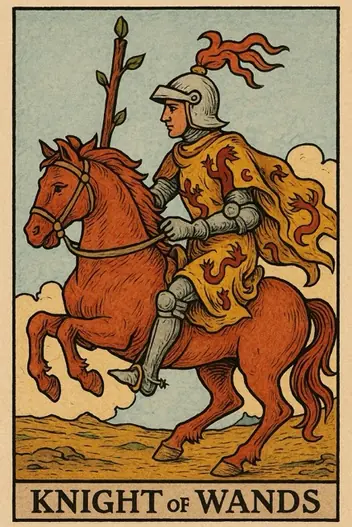
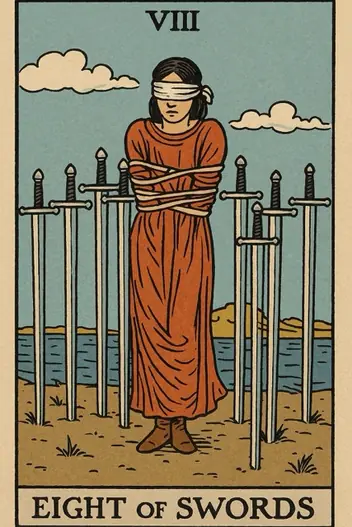
When the fiery, forward-charging energy of the Knight Of Wands meets the restrictive, self-imposed prison of the Eight Of Swords, you are looking at a classic psychological conflict: the desire for action versus the paralysis of fear. The Knight represents raw ambition, adventurous spirit, and a compulsive need to break free from stagnation. The Eight of Swords represents a mental trap—a state of being blindfolded by negative beliefs, surrounded by perceived threats that are largely of your own making. In real life, this combination often describes a person who has a brilliant idea or a burning passion but feels completely blocked by their own anxiety, indecision, or a lack of clear information. The result is a frustrating standstill where the engine is revving, but the brakes are locked.
This pairing forces a pragmatic question: Is the obstacle real, or is it a product of your own cognitive distortions? The Knight’s impulsive nature wants to charge forward blindly, which could lead to a painful crash. The Eight of Swords warns that you might be overthinking yourself into a corner. The key insight here is that the real battle is not external—it is internal. The path forward requires you to first remove the blindfold (identify your limiting beliefs) before you can harness the Knight’s fire productively. Without this conscious step, you risk either reckless action or complete paralysis.
Core Dynamics & Interpretation
The psychological state created by the Knight of Wands and Eight of Swords is one of high energy trapped in a low-clarity environment. The Knight’s archetype is the explorer, the entrepreneur, the person who acts on impulse and intuition. The Eight of Swords is the archetype of the victim, the overthinker, the person who feels helpless. When these collide, the seeker experiences a powerful internal tension: they feel a strong urge to move, to start a new project, or to express their passion, but they are simultaneously overwhelmed by a sense of being blocked. This is not a physical blockage but a mental construct—a web of “what ifs,” past failures, and self-critical narratives.
Practically, this manifests as procrastination with a twist of anxiety. You might find yourself constantly planning, researching, or talking about a big change but never actually executing it. The Knight’s fire is being suffocated by the Eight of Swords’ fog. The most important takeaway is that the swords are not real weapons; they are thoughts. The blindfold is a symbol of willful ignorance or a refusal to see the situation clearly. To move forward, you must first acknowledge that your perception of the problem is distorted. Action is needed, but not impulsive action. The strategic move is to use the Knight’s energy to cut through the mental fog, not to charge at it blindly. This requires a disciplined pause: list your perceived obstacles, question their validity, and then take one small, deliberate step forward.
What Do Knight of Wands and Eight of Swords Indicate for Your Career?
Strategic Opportunities:
Leverage your passion to break through analysis paralysis. If you have a business idea or a career change in mind, stop overthinking and start with a small, low-risk experiment. The Knight’s fire is best used for prototyping, not grand launches.
Strategic Opportunities:
Use your frustration as a signal. If you feel stuck, it is a clear sign that your current role or strategy is not aligned with your core values. This combination often precedes a necessary, if uncomfortable, professional pivot.
Calculated Risks:
Avoid making major financial commitments while in a state of anxiety. The Eight of Swords can distort your risk assessment. Do not quit your job or invest heavily until you have concrete data, not just gut feelings.
Professionally, this card pair is a warning against impulsive career moves born from frustration. You may feel trapped in a dead-end job or a failing project, and the Knight of Wands urges you to quit immediately. However, the Eight of Swords advises caution: your perception of the situation may be more negative than reality. The best strategy is to channel the Knight’s energy into exploration, not escape. Use your passion to network, learn a new skill, or pitch a creative idea within your current role. Financially, this is a time for liquidity, not leverage. Avoid taking on new debt or making speculative investments. The Eight of Swords indicates a need for clarity before commitment. A practical tip: spend one week gathering objective data about your career options before making any decision. This bridges the gap between impulsive action and paralyzing fear.
Your pair is already on the table. Ask your question and draw the clarifying card
or simply focus on it
Love and Relationships
If you are single:
This combination suggests you may be attracted to passionate, exciting individuals but are holding back due to fear of rejection or past emotional wounds. Your biggest obstacle is your own self-doubt, not the availability of potential partners.
If you are in a relationship:
You or your partner may be feeling frustrated by a lack of forward momentum in the relationship. One person wants to ignite change or adventure, while the other feels trapped by unspoken rules or insecurities. Open, honest communication is the only way to remove the blindfold.
In relationships, the Knight of Wands and Eight of Swords creates a dynamic of unexpressed passion and silent frustration. The Knight’s desire for novelty and excitement clashes with the Eight of Swords’ atmosphere of restriction and fear. This often manifests as one partner wanting to take the relationship to the next level (moving in, traveling, trying new things) while the other partner feels paralyzed by anxiety, past betrayals, or a fear of losing control. The critical relationship advice here is to avoid blaming each other. The Eight of Swords is not a malicious partner; it is a scared one. If you are the Knight, you must slow down and listen without judgment. If you are the Eight of Swords, you must actively work on identifying which of your fears are real and which are imagined. The path to harmony involves merging passion with psychological safety. Create a space where both partners can express their needs without feeling trapped or rushed.
Your unique Tarot reading
See how these cards interact with your destiny. Start a free personal reading now.
Reversed Knight of Wands and Eight of Swords Explained
Knight of Wands Reversed:
Action energy is blocked or devolves into recklessness. Instead of feeling constrained, you may commit impulsive, destructive acts. Warning: You risk burning bridges that could still be repaired. You need a time-out for reflection.
Eight of Swords Reversed:
This points to internal resistance that you are aware of but not ready to overcome. You see the way out but refuse to take it due to laziness or fear of change. Advice: Acknowledge your responsibility for inaction. This is not a "trap," but your conscious choice.
BOTH reversed:
Complete imbalance. The impulse is destructive, and the restrictions are irrational. Logical way to correct: You need an external support system—a mentor, coach, or psychologist. It is nearly impossible to break out of this cycle of self-sabotage and chaos on your own.
Knight of Wands and Eight of Swords: Warning Signs
The shadow side of this combination is reckless self-sabotage driven by cognitive biases. When the Knight of Wands is blocked by the Eight of Swords, the seeker may act out in irrational ways. They might quit a job in a fit of rage, only to realize they had no safety net. They might end a relationship abruptly because they felt “trapped,” when in reality, they simply failed to communicate their needs. The primary cognitive bias at play here is catastrophizing—the tendency to assume the worst possible outcome. The Knight’s impulsive energy, when combined with this bias, creates a perfect storm for poor judgment. Another pitfall is projection: the seeker may blame their partner, boss, or circumstances for their own internal paralysis. This externalization prevents them from seeing that the real prison is their own mind. The most dangerous behavior is acting on pure emotion without a reality check. If you feel a strong urge to “burn it all down,” pause for 48 hours. The Knight of Wands is a youthful, fiery energy that needs the discipline of a mature strategist.
Synthesis: Strategic Conclusion
How can the energy of the Knight of Wands be used constructively to balance the Eight of Swords? The answer lies in conscious action. Do not try to "turn off" fear—that is impossible. Instead, use the Knight's impulse as fuel for one, single, smallest yet concrete step. For example, if you are afraid to call a client, simply draft a message. If you are afraid to start a project, open the file and write the title.
Deep strategic advice:
Imagine the Eight of Swords is not a wall, but a labyrinth. You have the energy (the Knight) to run, but without a map, you will hit a dead end. Your task is to draw the map. Spend 15 minutes writing down answers to three questions: 1. What exactly am I afraid of? 2. What is the worst that could happen? 3. What is my first step if I stop being afraid? The answers will relieve 80% of the tension.
Key takeaway:
This combination is not a curse, but a point of growth. It shows where your strength (passion) meets your main limitation (fear). Overcoming this conflict will give you not just a result, but a deep sense of self-confidence. Do not wait for the fear to disappear. Act despite it, and you will see that the "swords" were merely shadows.
Applying This to Your Situation
The core message of the Knight of Wands and Eight of Swords is that your greatest obstacle is your own perspective. You have the passion and drive to move forward, but you are currently trapped by your own thoughts. The solution is not to charge blindly, nor to remain frozen—it is to remove the blindfold first, then take calculated action. This combination is a call to develop psychological clarity before pursuing your ambitions.
While this article provides a powerful archetypal analysis, the true meaning for your specific life situation depends on your unique context. To get a deep, personalized interpretation of this exact card combination for your specific question, use the Fortune Cards app. Available on the web or for download, it applies the wisdom of Tarot to your real-life challenges right now. Don’t just read about the cards—let them speak directly to you.
Interpretation by the Fortune Cards editorial team, based on the Rider–Waite tradition and Jungian archetypes. About our methodology · Updated: 2026-09-24
Other Combinations with Knight of Wands
Other Combinations with Eight of Swords
Explore Individual Card Meanings
Table of Contents
Ready to find answers to your questions?
Start your first reading now and look at your situation with fresh clarity. The cards are ready to reveal deeper meaning.