Death and Ten of Pentacles Together in Tarot
- Arcana
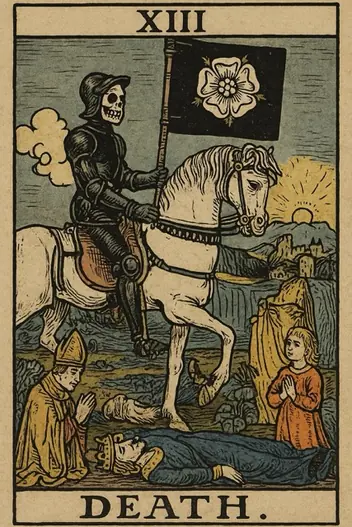
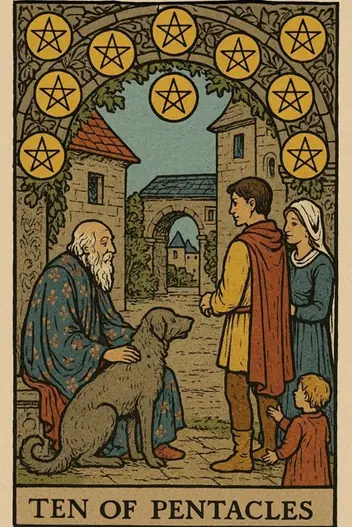
- Death — Major Arcana; Ten of Pentacles — Minor Arcana, Pentacles
- Elements
- Death — Water; Ten of Pentacles — Earth
- Elemental interaction
- Friendly elements — energies support each other
- Numerology
- 13 + 10 = 23 → 5
When the archetype of radical transformation collides with the archetype of material completion, the result is a psychological crucible. The Death card demands you dismantle what no longer serves you, while the Ten of Pentacles insists you honor your inheritance—whether that is family wealth, career status, or long-held beliefs. In practice, this combination signals a necessary rupture with a stable system, often driven by an internal or external crisis that forces you to re-evaluate what is truly worth preserving.
The strategic tension here is profound: you cannot cling to the old structure while trying to evolve. The Ten of Pentacles represents the comfort of established security, but Death warns that this comfort has become a cage. The key psychological insight is that letting go of a legacy—or a version of yourself tied to it—is not a loss, but a prerequisite for creating something more authentic and enduring.
Death and Ten of Pentacles Combination Meaning
The core dynamic of Death and Ten of Pentacles is a crisis of value. You are likely facing a situation where a long-standing system—a job, a relationship, a family tradition, or a financial plan—is reaching its natural end. Psychologically, this triggers a grief response for the security and identity that structure provided. The mind will resist, rationalizing that the status quo is "good enough" or "too risky to change." Cognitive dissonance peaks here: you know change is necessary, but the fear of losing your foundation is paralyzing.
The healthy resolution requires strategic detachment. You must objectively assess what parts of your legacy are worth carrying forward and which are dead weight. This is not about burning bridges impulsively; it is about systematic deconstruction. For example, in a family business, this might mean selling a failing division to preserve the core. In a relationship, it might mean ending a comfortable partnership that has no emotional growth. The Death card ensures that the end is final, but the Ten of Pentacles ensures that the value you extract from the experience becomes a new foundation.
The psychological state created is one of calculated mourning. You are allowed to feel the loss of the old, but you must simultaneously scan for the hidden assets—skills, relationships, resilience—that your past structure has cultivated. This is the Jungian process of individuation: sacrificing the persona tied to the legacy to discover the authentic self beneath. The reward is not immediate happiness, but a deeper, more resilient sense of purpose that is not dependent on external validation.
Career Meaning of Death and Ten of Pentacles
Strategic Opportunities:
Reinvent your career by leveraging your existing network and expertise. The Ten of Pentacles provides a safety net of skills and contacts; Death allows you to pivot into a new industry or role that aligns with your current values.
Strategic Opportunities:
Use a financial windfall or inheritance to fund a long-delayed entrepreneurial venture. The combination suggests that old money is best used to create new value, not to preserve a sinking ship.
Calculated Risks:
Avoid clinging to a failing business model, investment, or job title out of a sense of duty or tradition. The biggest risk is inaction—waiting for the crisis to force your hand rather than initiating the change yourself.
In the professional realm, this card pair is a call to audit your portfolio of commitments. You may be holding onto a project, a client, or a role that is consuming resources without yielding growth. The Death card demands you cut the dead weight, while the Ten of Pentacles reminds you to extract maximum value before you walk away. For business owners, this could mean selling a legacy product line to focus on innovation. For employees, it might mean resigning from a stable job to pursue a passion that offers less security but more meaning.
Financially, the warning is against the sunk cost fallacy. Just because you have invested years of effort or significant capital into a venture does not mean you should continue. Boldly ask yourself: "If I were starting from scratch today, would I build this same structure?" If the answer is no, the Death card gives you permission to walk away. The Ten of Pentacles ensures you negotiate a fair exit—severance, equity, or a referral—that honors your past contributions. Strategic patience is key: do not rush into a new investment until you have fully settled the old one.
Your pair is already on the table. Ask your question and draw the clarifying card
or simply focus on it
What Do Death and Ten of Pentacles Say About Love?
If you are single:
This combination suggests you are ready to release an old pattern about what you want in a partner. The "perfect" image you inherited from family or past relationships is dead. Focus on building a connection based on shared values, not external markers of success. A new relationship will likely emerge from a period of intentional solitude.
If you are in a relationship:
You and your partner are facing a fundamental restructuring of your shared life. This could mean ending a long-term relationship that has become a hollow routine, or it could mean transforming the structure itself—moving, changing financial arrangements, or redefining roles. Honest, uncomfortable conversations about what each of you truly values are non-negotiable.
In relationships, Death and Ten of Pentacles often appear when family pressure, financial entanglements, or inherited expectations have created a brittle shell around the partnership. The emotional intelligence required here is the ability to distinguish between loyalty to the relationship and loyalty to its outdated form. If you are staying together "for the kids," "for the house," or "because we always have," the Death card is a warning that this foundation is cracking.
The key relationship advice is to treat this as a strategic dissolution, not a personal attack. Use the Ten of Pentacles energy to negotiate a fair and dignified separation of shared resources, or to rebuild the relationship on a new contract that respects both partners' need for growth. If you choose to stay, you must both commit to killing the old scripts—the roles of provider, caretaker, or rebel—and co-author a new, authentic narrative. Boldly prioritize truth over comfort, even if it feels like a loss of security.
Reversed Positions: What Changes?
When one or both cards are reversed, the dynamic becomes distorted, but does not disappear.
Death Reversed + Ten of Pentacles Upright:
This is a situation of blocked crisis. You are aware that the system (family, business) is outdated, but you refuse to acknowledge the need for change out of fear. The result is a slow but steady decay from within. Advice: Do not wait for a "miracle"; begin a controlled dismantling before the process becomes unmanageable.
Death Upright + Ten of Pentacles Reversed:
Here, it is not the structure that is being destroyed, but its foundation—trust and resources. You are ready for change, but the "inheritance" (finances, family support) has proven to be unreliable or illusory. Warning: Do not build plans on what you do not have. Your transformation will take place under conditions of scarcity.
BOTH Reversed:
Complete imbalance. You are clinging to what is already dead (Ten reversed) and afraid to begin something new (Death reversed). This is a state of paralysis. The only way to correct the situation is to consciously provoke a "controlled explosion": resign, break a contract, declare bankruptcy. Any action is better than inaction.
Uncover hidden insights
Let our advanced Tarot system interpret these archetypes specifically for your personal path.
Shadow Side & Pitfalls
The shadow of Death and Ten of Pentacles manifests as rigid attachment to legacy at the cost of personal evolution. You may fall into the cognitive bias of status quo bias, where you overvalue the comfort of the known and underestimate the costs of staying. This leads to a slow, painful erosion of vitality—like a family business that refuses to adapt, or a relationship that suffocates both partners under the weight of "what we built together."
Conversely, the shadow can also appear as reckless destruction. You might misinterpret the Death card as a license to burn bridges impulsively, discarding valuable relationships or assets without a plan. This is self-sabotage disguised as liberation. The Ten of Pentacles energy is meant to ground the transformation, but if you ignore it, you risk ending up with no foundation at all. Poor judgment here looks like quitting a job without a backup, ending a relationship without communication, or liquidating assets in a panic.
Another pitfall is projecting the need for change onto others. You might blame your partner, boss, or family for your stagnation, rather than owning your desire for transformation. This creates a power struggle where everyone loses. The psychological task is to integrate the shadow: acknowledge that you are both the agent of change and the one who fears it. The most dangerous move is to wait for an external crisis to force your hand, rather than initiating the transformation with intention.
Death and Ten of Pentacles Combined Message
Constructive use of this pair requires the courage to acknowledge that the past is no longer an asset, but has become a liability. The energy of Death is not destruction for chaos's sake, but a surgical operation. Your task is to apply it in order to cut away from the Ten of Pentacles everything that prevents it from becoming sustainable under new conditions. This could mean abandoning a family business in favor of your own startup, breaking ties with a partner who is holding you back, or changing a profession that has ceased to bring meaning.
Strategically, you must act as an architect, not a victim. First, conduct an audit: what from your "inheritance" (skills, connections, resources) is a viable core? What is toxic ballast? Then plan the "controlled death" of the old: sell, give away, close, let go. And only then, on the cleared foundation, begin to build a new structure. The key principle: do not try to preserve the form; preserve the function.
This process requires a cool head and a firm will. You cannot change the inevitability of change, but you can choose exactly how it will happen: as a painful collapse or as a conscious reorganization. Trust logic, not emotions, and you will emerge from this crisis not empty-handed, but with a renewed, more solid foundation for the future.
Where to Go From Here
The core message of Death and Ten of Pentacles is that true security comes from the ability to evolve, not from the preservation of the past. You are at a crossroad where letting go of a legacy—whether financial, relational, or psychological—is the only path to creating something that is genuinely yours. The pain of the end is real, but so is the value of the new beginning.
To unlock the full power of this combination for your specific situation, you need context. While this article outlines the archetypal dynamics, the Fortune Cards app provides a deep, personalized interpretation based on your exact question. Whether you are navigating a career pivot, a relationship crisis, or a financial decision, the app analyzes your unique cards and offers actionable, psychologically-informed guidance. Use it on the web or download it now to get the clarity you need to transform your legacy into your greatest strength.
Interpretation by the Fortune Cards editorial team, based on the Rider–Waite tradition and Jungian archetypes. About our methodology · Updated: 2026-08-26
Other Combinations with Death
Other Combinations with Ten of Pentacles
Explore Individual Card Meanings
Ready to find answers to your questions?
Start your first reading now and look at your situation with fresh clarity. The cards are ready to reveal deeper meaning.