Love Tarot: The Hanged Man and Three of Swords
- Arcana
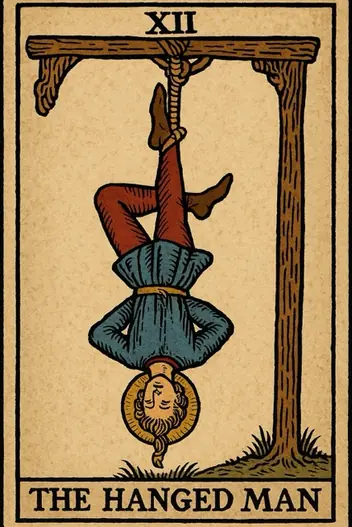
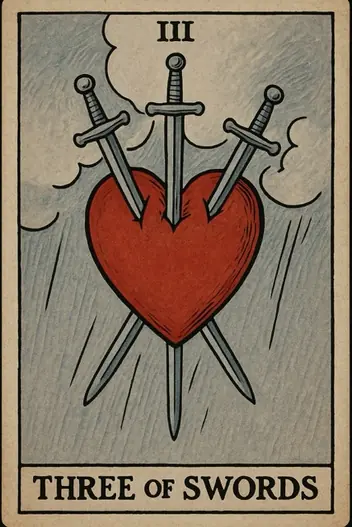
- The Hanged Man — Major Arcana; Three of Swords — Minor Arcana, Swords
- Elements
- The Hanged Man — Water; Three of Swords — Air
- Elemental interaction
- Neutral elements — energies coexist without conflict
- Numerology
- 12 + 3 = 15 → 6
When the Hanged Man—a card of suspension, surrender, and altered perspective—meets the Three of Swords—a card of heartbreak, betrayal, and piercing truth—the result is a psychological crossroads. You are not simply waiting; you are waiting while wounded. This combination suggests a period where forced stillness collides with emotional pain, creating an opportunity to reframe your suffering as data rather than destiny. In Jungian terms, this is the moment when the ego must sacrifice its attachment to a narrative that is no longer true, allowing the Self to integrate a difficult reality.
The strategic implication is clear: you cannot act your way out of this. Any attempt to rush past the pain or rationalize it away will only deepen the wound. Instead, this pairing demands deliberate inaction—a conscious pause to observe the patterns of loss and betrayal without immediate judgment. The key question is not "How do I fix this?" but "What is this pain teaching me about my own blind spots?"
The Hanged Man and Three of Swords Combination Meaning
The core dynamic here is a paradox of agency: you are simultaneously immobilized and acutely aware. The Hanged Man suspends you in time, while the Three of Swords injects a sharp, undeniable truth into that stillness. Psychologically, this mirrors the process of cognitive dissonance—the discomfort of holding two conflicting beliefs (e.g., "I loved them" and "They betrayed me"). The Hanged Man refuses to let you escape this tension, forcing you to sit with the contradiction until a new, more integrated perspective emerges.
This is not a passive suffering; it is active surrender. You must voluntarily let go of the need for immediate resolution, revenge, or closure. The Three of Swords cuts through denial, revealing what you have been avoiding. The Hanged Man then asks you to view that wound from a different angle—perhaps seeing your own role in the dynamic, or recognizing that the pain is a necessary sacrifice of a false self (an identity built on being loved, trusted, or secure). The real work is separating the objective event from the subjective story you tell about it.
In practical terms, this combination often appears when you are stuck in a loop of rumination—replaying the hurt without gaining insight. The Hanged Man breaks that loop by demanding you stop trying to "figure it out" through logic alone. Instead, you must observe your emotions as phenomena, not as commands. This creates space for a paradigm shift: the betrayal you experienced may actually be a liberation from a relationship or job that was already deadening your soul.
Your pair is already on the table. Ask your question and draw the clarifying card
or simply focus on it
What Do The Hanged Man and Three of Swords Indicate for Your Career?
Strategic Opportunities:
Use the pause to audit your professional network for toxic alliances. A difficult conversation about a broken partnership or unfair contract may be overdue.
Strategic Opportunities:
This is an ideal time to re-evaluate your career narrative. The pain of a missed promotion or project failure can reveal what you actually value versus what you were conditioned to chase.
Calculated Risks:
Do not make financial decisions while emotionally raw. The Three of Swords skews judgment toward pessimism; the Hanged Man can trap you in indecision. Wait until the initial shock subsides.
In career contexts, this combination often appears when you are stuck in a role that feels like a sacrifice (overwork, low recognition, ethical compromise) while also facing a painful professional setback—a layoff, a client loss, or a public failure. The Hanged Man says: stop fighting the suspension. You may need to accept a temporary demotion, a sabbatical, or a lateral move to gain the perspective needed for a smarter long-term strategy.
Financially, the warning is clear: do not use money to medicate emotional pain. The Three of Swords can trigger impulsive spending (retail therapy) or reckless investments (trying to "win back" losses). The Hanged Man advises a 90-day freeze on major financial decisions. Instead, use this period to renegotiate terms with creditors, restructure debt, or simply observe your spending patterns without judgment. The most strategic move is to treat this as a forced reset, not a catastrophe.
The Hanged Man and Three of Swords in Love Tarot
If you are single:
This pair warns against rushing into a new connection to numb the pain of a past wound. Use this time to grieve openly, not to seek validation. The right partner will meet you when you are no longer trying to escape yourself.
If you are in a relationship:
A painful truth is surfacing—perhaps infidelity, unmet needs, or fundamental incompatibility. Do not suppress the conversation. The Hanged Man advises pausing before reacting, but the Three of Swords demands honesty. A temporary separation or structured dialogue may be necessary.
In relationships, this combination signals a crisis of trust. The Three of Swords represents the sharp word, the secret revealed, or the heartbreak that cannot be undone. The Hanged Man, however, offers a radical reframe: this pain is the price of authenticity. If you are in a partnership, the betrayal may be a symptom of a deeper imbalance—perhaps one partner has been sacrificing too much of themselves (the Hanged Man's shadow) while the other has been detached (the Three of Swords' cold logic). The key advice is to stop blaming and start observing the system dynamics. What pattern of sacrifice and wounding have you both co-created?
For singles, this combination is a call to integrate your past heartbreaks before projecting them onto a new person. The Hanged Man's suspension is not punishment; it is a laboratory for emotional intelligence. Use this time to journal about the recurring themes in your romantic history. Bold your commitment to not repeat the same mistakes by understanding the psychological blueprint of your previous relationships.
Uncover hidden insights
Let our advanced Tarot system interpret these archetypes specifically for your personal path.
The Hanged Man and Three of Swords: Warning Signs
The shadow of this combination is masochistic paralysis—using the Hanged Man's suspension as an excuse to wallow in the Three of Swords' pain. You may unconsciously romanticize your suffering, believing that enduring it makes you noble or that the "right" outcome will reward your patience. This is a cognitive bias called effort justification: the longer you suffer, the more you convince yourself the sacrifice was meaningful, even when it is not.
Another pitfall is projecting the wound outward. Instead of sitting with the pain, you may blame a colleague, partner, or system, thereby avoiding the Hanged Man's true lesson: your perspective is the only thing you can change. If you refuse to shift your vantage point, the Three of Swords will keep stabbing you with the same truth until you learn to see it differently. Watch for signs of passive-aggression or silent treatment—these are distortions of the Hanged Man's stillness, weaponized to control others rather than heal yourself.
Finally, there is a risk of premature forgiveness. The Three of Swords demands acknowledgment of the wound, but the Hanged Man's energy can trick you into "letting go" before you have fully processed the betrayal. This leads to repressed resentment that will resurface later. True integration requires you to feel the pain fully, not transcend it prematurely.
Reversed Positions: What Changes?
Reversed cards shift the dynamic from "active patience" to "resistance to change."
The Hanged Man Reversed:
This is blocked potential and recklessness. You are no longer enduring, but you are also not seeking a way out. You are simply refusing to look at the situation from a different angle. You are stuck in an old pattern, but no longer willing to pay the price for it. Advice: force a pause. Go on vacation or take a time-out. Your refusal of sacrifice must be conscious, not impulsive.
Three of Swords Reversed:
This is internal resistance to pain and weakness. The trauma has already occurred, but you refuse to acknowledge it. You deny your feelings, pretending that "everything is fine." This is a path to psychosomatics and depression. Advice: give yourself the right to feel the pain. Live through it. Write a letter to the person who hurt you (don't send it), cry, see a psychologist. Suppressed pain does not disappear—it destroys you from within.
BOTH Reversed:
Complete imbalance. You are simultaneously enduring and denying the pain. This is a state of total stagnation and apathy. You can neither change the situation nor accept it. Method of correction: radical external intervention. You need a harsh external stimulus—getting fired, a breakup, moving away. Do the thing you fear most. Destroy the system that holds you. Only through chaos can you find a new foothold.
Synthesis: Strategic Conclusion
How can the energy of The Hanged Man be used constructively to balance the Three of Swords? Transform passive suffering into active observation. The Hanged Man grants you a unique ability—to see the world from a different angle. Use this to diagnose the source of pain, rather than merely enduring it.
Your strategy is one of "controlled sacrifice." Determine what you are willing to relinquish to be free of the pain. For example: "I am willing to sacrifice my ambitions on this project to preserve my mental health." Or: "I am willing to sever communication with this person to stop suffering." The sacrifice must be a tool, not a goal.
In this context, the Three of Swords becomes a catalyst for surgical intervention. It reveals precisely what needs to be "cut away": toxic connections, false beliefs, outdated goals. Do not try to "heal" the pain—use it as a scalpel. Ask yourself: "What exactly in this situation is causing me pain?" and "Can I change this, or must I remove it?"
A deep strategic counsel: learn to distinguish between "growing pains" and "destructive pains." The former is the discomfort of leaving your comfort zone (The Hanged Man). The latter is a signal that the system is breaking down (Three of Swords). If you feel betrayed or devalued—that is destruction. Leave. If you feel insecurity before a new challenge—that is growth. Stay. Your task is not to avoid pain, but to choose which pain to endure. Make this choice consciously.
Where to Go From Here
The Hanged Man and Three of Swords together are not a curse; they are a surgical pause. The message is clear: you must stop, feel the cut, and then choose to see the wound not as a weakness but as a window into a more authentic path. Whether in love, career, or self-growth, the antidote is active surrender—a deliberate, conscious decision to hold the pain without being consumed by it. The next chapter begins when you stop fighting the suspension and start learning from the stillness.
Your unique situation demands a tailored interpretation. While this article outlines the general archetype, the true power of Tarot lies in applying these insights to your specific question. The Fortune Cards app allows you to input your exact context—relationship status, career dilemma, or personal block—and receive a deep, personalized reading of this exact combination. Use it on the web or download it now to transform this painful pause into your most strategic breakthrough.
Interpretation by the Fortune Cards editorial team, based on the Rider–Waite tradition and Jungian archetypes. About our methodology · Updated: 2026-08-26
Other Combinations with The Hanged Man
Other Combinations with Three of Swords
Explore Individual Card Meanings
Table of Contents
- The Hanged Man and Three of Swords Combination Meaning
- What Do The Hanged Man and Three of Swords Indicate for Your Career?
- The Hanged Man and Three of Swords in Love Tarot
- The Hanged Man and Three of Swords: Warning Signs
- Reversed Positions: What Changes?
- Synthesis: Strategic Conclusion
- Where to Go From Here
Ready to find answers to your questions?
Start your first reading now and look at your situation with fresh clarity. The cards are ready to reveal deeper meaning.