Love Tarot: Three of Swords and Knight of Swords
- Arcana
- Three of Swords — Minor Arcana, Swords; Knight of Swords — Minor Arcana, Swords
- Elements
- Three of Swords — Air; Knight of Swords — Air
- Elemental interaction
- Same element — energies intensify each other
- Numerology
- 3 + 12 = 15 → 6
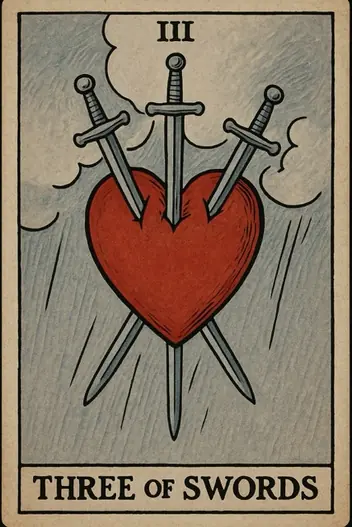
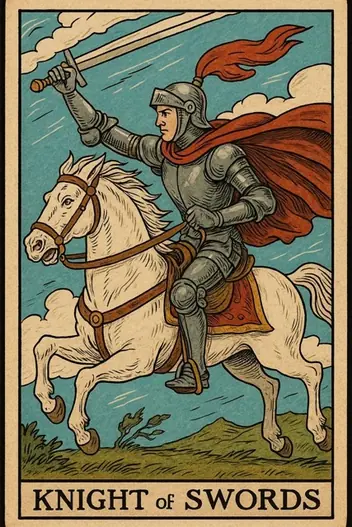
When the Three of Swords—the card of heartbreak, piercing truth, and emotional wounding—meets the Knight of Swords—the archetype of swift, intellectual action and blunt communication—we get a potent mix of emotional pain fueled by cognitive speed. This is not a gentle pairing. It represents the moment a painful realization hits you like a lightning bolt, or when you charge headfirst into a conflict armed with a cutting truth.
Psychologically, this combination activates the Jungian shadow of the "Wounded Thinker." The Knight’s relentless drive for clarity collides with the Three’s raw vulnerability. The result is a high-stakes scenario where intellect overrides emotional safety, and the seeker may speak or act before processing the grief. In practical terms, this is the energy of a breakup text sent in anger, a harsh performance review delivered without empathy, or a sudden, painful insight that forces you to restructure your worldview. The core dynamic is truth at the cost of peace.
Core Dynamics & Interpretation
The Three of Swords represents a cognitive dissonance—the painful gap between what you believed to be true and what reality has now forced you to see. It is a state of emotional hemorrhage, where the mind replays past hurts. The Knight of Swords is the opposite: it is pure forward momentum, driven by logic and a desire to cut through deception. When these cards merge, the Knight’s energy acts as a catalyst for the Three’s pain. The wound is not allowed to fester in silence; it is forced into the open, often through a direct confrontation or a sudden decision.
This combination demands urgent emotional triage. The Knight’s impulsivity can make the Three’s pain worse if the seeker acts without reflection. The key psychological insight is that this pairing is not about avoiding pain, but about using it as fuel for decisive action. The seeker must ask: "Is this truth I am about to speak necessary, or is it just weaponized hurt?" The healthy path involves channeling the Knight’s clarity into a structured, honest conversation, rather than a verbal sword fight. The shadow path is a self-righteous charge into conflict, leaving emotional wreckage behind.
Your pair is already on the table. Ask your question and draw the clarifying card
or simply focus on it
What Do Three of Swords and Knight of Swords Indicate for Your Career?
Strategic Opportunities:
Cutting a dead-end project or partnership to free up resources for a more aligned opportunity.
Strategic Opportunities:
Conducting a brutally honest performance review that leads to a necessary role change or exit strategy.
Calculated Risks:
Avoid making a sudden career change based on a single painful event (e.g., one bad meeting). Do not send a resignation letter in anger.
In a professional context, this pairing signals a moment of critical decision-making under emotional duress. The Knight of Swords provides the mental clarity to see a structural flaw in a business plan or a toxic team dynamic, while the Three of Swords represents the emotional cost of ignoring it. The strategic move is to use the pain as data, not as a driver. For example, if you feel betrayed by a colleague, this combination does not advise a dramatic confrontation. Instead, it recommends a cool-headed, documented exit strategy or a formal complaint filed with clear evidence. Financially, beware of impulsive investments made to "prove" something after a loss. The best financial advice from these cards is to take a 48-hour pause before any major money move, allowing the initial sting of the pain to subside before the Knight’s sword swings.
Uncover hidden insights
Let our advanced Tarot system interpret these archetypes specifically for your personal path.
Love and Relationships
If you are single:
This combination suggests you may be attracted to someone who is intellectually stimulating but emotionally unavailable. A recent heartbreak is likely being analyzed to death, rather than felt and healed. Your next step is to pause the mental autopsy and practice somatic self-care.
If you are in a relationship:
A painful truth will be spoken or heard in the near future. The dynamic is one of one partner acting as the "prosecutor" while the other feels wounded. Avoid using logic to dismiss your partner's feelings.
In a relationship reading, the Three of Swords and Knight of Swords points to a communication crisis driven by unprocessed hurt. The Knight’s energy can manifest as verbal aggression or a cold, analytical dismissal of a partner’s emotional pain. The most dangerous pitfall is believing that "winning the argument" is the same as resolving the issue. Instead, this pair calls for radical honesty with a structured boundary: speak your truth, but do so with the explicit goal of healing, not harming. Use "I" statements to own your pain, rather than "you" statements to assign blame. If you are single, this combination warns against romanticizing a "brutally honest" partner who may simply lack emotional intelligence. Seek someone who can be direct and compassionate.
Three of Swords and Knight of Swords: Warning Signs
The shadow of this combination is a cognitive bias called "emotional reasoning" —believing that because you feel hurt, your harsh reaction is justified. The Knight of Swords, in its shadow form, becomes a bully armed with facts, using truth as a weapon to inflict further pain. The seeker may confuse speed with wisdom, acting on the first painful insight without considering long-term consequences. Another common pitfall is intellectualizing the wound—analyzing the betrayal to avoid actually feeling the grief. This leads to a cycle of rumination and impulsive action, where the seeker swings between obsessive thinking and rash decisions. The most dangerous outcome is a self-fulfilling prophecy of isolation, where the seeker’s harsh words drive away the very people they need for support.
What If Three of Swords or Knight of Swords Appears Reversed?
The reversed Three of Swords often indicates that pain is being denied or repressed. Instead of acknowledging a loss, the person pretends that "everything is fine." Paired with the Knight of Swords, this creates a dangerous combination: a rational attack without an emotional foundation. You will argue, prove, and fight, not for the sake of a result, but for the process itself. Advice: admit that you are in pain. This is not weakness, but a necessary condition for a precise strike.
The reversed Knight of Swords points to internal resistance and passive aggression. Instead of direct conflict, the person uses caustic remarks, sarcasm, or "forgetting" important details. Paired with the upright Three of Swords, this creates a toxic atmosphere where pain accumulates but finds no outlet. Warning: if you feel the urge to "sting" your partner rather than talk to them, you are in a trap.
If both cards are reversed, we see a complete imbalance. The person is in a state of chronic neurosis: they can neither process the pain (Three reversed) nor express it constructively (Knight reversed). Method for correction: a temporary "moratorium on decisions." For one week, forbid yourself from any important conversations or financial actions. Focus on physical practices (sports, breathing) to "ground" the psyche, rather than on intellectual analysis.
Three of Swords and Knight of Swords Combined Message
How to constructively use the energy of this combination? The key lies in directing the vector of attack. The Three of Swords tells you: "This is where it hurts." The Knight of Swords says: "This is what you must strike." Most people mistakenly direct the blow outward—at their partner, boss, or competitor. The strategic genius of this combination is to aim the blade at the problem itself, not at its bearer.
Imagine the Three of Swords as a diagnosis (inflammation) and the Knight of Swords as a scalpel. Your task is not to hack at the patient (the person or project), but to remove the tumor (the specific cause of the pain). A profound piece of advice: formulate your pain as a clear request. Instead of "I'm hurt because he deceived me" (Three), say: "I demand transparency in the following three points of the report" (Knight). Translate emotional trauma into an action protocol.
This union of cards is an instrument for "surgery on reality." It grants you the unique ability to see truth in its most unflattering form and act with terrifying resolve. But remember: a surgeon who operates without anesthesia and antiseptic is a sadist. Your mind is the scalpel, but your capacity for empathy and patience is the anesthesia and the sutures. Use both energies not merely to cut the knot, but to untie it, preserving the integrity of the system.
Where to Go From Here
The Three of Swords and Knight of Swords is a wake-up call delivered at high speed. It asks you to sit with the pain before you act on the insight. The core message is: truth without compassion is cruelty, and action without reflection is chaos. Your next step is to pause, breathe, and ask yourself: "Am I speaking from a healed place, or from a wound that is still bleeding?"
While this article provides the general archetype, the true magic happens when Tarot is applied to your unique situation. The Fortune Cards app can give you a deep, personalized interpretation of this exact combination for your specific question right now. Whether you use it on the web or download it, you’ll get tailored advice that accounts for your relationship history, career context, and emotional state. Don’t guess—get clarity. Use Fortune Cards today.
Interpretation by the Fortune Cards editorial team, based on the Rider–Waite tradition and Jungian archetypes. About our methodology · Updated: 2026-08-26
Other Combinations with Three of Swords
Other Combinations with Knight of Swords
Explore Individual Card Meanings
Table of Contents
- Core Dynamics & Interpretation
- What Do Three of Swords and Knight of Swords Indicate for Your Career?
- Love and Relationships
- Three of Swords and Knight of Swords: Warning Signs
- What If Three of Swords or Knight of Swords Appears Reversed?
- Three of Swords and Knight of Swords Combined Message
- Where to Go From Here
Ready to find answers to your questions?
Start your first reading now and look at your situation with fresh clarity. The cards are ready to reveal deeper meaning.