Two of Pentacles & Page of Pentacles in Tarot: Combined Meaning and Advice
- Arcana
- Two of Pentacles — Minor Arcana, Pentacles; Page of Pentacles — Minor Arcana, Pentacles
- Elements
- Two of Pentacles — Earth; Page of Pentacles — Earth
- Elemental interaction
- Same element — energies intensify each other
- Numerology
- 2 + 11 = 13 → 4
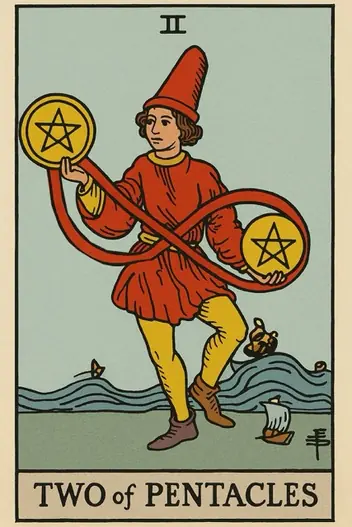
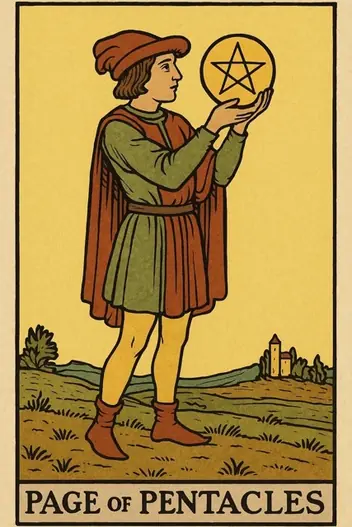
When the Two of Pentacles meets the Page of Pentacles, you are facing a psychological tension between maintaining stability and embracing a new learning curve. The Two represents your current responsibilities, cash flow, and the delicate balancing act of daily life. The Page is the archetype of the curious student, eager to start a new project, study a skill, or invest in a fresh venture. The collision of these energies creates a pragmatic dilemma: how do you learn something new without destabilizing what you’ve already built?
This combination often appears when you are considering taking on a side hustle, a part-time course, or a new financial commitment while already juggling a full plate. It is not a card of crisis, but of calculated multitasking. The key insight here is that the Page’s enthusiasm must be tempered by the Two’s demand for rhythm and adaptability. You can expand, but only if you are willing to adjust your schedule and priorities without abandoning your core obligations.
Two of Pentacles and Page of Pentacles: How These Energies Interact
The psychological state created by the Two of Pentacles and Page of Pentacles is one of adaptive learning under pressure. You are not overwhelmed yet, but you are on the edge of it. The seeker in this energy is likely someone who feels a pull to upgrade their skills or income streams, but who also has existing commitments—work, family, bills—that require constant attention. The core dynamic is risk management through flexibility: you must be willing to pivot quickly if one area demands more time than anticipated.
This pairing highlights a cognitive bias toward optimism—the Page wants to dive in, but the Two warns that you only have two hands. The most important insight is that success here depends on your ability to prioritize ruthlessly. You cannot do everything at once. Instead, you must choose one new initiative and integrate it into your current routine in small, sustainable increments. Think of it as a pilot project, not a full-scale launch. The psychological payoff is growth without burnout, but only if you maintain a feedback loop: check in weekly to see if your balance is holding.
In real-world terms, this card combination often shows up when you are considering a career pivot, starting a small business on the side, or taking an online certification while working full-time. The message is clear: you can learn and earn simultaneously, but you must treat your time and energy as finite resources. The Two of Pentacles represents the juggling act itself, while the Page is the new ball you are trying to add. The trick is to toss it gently and catch it without dropping the others.
Ask your question and flip the cards
or simply focus on it
What Do Two of Pentacles and Page of Pentacles Say About Love?
If you are single:
This combination suggests you may be attracted to someone who is ambitious but scattered—perhaps a person with multiple projects or a busy lifestyle. Focus on whether they can make space for you amidst their juggling act, or if you will always be competing for their attention.
If you are in a relationship:
You and your partner may be in a phase of learning something new together (a financial goal, a shared hobby, or parenting strategy), but watch out for one person feeling like they are doing all the balancing work. Uneven effort can create resentment.
In relationships, the Two of Pentacles and Page of Pentacles points to a dynamic where emotional bandwidth is stretched thin. One or both partners may be preoccupied with personal growth or career moves, leaving less time for nurturing the connection. The psychological challenge here is maintaining intimacy while pursuing individual goals. You need to schedule deliberate quality time, even if it feels forced. The key relationship advice is to communicate your capacity honestly: if you can only give 60% right now, say so, and negotiate what the other 40% looks like. Avoid the trap of assuming your partner knows you’re busy—explicit check-ins prevent misunderstandings.
This combination also warns against using productivity as an emotional shield. If you bury yourself in learning or side projects to avoid addressing relationship issues, the Page’s enthusiasm becomes a form of avoidance. Instead, use the Two’s adaptability to shift your focus: one week prioritize work, the next week prioritize your partner. Balance is not about equal hours, but about mutual acknowledgment of each other’s needs.
Uncover hidden insights
Let our advanced Tarot system interpret these archetypes specifically for your personal path.
Career and Finances
Strategic Opportunities:
Start a side project or freelance gig that aligns with your long-term career goals, but limit your time investment to 5-10 hours per week initially.
Strategic Opportunities:
Enroll in a short-term certification or workshop that directly enhances your current role, rather than a full degree program that demands heavy commitment.
Calculated Risks:
Avoid taking on new debt to fund this learning or venture. The Page is about small steps, not big loans. Cash-flow disruptions are the primary risk here.
From a career and financial perspective, this combination is a green light for incremental growth, not a reckless leap. The Two of Pentacles reminds you that your current income stream requires active management, so any new venture must be self-funding or low-cost. The Page of Pentacles suggests that the best return on investment comes from applied learning—choose a skill you can immediately use to solve a problem at work or generate a small side income. Bold strategic tip: treat this new initiative as an experiment. Set a 90-day trial period with clear metrics (e.g., “earn $500 extra per month” or “complete one course module per week”). If it works, scale up; if not, pivot without guilt.
Important financial warning:
Do not confuse the Page’s curiosity with the Two’s stability. If you are already struggling to pay bills, this combination does not mean you should take on more. Instead, it suggests optimizing what you already have—learn to negotiate a raise, improve your efficiency at work, or automate your budget before adding a new income stream. The risk here is spreading yourself too thin financially, leading to late fees, overdrafts, or missed opportunities because you were distracted.
Two of Pentacles and Page of Pentacles Reversed: What Changes?
If the Two of Pentacles is reversed:
You have stopped juggling, but not because you have become more efficient, but because you have lost your momentum. This is a state of "frozen chaos" — you cannot choose a priority and are stuck in procrastination. Warning: do not try to "catch up" on what you missed by starting everything over. Instead, reduce the number of tasks to one critical one.
If the Page of Pentacles is reversed:
This is internal resistance to learning. You know what needs to be done, but you sabotage the process. The reason is a fear of imperfection or laziness. Advice: lower the bar. Do not try to become an expert in a week. Take the first, smallest step that will take 15 minutes.
If BOTH are reversed:
Complete imbalance. You are chaotic (reversed Two) and lazy (reversed Page). This is a crisis of life management. The logical way to fix it: introduce a strict external deadline. Find someone who will hold you accountable for results. Without external control, you risk falling into endless planning without action.
What Are the Risks of Two of Pentacles and Page of Pentacles?
The shadow manifestation of this pairing emerges when the seeker overestimates their capacity for multitasking. The cognitive bias at play is the planning fallacy—the tendency to believe you can accomplish more in a given timeframe than is realistic. This leads to burnout, missed deadlines, and shallow learning (where you start many things but finish none). The Page’s enthusiasm becomes scattered, and the Two’s juggling becomes frantic.
Another pitfall is perfectionism disguised as learning. You may delay taking action because you want to “learn enough first,” when in reality the Two of Pentacles demands you adapt on the fly. The shadow side also includes financial impulsivity—buying expensive courses, tools, or equipment before you have a clear plan to use them. Self-sabotage here looks like starting a new project, getting overwhelmed, and then abandoning it, reinforcing a cycle of guilt and procrastination. The antidote is ruthless prioritization: ask yourself, “If I could only do one new thing this month, what would give me the highest return?” Then do only that.
Synthesis: Strategic Conclusion
Constructive use of this energy requires a conscious renunciation of total control. The Two of Pentacles is about trusting the process, while the Page is about trusting yourself. To balance these archetypes, you need to create a "learning ecosystem". Set aside one day a week (e.g., Wednesday) when you completely switch off the "juggler" mode and work solely as a "student". On the remaining days, use the flexibility of the Two, but with one rigid rule: do not start a new task without finishing the previous stage of learning.
Strategic advice: invest in creating templates and checklists. The Two of Pentacles demands speed, and the Page demands precision. Templates are the bridge between them. By creating a structure for routine tasks once, you free up cognitive resources for deep learning. Otherwise, you will be forever reinventing the wheel and wasting energy on context switching. Remember: your goal is not to do everything, but to do the key things with maximum quality. This combination is not a sentence to chaos, but an invitation to the conscious design of your life.
Applying This to Your Situation
The core message of the Two of Pentacles and Page of Pentacles is that growth is possible, but only with disciplined flexibility. You are being asked to add a new skill or venture to your life without dropping your existing responsibilities. The key is to start small, track your progress, and be willing to adjust your schedule weekly. This is not a time for grand gestures—it is a time for steady, intentional expansion.
While this article gives you the general archetype, the true power of Tarot lies in how it applies to your unique situation. The Fortune Cards app allows you to input your specific question—about a relationship, career decision, or personal challenge—and receive a deep, personalized interpretation of this exact card combination. You can use the app on the web or download it now to get clarity on how to balance your current priorities with the new opportunity calling you. Don’t guess—let the cards speak directly to your life.
Interpretation by the Fortune Cards editorial team, based on the Rider–Waite tradition and Jungian archetypes. About our methodology · Updated: 2026-08-01
Other Combinations with Two of Pentacles
Other Combinations with Page of Pentacles
Explore Individual Card Meanings
Table of Contents
- Two of Pentacles and Page of Pentacles: How These Energies Interact
- What Do Two of Pentacles and Page of Pentacles Say About Love?
- Career and Finances
- Two of Pentacles and Page of Pentacles Reversed: What Changes?
- What Are the Risks of Two of Pentacles and Page of Pentacles?
- Synthesis: Strategic Conclusion
- Applying This to Your Situation
Ready to Discover Your Path?
Join thousands of seekers who have found clarity and guidance through our platform. Your cosmic journey awaits.