Two of Pentacles and Six of Pentacles Reversed in Tarot
- Arcana
- Two of Pentacles — Minor Arcana, Pentacles; Six of Pentacles — Minor Arcana, Pentacles
- Elements
- Two of Pentacles — Earth; Six of Pentacles — Earth
- Elemental interaction
- Same element — energies intensify each other
- Numerology
- 2 + 6 = 8
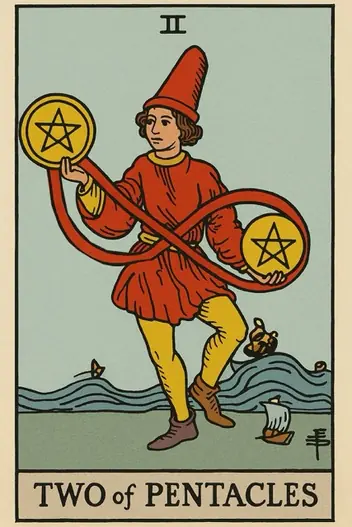
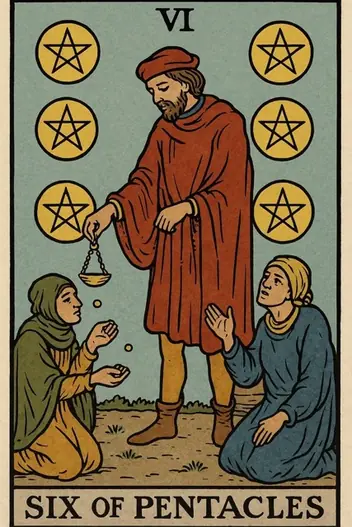
When the Two of Pentacles—the card of juggling priorities, adaptability, and financial flux—meets the Six of Pentacles—the card of charity, reciprocity, and power dynamics in giving—we encounter a powerful tension. This pairing forces a confrontation between your desire to be generous and the objective limits of your time, energy, or money. It asks: Can you maintain equilibrium while extending help to others? The answer lies in strategic self-awareness and boundary-setting.
In practical terms, this combination often appears when you are asked to support someone—emotionally, financially, or professionally—while your own resources are stretched thin. It is not a warning against generosity, but a call to calculate the cost of your kindness. The archetypes here are the Agile Juggler and the Philanthropist; their collision demands that you decide whether your giving is sustainable or a path to burnout.
Two of Pentacles and Six of Pentacles: How These Energies Interact
The psychological core of this pairing is the conflict between altruism and self-preservation. The Two of Pentacles represents a state of active calibration: you are managing multiple obligations, fluctuating income, or competing deadlines. The Six of Pentacles introduces a transactional element—someone is in a position to give, and someone is in a position to receive. When these energies merge, you are likely evaluating whether your current capacity allows for generosity without destabilizing your own foundation.
This is not a passive or fatalistic dynamic. It is a strategic decision point. You may feel pulled to help a friend financially, yet your own budget is tight. Or you may be asked to take on a mentor’s workload while juggling your own projects. The key insight here is that the Six of Pentacles is not purely benevolent; it carries an implicit power differential. The giver holds leverage, and the receiver may feel indebted. The Two of Pentacles reminds you to check whether this exchange is balanced or if it will tip you into chaos.
The most important takeaway is that sustainable generosity requires clear boundaries and honest self-assessment. If you give from a place of lack, you risk resentment and burnout. If you receive from a place of entitlement, you risk dependency. The healthiest path is to negotiate the terms of the exchange—whether that means offering a smaller amount, a different kind of support, or a timeline that respects your own needs.
Two of Pentacles and Six of Pentacles as Feelings
If you are single:
This combination suggests you may be meeting someone who is either financially unstable or emotionally demanding. Before diving in, assess whether you have the bandwidth to support their needs without neglecting your own. A balanced connection requires mutual reciprocity, not just one-sided giving.
If you are in a relationship:
You and your partner may be navigating a period of uneven resource distribution—perhaps one of you is earning more, or one is carrying more emotional labor. The key is to openly discuss the imbalance and agree on how to recalibrate without creating resentment.
In relationships, this card pair often reveals a hidden power dynamic around giving and receiving. You might find yourself acting as the primary caretaker, financier, or problem-solver, while your partner takes a more passive role. The Two of Pentacles warns that this imbalance is unsustainable unless it is consciously managed. Boldly address the asymmetry by setting specific expectations: “I can help with rent this month, but next month we need to split it equally.” Alternatively, if you are the one receiving help, avoid internalizing shame—instead, view it as a temporary loan of trust that you can repay through other forms of reciprocity.
The critical relationship advice here is to separate generosity from obligation. If you feel compelled to give out of guilt or fear of conflict, you are likely overextending. Healthy partnerships thrive on explicit agreements, not unspoken expectations. Use this combination as a prompt to have a candid conversation about your respective capacities and boundaries.
Your pair is already on the table. Ask your question and draw the clarifying card
or simply focus on it
Two of Pentacles and Six of Pentacles: Career and Money
Strategic Opportunities:
Leverage your adaptability to offer value to others without overcommitting. For example, propose a part-time consultancy or a project-based collaboration that respects your schedule.
Strategic Opportunities:
Use your network wisely. The Six of Pentacles can indicate a mentor or sponsor who is willing to invest in your growth—but only if you demonstrate reliability and clear goals.
Calculated Risks:
Avoid lending money to colleagues or taking on unpaid work that promises future returns. The Two of Pentacles warns that your cash flow is too variable to absorb a loss. Say no to financial favors unless they are explicitly documented.
In a professional context, this combination is a reality check on resource management. You may be tempted to take on extra projects, offer discounts, or donate your time to a cause. While generosity can build goodwill, it must be weighed against your own financial stability. The Six of Pentacles can also signify a promotion or raise—but the Two of Pentacles suggests it may come with increased workload that requires ruthless prioritization.
A key financial warning: Do not confuse short-term generosity with long-term security. The Two of Pentacles’ energy is cyclical—resources come and go. The Six of Pentacles’ energy is hierarchical—someone is above, someone is below. Avoid putting yourself in the “below” position by giving away more than you can afford. Instead, negotiate win-win terms: barter skills, set payment plans, or offer mentorship instead of money. Strategically, this is a time to be a shrewd steward of your assets, not a reckless philanthropist.
The Shadow Side of Two of Pentacles and Six of Pentacles
The shadow of this pairing emerges when you ignore the Two of Pentacles’ warning signs. You may overextend yourself to appear generous, only to crash into financial or emotional exhaustion. This is the Martyr Complex—a cognitive bias where you equate self-sacrifice with virtue, ignoring the long-term damage. Alternatively, you might hoard your resources out of fear, refusing to give even when you have plenty, which isolates you from meaningful connections.
Another pitfall is power plays disguised as charity. The Six of Pentacles can be manipulative: giving with strings attached, or using generosity to create dependency. If you find yourself keeping score of who owes what, or if you feel resentful when your help isn’t reciprocated, you are operating from a shadow transactional mindset. The Two of Pentacles then becomes a frantic attempt to balance an unbalanced equation—a recipe for chronic stress.
Self-sabotage occurs when you ignore the need for explicit agreements. For example, you lend money to a friend without a repayment plan, then juggle your own bills to compensate. This is not generosity; it is poor risk management. The shadow side demands that you confront your own motives: Are you giving to feel needed? To avoid conflict? To control the outcome? Honest introspection will reveal whether your actions are aligned with your actual capacity.
Deepen your understanding
Find out exactly what this reading means for your current life situation with our oracle.
Two of Pentacles and Six of Pentacles Reversed: How to Read It
When cards appear reversed, the dynamic becomes distorted, and constructive qualities turn into traps.
If the Two of Pentacles is reversed:
This indicates blocked potential or recklessness. The person is either frozen in indecision, unsure what to grasp, or conversely, making chaotic movements without seeing the bigger picture. Advice: stop and pause. Any generosity now is an attempt to buy control over chaos, which will lead to exhaustion.
If the Six of Pentacles is reversed:
Inner resistance to accepting help manifests, or conversely, stinginess. The person may fear being deceived or feel unworthy of support. Warning: refusing resources out of pride is as dangerous as thoughtlessly giving them away. Seek balance between independence and the ability to accept a gift.
If BOTH are reversed:
This is complete imbalance. Chaos (Two) and greed/resentment (Six) create a cycle of self-sabotage. You can neither manage your own life nor trust others. Remedy: return to basics. Make a list of your real resources (time, money, energy) and a list of critical needs. Eliminate everything that doesn't fall into the top three items of each list.
Two of Pentacles and Six of Pentacles: Tarot Advice
Constructive use of this energy requires discipline and honesty. The Two of Pentacles gives you flexibility and the ability to adapt to change, while the Six of Pentacles offers the opportunity to build lasting connections through conscious exchange. Your task is not to try to keep everything in the air, but to learn to let go of what does not serve your main goal.
Strategic advice: apply the Pareto principle. 80% of your resources (time, money, attention) should go to 20% of your key projects or relationships. The rest — delegate, postpone, or decline. Generosity (the Six) should be directed toward what strengthens your system (the Two), not toward what will destroy it.
This is not about greed. It is about capitalizing on resources. If you give yourself away left and right, you will be left without strength at the very moment you need it for yourself. Create a "stability fund" — a reserve of time and money that allows you to be generous without fear for your future. Only then will juggling turn into a dance, and generosity into strength.
Applying This to Your Situation
The core message of the Two of Pentacles and Six of Pentacles is that generosity must be sustainable to be meaningful. You are being asked to balance your innate desire to help with the practical realities of your life. Whether in love, career, or finances, the answer lies in clear boundaries, honest communication, and a willingness to say no when necessary. This is not selfishness—it is strategic self-care.
While this analysis provides the archetypal framework, the true power of Tarot lies in its application to your unique situation. Every relationship, career move, and financial decision has its own context that no general reading can fully capture. To get a deep, personalized interpretation of this exact combination for your specific question, use the Fortune Cards app. Available on the web or for download, it analyzes your unique circumstances and delivers actionable insights tailored to you. Don’t settle for generic advice—unlock the clarity you need right now.
Interpretation by the Fortune Cards editorial team, based on the Rider–Waite tradition and Jungian archetypes. About our methodology · Updated: 2026-08-26
Other Combinations with Two of Pentacles
Other Combinations with Six of Pentacles
Explore Individual Card Meanings
Table of Contents
- Two of Pentacles and Six of Pentacles: How These Energies Interact
- Two of Pentacles and Six of Pentacles as Feelings
- Two of Pentacles and Six of Pentacles: Career and Money
- The Shadow Side of Two of Pentacles and Six of Pentacles
- Two of Pentacles and Six of Pentacles Reversed: How to Read It
- Two of Pentacles and Six of Pentacles: Tarot Advice
- Applying This to Your Situation
Ready to find answers to your questions?
Start your first reading now and look at your situation with fresh clarity. The cards are ready to reveal deeper meaning.