Queen of Cups
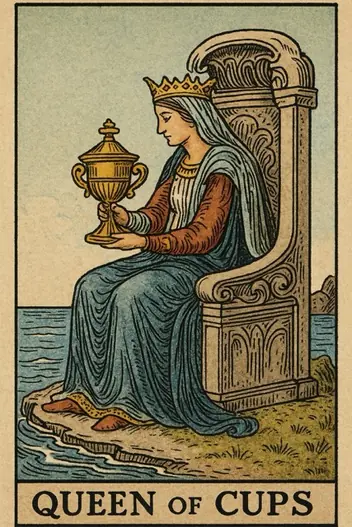
- Arcana
- Minor Arcana, Suit of Cups
- Element
- Water
- Numerology
- 13 → 4
The Queen of Cups represents the Jungian archetype of the Anima—the internalized capacity for emotional intelligence, empathy, and intuitive depth. She embodies the mature integration of feeling into conscious decision-making, a stage where emotions are not suppressed nor indulged, but harnessed as a source of strategic clarity. This card signals a phase where your emotional sensitivity becomes a pragmatic asset, not a liability.
The core challenge of the Queen of Cups is balancing compassion with boundaries. She asks you to use your emotional awareness to navigate complex human dynamics without losing yourself in them. The main idea is that feeling deeply is a strength, but only when paired with the discipline to filter those feelings through rational assessment. This card rewards those who can sit with discomfort, read the unspoken, and act with both heart and mind aligned.
What Does Queen of Cups Mean in Tarot?
The Queen of Cups provides a psychological state of high emotional attunement. In practice, this means you are likely perceiving the subtle moods, motivations, and unspoken needs of others with unusual clarity. This is not about psychic "energy," but about pattern recognition in human behavior. You can see beneath the surface because you have learned to trust your emotional data as legitimate information. The consequence is superior social navigation—you know when to push, when to hold, and when to withdraw.
Decision-making under this card demands a two-step process. First, allow yourself to feel the emotional weight of a situation; second, step back and analyze that feeling without becoming attached to it. This is the pragmatic use of intuition. The risk is mistaking emotional resonance for objective truth—just because you feel something strongly does not mean it is accurate. The Queen of Cups excels when she uses her sensitivity to gather data, then applies logical scrutiny before acting.
The key resource here is emotional resilience. You can absorb the stress of others without absorbing their problems. This creates a powerful position in negotiations, leadership, and interpersonal dynamics. You remain calm while others react, offering a stable presence that de-escalates conflict. The mindset to cultivate is: I will feel this, understand it, and then decide what to do with it. This is the difference between being controlled by emotion and controlling emotion.
Ask your question and flip the cards
or simply focus on it
Yes/No Answer
Leaning yes.. The Queen of Cups embodies emotional depth, intuitive knowing, and unconditional compassion—her waters run deep, not fast. This answer leans toward “yes” because the card signals a situation that requires emotional attunement, not logical force; the outcome will favor the one who leads with empathy and receptivity. In reversed position, the energy shifts toward emotional overwhelm, codependence, or blocked intuition—a no or a conditional maybe that depends on whether you can first heal your own inner wounds. The critical condition: the question must involve matters of the heart, creativity, or caregiving—this card is useless for transactional or career-based queries unless they hinge on emotional labor or psychic insight.
Uncover hidden insights
Let our advanced Tarot system interpret these archetypes specifically for your personal path.
Queen of Cups as the Card of the Day
The Queen of Cups carries a soft, oceanic energy today—your primary vector is receptivity, not action. Focus on listening to your gut feelings and the unspoken emotions in your environment; this is a day for holding space, not pushing agendas. Take specific actions like journaling your dreams, checking in on a friend without an agenda, or practicing a creative ritual that channels your subconscious. Avoid the trap of emotional rescuing—do not absorb others’ pain as your own, and guard against the urge to fix what only needs witnessing. Energy to sidestep: melodrama, martyrdom, and the illusion that your sensitivity is a weakness.
What Does Queen of Cups Mean in a Love Reading?
If you are not in a relationship:
You are likely attracted to partners who seem emotionally complex or wounded. Focus on choosing someone who demonstrates emotional availability, not just emotional depth. Your empathy can blind you to red flags.
If you are in a relationship:
You may be carrying the emotional labor for both partners. Establish clear boundaries around your own need for space and self-care. Do not let your partner's emotions become your responsibility.
In a relationship context, the Queen of Cups demands high emotional intelligence and active conflict resolution. You are the one who can articulate the unspoken tension, name the underlying feeling, and propose a path forward. This is a powerful leadership role, but it can become exhausting if you do not require reciprocity. The primary behavioral pattern to watch is over-empathizing: taking on your partner's sadness or anxiety as your own. This creates codependency, not intimacy.
The main practical relationship advice is to practice detached compassion. You can care deeply without fixing everything. Listen, validate, and then ask: "What do you need from me, and what can you handle yourself?" This protects your emotional resources and forces your partner to grow. The Queen of Cups thrives in a relationship where both people are emotionally literate, but she must guard against becoming the sole emotional caretaker.
What does he/she think of me?
They perceive you as a vessel of emotional safety—someone who sees past their masks and holds their vulnerability without judgment. You evoke a mix of awe and slight intimidation, because your intuitive depth mirrors the parts of themselves they’ve buried; this creates a magnetic pull but also a subtle fear of being seen too clearly. Their hidden hope is that you will offer them unconditional acceptance without requiring them to articulate their pain, while their unspoken fear is that you will withdraw your warmth if they prove unworthy. There is an internal conflict: they idealize you as a nurturing figure, yet they may resent the dependency this ideal creates in themselves. Beneath the surface, they are testing whether your compassion is a genuine gift or a tool for emotional control—the Queen of Cups never forces the river, and they are waiting to see if you will let it flow freely or dam it with expectations.
Queen of Cups in Career and Finance
Strategic Opportunities:
Use your emotional intelligence to read room dynamics in negotiations or team meetings. You can sense unspoken resistance or hidden alliances—leverage this to build consensus or avoid pitfalls.
Resource Management:
Channel your empathy into client-facing roles, counseling, coaching, or creative fields where understanding human needs is a competitive advantage. Your ability to listen deeply creates trust and loyalty.
Calculated Risks:
Beware of over-investing in emotionally draining projects or people-pleasing. Do not take on work that asks you to absorb others' stress without clear boundaries or compensation. Your empathy is a resource, not a free service.
In professional settings, the Queen of Cups excels in leadership through emotional stability. You are the person who can handle a crisis without panic, who can mediate between conflicting parties, and who can sense when a team is burning out. This makes you invaluable in roles that require high trust and human connection. However, you must avoid the trap of emotional labor without reward—do not let yourself become the unpaid therapist of the office.
Financially, this card advises caution with emotionally-driven spending. You may be prone to generosity or impulsive purchases to ease tension. Create a logical budget and stick to it, even when you feel like "giving." The Queen of Cups can also succeed in investments related to wellness, hospitality, or care industries, where her intuitive read of market needs is an asset. Strategic advice: treat your financial decisions as separate from your emotional state.
What Does Queen of Cups Reversed Mean?
When reversed, the Queen of Cups signifies blocked emotional intelligence or internal resistance. The intuitive clarity is still present, but it is either suppressed or distorted. The most common manifestation is emotional overwhelm—you feel everything too intensely, without the filtering mechanism that makes it useful. This leads to irrational decisions based on fear, guilt, or misplaced loyalty. You may find yourself unable to say no, absorbing others' problems until you collapse.
The reversed card also points to emotional dishonesty with yourself. You may be ignoring your own needs while focusing on others, or you might be using empathy as a way to control situations. The warning here is to stop confusing feeling with knowing. Just because you feel anxious does not mean the situation is dangerous. The corrective action is to re-establish boundaries and practice emotional regulation—meditation, journaling, or therapy can help rebuild the internal structure that the upright Queen naturally has. Reversed, she is a warning to stop sacrificing yourself for others' comfort.
Shadow Side and Pitfalls
The shadow of the Queen of Cups is emotional manipulation through vulnerability. In its negative form, this archetype can use her deep understanding of others' feelings to control them—playing the victim, inducing guilt, or withholding emotional support to gain power. This is not always conscious; it often stems from a fear of being abandoned or rejected. The cognitive bias is emotional reasoning: "I feel hurt, so you must have hurt me intentionally."
Another pitfall is perfectionism in emotional care. You may believe that you must always be the perfect listener, the perfect partner, the perfect healer. This leads to burnout and resentment. The Queen of Cups must learn that her worth is not tied to how much she gives. Self-sabotage occurs when she ignores her own needs until she explodes, then blames others for not noticing. The critical error is over-identifying with the caretaker role—you are not responsible for everyone's happiness. The shadow path is one of martyrdom, where suffering becomes a source of identity.
Queen of Cups: The Combined Message
The Queen of Cups is the card of emotional sovereignty. To use her energy constructively, you must treat your feelings as data, not directives. The strategic approach is to develop a system: when you feel a strong emotional reaction, pause and ask, "What is this telling me about the situation, and what is it telling me about myself?" This separates the useful signal from the noise. The Queen of Cups is most powerful when she is calm in the storm, using her sensitivity to navigate, not to drown.
Your main task is to build a container for your emotional life. This means setting clear boundaries on your time, energy, and emotional availability. You can be deeply empathetic without being endlessly available. The strategic advice is to schedule your emotional labor—dedicate specific times for deep listening or support, and guard the rest for yourself. This turns an abstract trait into a repeatable, sustainable practice.
The ultimate lesson of the Queen of Cups is that emotional depth is a form of power, not weakness. But like any power, it requires discipline. You must learn to feel fully without acting impulsively, to care deeply without losing yourself, and to trust your intuition while verifying it with logic. When you master this balance, you become a force of stability and insight in any situation—a person others turn to not because you fix their problems, but because you help them see clearly. Your sensitivity is your strength, but only when it is managed with intention.
Where to Go From Here
This psychological and strategic breakdown provides a deep understanding of archetypes. However, Tarot is never universal for everyone. To understand exactly how this dynamic applies to your specific situation, a reading tailored exclusively to you is necessary.
Download the Fortune Cards app or visit our platform to get a deep AI interpretation of your unique spread. Don't just read about the cards—use Fortune Cards to find out exactly what step you need to take next.
Try Tarot Spreads with Queen of Cups
Interpretation by the Fortune Cards editorial team, based on the Rider–Waite tradition and Jungian archetypes. About our methodology · Updated: 2026-08-26
Top Combinations with Queen of Cups
Discover how Queen of Cups interacts with other major cards in the deck to form powerful messages.
All 77 Combinations with Queen of Cups
Discover how this card interacts with every other card in the Tarot deck and reveal hidden meanings.
Table of Contents
- What Does Queen of Cups Mean in Tarot?
- Yes/No Answer
- Queen of Cups as the Card of the Day
- What Does Queen of Cups Mean in a Love Reading?
- What does he/she think of me?
- Queen of Cups in Career and Finance
- What Does Queen of Cups Reversed Mean?
- Shadow Side and Pitfalls
- Queen of Cups: The Combined Message
- Where to Go From Here
Explore Tarot Universe

Ready to find answers to your questions?
Start your first reading now and look at your situation with fresh clarity. The cards are ready to reveal deeper meaning.