Four of Swords and Seven of Swords Together in Tarot
- Arcana
- Four of Swords — Minor Arcana, Swords; Seven of Swords — Minor Arcana, Swords
- Elements
- Four of Swords — Air; Seven of Swords — Air
- Elemental interaction
- Same element — energies intensify each other
- Numerology
- 4 + 7 = 11 → 2
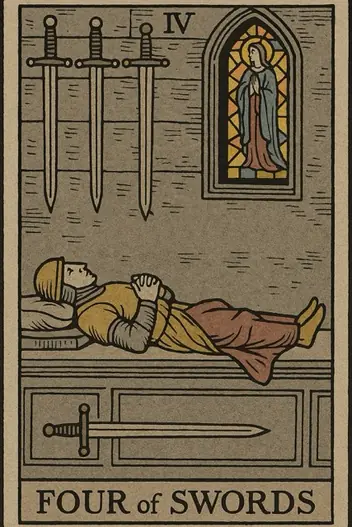
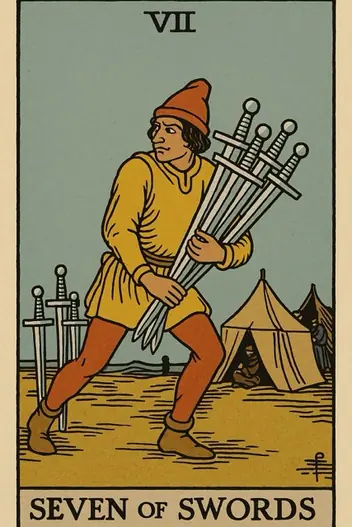
The intersection of the Four of Swords and the Seven of Swords creates a fascinating psychological tension between deliberate rest and calculated action. The Four of Swords represents a conscious retreat—a time to pause, recover, and gain mental clarity after a period of stress or conflict. The Seven of Swords, however, embodies strategic deception, stealth, and the need to outmaneuver a situation without direct confrontation. When these two archetypes collide, the result is a state of active preparation rather than passive waiting. You are not simply resting; you are quietly gathering intelligence, planning your next move, and protecting your energy from those who may not have your best interests at heart.
This combination often appears when a person is caught between the need to step back and the urge to act covertly. It suggests a period where silence is a weapon and observation is more powerful than engagement. The core question becomes: How can you use this time of withdrawal to gather information, reassess your strategy, and return with a clearer, more cunning plan? This is not about laziness or avoidance; it is about mental recalibration in the face of potential deception or complexity.
What Do Four of Swords and Seven of Swords Mean Together?
The psychological state created by the Four of Swords and Seven of Swords is one of guarded introspection. The mind is both resting and scheming. This is not a time for open vulnerability or full disclosure. Instead, the seeker is likely processing a situation where someone’s motives are unclear, or where direct confrontation would be counterproductive. The energy here is about strategic patience: you are holding your cards close to your chest while you analyze the playing field.
In real-world terms, this combination suggests you are in a pre-emptive mental pause. You may have been hurt, betrayed, or simply overwhelmed by a complex scenario. Now, you are using your time alone to reconstruct the narrative, identify hidden agendas, and plan your next steps with precision. The key insight is that your withdrawal is not weakness—it is a tactical move. You are allowing your subconscious to work on problems that require nuance and careful timing. The danger, however, is overthinking or becoming paranoid. The Seven of Swords can amplify suspicion, so it is crucial to distinguish between genuine intuition and fear-based projection.
Your pair is already on the table. Ask your question and draw the clarifying card
or simply focus on it
Career and Finances
Strategic Opportunities:
Use this period to audit your professional network and identify who is genuinely supportive versus who may be undermining you. The Seven of Swords energy can help you spot hidden competitors or untrustworthy partners.
Strategic Opportunities:
Reassess your long-term career plan without external pressure. The Four of Swords gives you the mental space to reconsider your goals, especially if you have been burned out or misled recently.
Calculated Risks:
Avoid making major financial commitments or signing contracts until you have thoroughly investigated all parties involved. The combination warns against acting on incomplete information or trusting surface-level appearances.
Professionally, this tarot pair signals a time for covert reconnaissance rather than bold action. If you are in a negotiation, this is the moment to step back and let the other party reveal their hand. A key financial warning: do not invest in opportunities that require immediate secrecy or exclusivity—these are classic red flags for manipulation. Instead, use your downtime to review past decisions, research competitors, and refine your strategy. The Four of Swords provides the clarity needed to dissect complex data, while the Seven of Swords gives you the cunning to navigate office politics. The most successful move is to stay quiet, gather intelligence, and only act when you have a clear, evidence-based advantage.
Ask your specific question
Don't rely on generic meanings. Get a customized reading tailored specifically to your energies.
Four of Swords and Seven of Swords in Love Tarot
If you are single:
This pair suggests you should slow down and observe before investing emotionally. A potential partner may be charming but not entirely transparent. Use this time to gather information about their character without revealing your full hand.
If you are in a relationship:
You or your partner may be withholding information or creating emotional distance to avoid conflict. This is a red flag for passive-aggressive dynamics or unspoken resentments.
In a relationship context, the Four of Swords and Seven of Swords combination often points to a power imbalance in communication. One partner may be retreating into silence (Four of Swords) while the other is being evasive or secretive (Seven of Swords). The result is a cycle of mistrust where neither party feels safe enough to be fully honest. The most important relationship advice here is to break the silence with structured, non-accusatory dialogue. Instead of demanding explanations, create a safe space for gradual disclosure. If you are the one retreating, ask yourself: Am I resting to heal, or am I hiding to avoid accountability? If you suspect deception, gather evidence calmly before confronting. Emotional intelligence demands that you distinguish between a need for privacy and a pattern of concealment.
Reversed Four of Swords and Seven of Swords Explained
Reversed cards radically alter the meaning of this combination, transforming it from a tactical pause into chaotic flight.
If the Four of Swords is Reversed:
You cannot afford rest. Your exhaustion has reached a critical point, but you continue to take impulsive, poorly thought-out actions. Instead of calmly developing a plan (Seven of Swords), you try to "trick" your fatigue by working even more, which leads to mistakes. Advice: stop immediately. Any "cunning" now will be like the actions of a cornered animal — dangerous and reckless.
If the Seven of Swords is Reversed:
This is a situation of a "failed conspiracy." You planned a retreat or a clever move, but your plan has been exposed, and you are backed into a corner. You are forced to retreat (Four of Swords) not by your own will, but because of a failed strategy. Internal resistance and feelings of shame block the ability to soberly assess the situation. Advice: admit your defeat. This is the only way to break out of isolation and start anew.
If BOTH are Reversed:
Complete imbalance. You are simultaneously exhausted, unable to rest, your plan has failed, and you don't know where to run. This is a state of acute crisis, paranoia, and a total loss of control. The way out of this state lies through total acceptance of reality. You need to admit that you cannot control everything and seek help from a third party (psychologist, lawyer, mentor). Advice: surrender. Stop playing games. Take a step back and allow the external system (law, ethics, friends) to protect you.
Four of Swords and Seven of Swords: Warning Signs
When the energy of these two cards is blocked or misapplied, the shadow manifestations are significant. The primary cognitive bias at play is confirmation bias: you may only seek out information that confirms your suspicion of being deceived, leading to unnecessary paranoia. Alternatively, the shadow side of the Seven of Swords can turn the Four of Swords into procrastination disguised as meditation. You might convince yourself you are “resting” when you are actually avoiding a necessary confrontation or decision. Self-sabotage occurs when you use strategic thinking as an excuse for inaction. Another pitfall is over-analyzing motives to the point where you miss obvious opportunities for trust and collaboration. If you find yourself constantly second-guessing others’ intentions, you may be projecting your own unacknowledged fears. The shadow asks: Are you truly being strategic, or are you hiding from vulnerability?
Four of Swords and Seven of Swords Combined Message
How can the energy of the Four of Swords be used constructively to balance the Seven of Swords? The answer is paradoxical: use rest for planning, but make that plan honest. Allow yourself complete isolation for 24-48 hours (Four of Swords), but dedicate this time not to empty worry, but to cold analysis. Write down on paper the answers to three questions: "What am I truly afraid of?", "What truth am I hiding from myself?", and "What is the simplest, most direct path to solving the problem?"
The deep strategic advice is to transform cunning into tactical flexibility. The Seven of Swords is not necessarily about theft or lies. It can be the ability to see unconventional paths out of a crisis. When you have rested (Four of Swords) and calmed your mind, you can use the energy of the Seven of Swords to find a legal, yet non-obvious way to solve the problem. For example, instead of lying to your boss about the reason for your absence, propose a new work schedule that suits everyone. Or, instead of hiding a debt, offer your creditor a unique repayment plan.
This combination teaches us "ethical cunning" — the ability to achieve your goals without violating moral principles or depleting your resources. Instead of being a "quiet manipulator," become a "quiet strategist." Your strength lies in the ability to see one step ahead, and your safety lies in knowing when to stop and recover. Only the balance between rest and planning grants true power over the situation.
Where to Go From Here
The core message of the Four of Swords and Seven of Swords is about using stillness as a strategic tool. Your mind is your greatest asset right now, but only if you apply it with discipline and emotional honesty. The challenge is to balance healthy skepticism with the courage to eventually re-engage. Remember: withdrawal is only valuable if it leads to a wiser re-entry.
While this article provides a thorough archetypal analysis, the true power of Tarot lies in its application to your unique situation. Every relationship, career challenge, and personal crossroads has its own nuances. To get a deep, personalized interpretation of how this exact combination applies to your specific question right now, use the Fortune Cards app. Available on the web or as a download, it delivers immediate, context-aware insights that go beyond general meanings. Stop guessing—let the cards speak directly to your life.
Interpretation by the Fortune Cards editorial team, based on the Rider–Waite tradition and Jungian archetypes. About our methodology · Updated: 2026-10-08
Other Combinations with Four of Swords
Other Combinations with Seven of Swords
Explore Individual Card Meanings
Table of Contents
- What Do Four of Swords and Seven of Swords Mean Together?
- Career and Finances
- Four of Swords and Seven of Swords in Love Tarot
- Reversed Four of Swords and Seven of Swords Explained
- Four of Swords and Seven of Swords: Warning Signs
- Four of Swords and Seven of Swords Combined Message
- Where to Go From Here
Ready to find answers to your questions?
Start your first reading now and look at your situation with fresh clarity. The cards are ready to reveal deeper meaning.