Love Tarot: Four of Wands and Page of Cups
- Arcana
- Four of Wands — Minor Arcana, Wands; Page of Cups — Minor Arcana, Cups
- Elements
- Four of Wands — Fire; Page of Cups — Water
- Elemental interaction
- Opposing elements — energies create tension
- Numerology
- 4 + 11 = 15 → 6
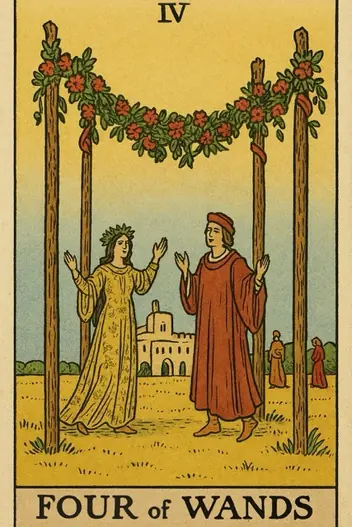
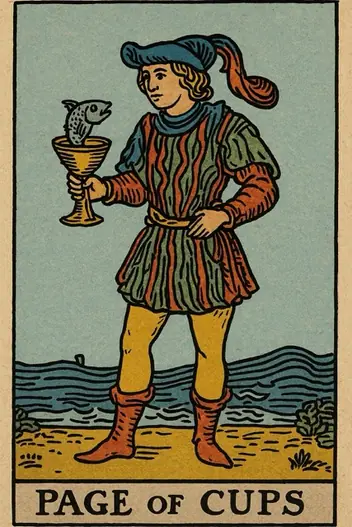
When the Four of Wands—a card of structure, celebration, and achieved milestones—collides with the Page of Cups—a messenger of nascent emotional intelligence, creative impulses, and intuitive whispers—you face a unique psychological tension. This pairing suggests a foundation that is stable enough to support new emotional risks, yet fragile enough to be destabilized by unchecked fantasy. The core question becomes: How do you integrate a desire for security with the need to explore uncharted emotional waters?
This combination often arises when a person has built a solid base—perhaps in a relationship, career, or personal identity—but feels a subtle pull toward something more tender, creative, or emotionally vulnerable. The Page of Cups represents the archetype of the "inner child" or the budding artist, while the Four of Wands represents the "adult" structure. The challenge is to let the child play without demolishing the house.
Four of Wands and Page of Cups Combination Meaning
The psychological state created by this merge is one of cautious optimism. You have earned your place of rest (Four of Wands), but you are not content to simply sit still. The Page of Cups injects a curiosity that feels both exciting and risky. You are likely evaluating whether your current structures can accommodate a new emotional or creative venture. This is not about reckless change; it is about calculated enrichment.
From a Jungian perspective, the Four of Wands represents the persona—the social mask and stable identity you present to the world. The Page of Cups is the anima or animus—the inner, often underdeveloped, emotional or intuitive self. The key dynamic is integration: Can you invite your softer, more imaginative side into your established life without causing a collapse? Pragmatically, this means asking: Does this new feeling fit within my current commitments, or does it require a fundamental restructuring?
The real-world implication is a decision point. You are being asked to protect your foundation while being open to its evolution. The Four of Wands provides the safety net, but the Page of Cups demands you test its strength. Do not ignore the whisper of your intuition, but do not let it override your hard-won stability without a clear plan. The most successful outcome involves introducing small, manageable experiments—a creative hobby, a new conversation, a gentle emotional risk—within the safe container you have built.
Your pair is already on the table. Ask your question and draw the clarifying card
or simply focus on it
Career Meaning of Four of Wands and Page of Cups
Strategic Opportunities:
Use your established professional reputation (Four of Wands) as a launchpad for a creative side project or a new team collaboration that taps into your intuition (Page of Cups).
Strategic Opportunities:
Seek out a mentorship role where you can guide others while also learning from their fresh, innovative ideas.
Calculated Risks:
Avoid making major financial commitments based solely on a "gut feeling" or an exciting, but unproven, idea. The Page of Cups can be naive; validate your intuition with concrete data.
Professionally, this combination suggests a phase of creative incubation within a stable environment. You are not being asked to quit your job or abandon your career path. Instead, you are being asked to integrate a new skill, perspective, or emotional intelligence into your existing role. The Four of Wands provides the structural support—the team, the process, the reputation—that makes innovation safe. The Page of Cups provides the spark—a new approach to client relationships, a creative solution to a stale problem, or an intuitive read on market sentiment.
Financially, the warning is clear: Do not confuse emotional excitement with financial opportunity. The Page of Cups is the dreamer, not the accountant. Bold financial strategy: Use your stable income (Four of Wands) to fund a small, low-risk experiment (Page of Cups). Set a clear budget and timeline for this creative venture. If it fails, your foundation remains intact. If it succeeds, you have expanded your territory without jeopardizing your security. Avoid the cognitive bias of the "sunk cost fallacy"—just because you have invested time in an idea does not mean it is financially viable.
Ask your specific question
Don't rely on generic meanings. Get a customized reading tailored specifically to your energies.
What Do Four of Wands and Page of Cups Say About Love?
If you are single:
This pairing suggests you are attracted to a person who offers both emotional depth and stability, but you may project a fantasy onto a solid partner. Evaluate whether the connection is real or if you are seeking a "rescuer" for your unexpressed feelings.
If you are in a relationship:
You or your partner may be feeling a creative or emotional restlessness within a secure bond. The risk is mistaking a need for personal expression as a need to change the relationship structure.
In relationships, this combination often signals a healthy tension between comfort and novelty. The Four of Wands represents the home you have built—shared values, routines, and mutual support. The Page of Cups brings a new emotional message: a desire to be seen as more tender, more vulnerable, or more creative. The critical insight is to communicate this need clearly, rather than acting on it impulsively. Bold relationship advice: Avoid the trap of "emotional infidelity" where you share your new feelings with someone outside the partnership first. Bring the Page of Cups home. Invite your partner into your creative or emotional exploration. This can reinvigorate the relationship if handled with transparency and respect for boundaries. However, if the Four of Wands feels like a cage, the Page of Cups may signal a genuine need for a different kind of partnership—one that allows for more fluid emotional expression.
Shadow Side & Pitfalls
The shadow manifestation of this pairing is emotional immaturity disguised as creativity. You may use the Page of Cups' sensitivity as an excuse to avoid responsibility or to destabilize a perfectly good situation out of boredom. The cognitive bias at play is the "grass is greener" syndrome—believing that the new emotional feeling (Page of Cups) is inherently more valuable than the stable reality you have (Four of Wands). This can lead to self-sabotage: abandoning a solid relationship or career for a fleeting fantasy.
Another pitfall is passive aggression. Instead of expressing a new emotional need directly, you may sulk, withdraw, or act out in subtle ways, expecting your partner or team to read your mind. The Four of Wands requires clear structures; the Page of Cups requires clear communication. The shadow emerges when these energies are split—when you keep your feelings hidden while maintaining a facade of stability. This creates a psychological dissonance that erodes trust over time. The antidote is radical honesty with yourself and others about what you are feeling and what you actually want to change.
What If Four of Wands or Page of Cups Appears Reversed?
When the Four of Wands is reversed and the Page of Cups is upright, a situation of blocked potential arises. The foundation is cracking at the seams — perhaps you cancelled a celebration, lost your home or job. At this moment, the Page of Cups offers emotional support or a creative idea as a lifeline. Advice: do not try to restore the old structure at any cost. Use the Page's impulse to create a new, more flexible foundation.
If the Page of Cups is reversed and the Four of Wands is upright, this points to internal resistance to feelings. You have stability but reject any emotional offers due to fear or cynicism. Warning: such isolation will lead to burnout and stagnation. You risk turning your home into a prison. You need to consciously open yourself to one new experience — sign up for a course, accept a date invitation.
When both cards are reversed, complete imbalance sets in. Neither stability nor sincerity. This is a state of chaos: you feel insecure and reject any attempts to establish connection. Logical way to correct it: return to basic needs. First, restore the Four of Wands — get your home, finances, and daily routine in order. Only then try to express emotions (Page of Cups). Do not attempt to do two things at once.
What Is the Overall Message of Four of Wands and Page of Cups?
To constructively harness the energy of this pair, you must become the architect of your own emotions. The Four of Wands is the framework of the building. The Page of Cups is the interior and atmosphere. Without the framework, the interior collapses; without the atmosphere, the framework remains an empty box. Your task is to consciously integrate novelty into the existing system without destroying it.
Strategic advice: start small. Do not attempt to change your entire life at once. Choose one area (relationships, career, hobby) and conduct a "safe experiment." For example, if you receive a creative proposal at work, do not abandon your current responsibilities. Set aside 2 hours per week for this project. If the Page of Cups proves fruitful, you can expand its influence, gradually transforming the Four of Wands.
The main takeaway: stability is not the enemy of novelty, but its best foundation. Emotional openness without structure leads to chaos. Structure without emotion leads to stagnation. This combination offers you a rare chance to unite the best of both worlds. Embrace it with clarity and pragmatism. Your task is not to choose between home and adventure, but to make home a place for adventure.
Your Next Step: Personal Context Matters
The core message of the Four of Wands and Page of Cups is this: You have built a solid stage, and now you are being called to perform a new, more emotionally honest act. The stability you have earned is not a prison; it is a safe platform from which to explore your deeper instincts. Trust your foundation enough to take a small, creative risk, but verify your feelings with logic before making any irreversible moves.
While this analysis provides the general archetype, the true magic happens when Tarot is applied to your specific situation. The meaning of these cards shifts dramatically depending on whether you are questioning a relationship, a career move, or a creative project. To get a deep, personalized interpretation of this exact combination for your unique question, use the Fortune Cards app right now. Available on the web and for download, it will analyze your personal context and deliver strategic, actionable insights tailored to you.
Interpretation by the Fortune Cards editorial team, based on the Rider–Waite tradition and Jungian archetypes. About our methodology · Updated: 2026-08-26
Other Combinations with Four of Wands
Other Combinations with Page of Cups
Explore Individual Card Meanings
Table of Contents
- Four of Wands and Page of Cups Combination Meaning
- Career Meaning of Four of Wands and Page of Cups
- What Do Four of Wands and Page of Cups Say About Love?
- Shadow Side & Pitfalls
- What If Four of Wands or Page of Cups Appears Reversed?
- What Is the Overall Message of Four of Wands and Page of Cups?
- Your Next Step: Personal Context Matters
Ready to find answers to your questions?
Start your first reading now and look at your situation with fresh clarity. The cards are ready to reveal deeper meaning.