King of Cups and King of Swords Tarot as Feelings
- Arcana
- King of Cups — Minor Arcana, Cups; King of Swords — Minor Arcana, Swords
- Elements
- King of Cups — Water; King of Swords — Air
- Elemental interaction
- Neutral elements — energies coexist without conflict
- Numerology
- 14 + 14 = 28 → 1
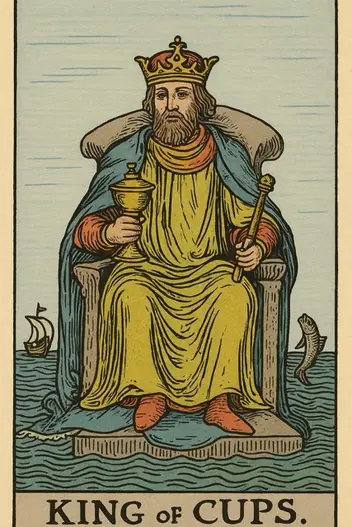
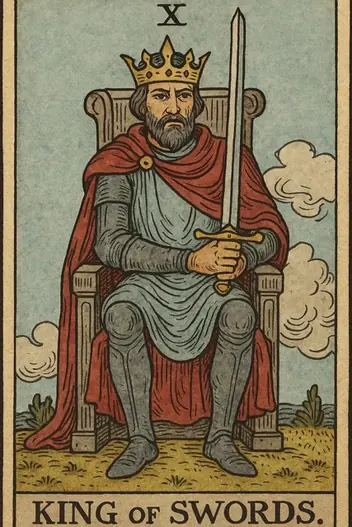
The intersection of the King of Cups and the King of Swords represents a rare and powerful synthesis of emotional mastery and intellectual clarity. In Jungian terms, this pairing embodies the integration of the feeling function (valuing, relating, connecting) with the thinking function (analyzing, strategizing, deciding). When these two archetypes collide in a reading, they signal a moment where you can lead with both heart and mind without sacrificing one for the other.
In real life, this combination often appears when you are facing a high-stakes decision that requires both empathy and objectivity. You may need to deliver difficult feedback with compassion, negotiate a contract while maintaining emotional rapport, or choose a partner who respects your need for both intimacy and independence. The core challenge is to avoid emotional suppression (pure King of Swords) and avoid emotional flooding (pure King of Cups), instead finding the narrow path of calm, deliberate, and connected authority.
What Do King of Cups and King of Swords Mean Together?
The psychological state created by the King of Cups and King of Swords is one of controlled emotional energy directed by clear logic. You are not cold or detached; rather, you have learned to observe your own feelings without being controlled by them. This allows you to see the emotional landscape of a situation (King of Cups) and map out the most strategic path forward (King of Swords). The key insight here is that emotional intelligence is not the opposite of rational analysis—it is its complement.
In practice, this combination suggests a person who has mastered the art of boundary-setting. The King of Cups provides the warmth and empathy to understand others' needs, while the King of Swords provides the clarity to say "no" or "not now" without guilt. This is the energy of a skilled negotiator, a wise leader, or a therapist with a business mind. You are able to hold space for difficult emotions while simultaneously steering the conversation toward resolution. The shadow risk is intellectualizing emotions to avoid vulnerability, but when balanced, this pairing offers exceptional judgment.
For the seeker, this combination indicates that you are ready to make a decision that honors both your values and your intellect. It is a green light to act with authority, provided you remain aware of the emotional stakes for yourself and others. The practical implication is clear: do not rush. This is a time for careful, considered action, not impulsive reactions.
Love and Relationships
If you are single:
This pairing suggests you are attracting or evaluating a partner who is emotionally mature and intellectually stimulating. Look for someone who can engage in deep conversation without becoming defensive, and who respects your need for both connection and autonomy.
If you are in a relationship:
The dynamic between you and your partner is one of mutual respect and balanced power. You are likely navigating a conversation about boundaries, future plans, or conflict resolution with a level of maturity that strengthens the bond.
In relationships, the King of Cups and King of Swords together signal a relationship built on a foundation of emotional honesty and clear communication. The most important relationship advice here is to lead with curiosity, not judgment. When disagreements arise, use the King of Swords to analyze the facts and the King of Cups to acknowledge feelings. This prevents the common trap of one partner dominating through logic while the other withdraws emotionally.
Boldly practice "radical candor"—speak the truth with compassion. If you are considering a long-term commitment, this combination confirms that you have the tools to navigate the inevitable challenges. Avoid passive-aggression (a shadow of the King of Cups) and avoid cold ultimatums (a shadow of the King of Swords). Instead, frame decisions as collaborative: "Here is what I see logically, and here is how I feel about it. What do you see and feel?"
Your pair is already on the table. Ask your question and draw the clarifying card
or simply focus on it
What Do King of Cups and King of Swords Indicate for Your Career?
Strategic Opportunities:
Leadership roles that require both people management and strategic planning—such as team lead, mediator, or client relationship manager. This is a strong time to negotiate a promotion or pitch a high-stakes idea.
Strategic Opportunities:
Mentoring or consulting where you can guide others through complex emotional or organizational changes. Your ability to combine empathy with hard data is a rare asset.
Calculated Risks:
Avoid over-analyzing to the point of paralysis. The King of Swords can lead to analysis paralysis if you wait for perfect data. Set a decision deadline and trust your emotional read on the room.
Professionally, this combination is a powerful indicator of strategic decision-making. You are in a position to lead with authority while maintaining trust. In negotiations, you will excel because you can read the other party's emotional state (King of Cups) while holding firm on your logical bottom line (King of Swords). Financially, this is a time for calculated moves, not gambles. Review your portfolio or business plan with both your values and your data in mind.
A key financial warning:
Do not let emotional attachment to a past project or relationship cloud your judgment. The King of Swords demands objectivity, while the King of Cups asks you to honor your feelings without being ruled by them. If you are considering a career change, this combination supports it—provided you have done the research. Trust your gut, but verify with spreadsheets.
Reversed King of Cups and King of Swords Explained
When cards appear reversed, the equilibrium is disrupted, and the archetypes manifest through their shadow side.
Reversed King of Cups:
Emotional competence is blocked. You either become emotionally unavailable, hiding behind the cold intellect of the King of Swords, or, conversely, slide into manipulative sentimentality, using tears and grievances to achieve your goals. Advice: check whether you are trying to control others through guilt.
Reversed King of Swords:
Rationality turns into harsh criticism or passive aggression. Intellect is used not for analysis, but for sabotage. Paired with the upright King of Cups, this creates a situation where you "understand everything" but do nothing. Warning: avoid the mental traps of "yes, but..." that block any action.
Both cards reversed:
A complete imbalance sets in. Emotional immaturity combines with intellectual dishonesty. This is a state of chaos where decisions are made impulsively and responsibility is shifted onto others. The only logical way to rectify the situation is to artificially introduce structure: write down decisions, follow a plan, and ask an external observer (coach, psychologist) to provide objective feedback.
Uncover hidden insights
Let our advanced Tarot system interpret these archetypes specifically for your personal path.
Shadow Side & Pitfalls
The shadow manifestation of this pairing is emotional manipulation disguised as rationality. A person under this shadow may use their emotional intelligence to gaslight or control others while claiming to be "just being logical." They may also suppress their own feelings so thoroughly that they become disconnected from their authentic needs, leading to burnout or sudden emotional outbursts. The cognitive bias to watch for is the illusion of complete objectivity—believing that your analysis is pure and unbiased, when in fact your emotions are influencing your conclusions.
Another pitfall is over-functioning as the "rescuer" or "fixer." The King of Cups wants to heal, while the King of Swords wants to solve. Together, they can create a dynamic where you take on too much responsibility for others' problems, leading to resentment. Self-sabotage may appear as avoiding vulnerability—staying in the role of the detached advisor rather than fully engaging in a relationship or decision. If you feel a coldness creeping into your interactions, or if you are using logic to avoid feeling your own pain, the shadow is active.
Synthesis: Strategic Conclusion
Constructive use of this combination requires a conscious switching of modes. Imagine you are operating two different tools. First, you put on the "mask" of the King of Cups — you listen, empathize, and create a safe space. Your goal is to gather data on motivations and fears (your own and others'). Then, you switch to the King of Swords — you analyze this data, cut through the emotional noise, and formulate a clear, ethical plan of action.
The key strategic advice: never mix these two processes into a single moment. Attempting to console and criticize simultaneously is a sure path to conflict. Separate "empathetic listening" and "rational planning" in time. For example, in negotiations, first let your opponent speak their piece (Cups), then offer a structure for a solution (Swords). This sequence builds trust and respect. Your strength lies in your ability to be flexible, not in an attempt to be perfect. Accept that balance is a dynamic process, not a static point.
Applying This to Your Situation
The core message of the King of Cups and King of Swords is that you possess the rare ability to lead with both heart and mind. When these cards appear, you are being called to make a decision that honors your emotional truth while respecting objective reality. The key is balance: not one at the expense of the other, but both in service of a higher purpose. Trust your judgment, but stay humble enough to listen.
While this article provides a deep understanding of the general archetype, the true power of Tarot comes when it is applied to your specific situation. Your unique question, timing, and personal history change the meaning in subtle but crucial ways.
Get a deeply personalized interpretation of the King of Cups and King of Swords for your exact question. Use the Fortune Cards app on the web or download it now. In just a few minutes, you will receive a tailored reading that accounts for your love life, career, or personal growth challenges. Stop guessing—get clarity that fits your life.
Interpretation by the Fortune Cards editorial team, based on the Rider–Waite tradition and Jungian archetypes. About our methodology · Updated: 2026-08-26
Other Combinations with King of Cups
Other Combinations with King of Swords
Explore Individual Card Meanings
Table of Contents
Ready to find answers to your questions?
Start your first reading now and look at your situation with fresh clarity. The cards are ready to reveal deeper meaning.