Page of Cups + Four of Pentacles: What This Tarot Pairing Means
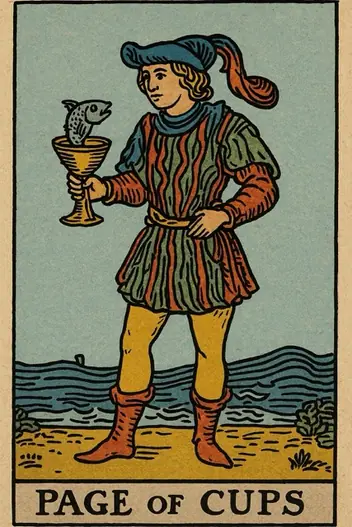
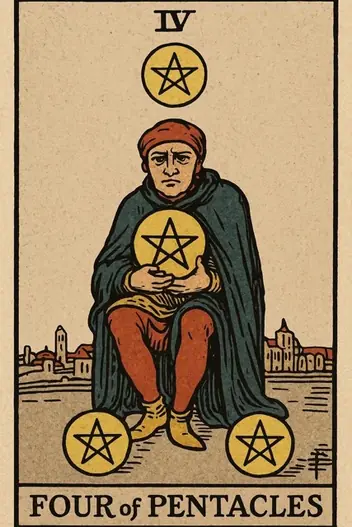
- Arcana
- Page of Cups — Minor Arcana, Cups; Four of Pentacles — Minor Arcana, Pentacles
- Elements
- Page of Cups — Water; Four of Pentacles — Earth
- Elemental interaction
- Friendly elements — energies support each other
- Numerology
- 11 + 4 = 15 → 6
The intersection of the Page of Cups and the Four of Pentacles creates a fascinating psychological tension. The Page of Cups embodies a fresh, vulnerable emotional impulse—a desire to connect, create, or express feelings without judgment. It represents the archetype of the Inner Child or the budding artist, driven by curiosity and raw sentiment. In stark contrast, the Four of Pentacles reflects a rigid need for security and control—the archetype of the Defender or the Hoarder. This card clings to resources, boundaries, and established structures out of a fear of loss. When these energies collide, the result is a classic internal conflict: the heart wants to reach out, but the mind locks everything down. This combination often appears when a person is torn between the risk of emotional exposure and the comfort of self-protective isolation.
Core Dynamics & Interpretation
The core dynamic here is a battle between emotional generosity and resource scarcity. The Page of Cups wants to offer a gift—a feeling, a creative idea, or a gesture of care—while the Four of Pentacles fears that giving anything away will lead to depletion. Psychologically, this can manifest as ambivalence toward intimacy or investment. You may feel a genuine urge to share your inner world, but a stronger, subconscious voice warns you that doing so is unsafe or unwise. This is not simple shyness; it is a cognitive bias known as "loss aversion" —the fear of losing what you have outweighs the potential gain of what you could receive.
In practical terms, this combination often describes a holding pattern in decision-making. You are aware of a new emotional or creative opportunity (Page of Cups), but you are paralyzed by the need to preserve your current stability (Four of Pentacles). The key insight is that security is not static. The Four of Pentacles can create a false sense of safety, where holding tight feels protective but actually suffocates growth. The Page of Cups, on the other hand, reminds you that emotional wealth grows through circulation, not hoarding. To resolve this tension, you must ask: What is the actual cost of protecting myself? What am I missing by not taking this small risk?
Ask your question and flip the cards
or simply focus on it
Page of Cups and Four of Pentacles in Love and Relationships
If you are single:
This pair suggests you are evaluating a new connection through a lens of scarcity. You may feel a spark (Page of Cups) but immediately pull back, worrying about getting hurt, wasting time, or losing your independence. The advice is to test the waters with a small, low-stakes gesture rather than committing or retreating completely.
If you are in a relationship:
You or your partner may be withholding affection, praise, or emotional support out of a fear of being taken for granted. There may be an unspoken power dynamic where one person offers feelings, and the other guards their own emotional resources tightly.
In relationships, this combination often signals a communication bottleneck. One partner (the Page) wants to share a tender thought, a new interest, or a vulnerable feeling, while the other (the Four) responds with defensiveness, skepticism, or a need to control the conversation. The psychological trap here is assuming that emotional giving is a zero-sum game—that if I open up, I lose power or status. The crucial relationship advice is to recognize that emotional security is built through mutual exchange, not unilateral defense. If you are the Page, resist the urge to retreat when met with resistance; instead, frame your offer as a request for collaboration, not a demand. If you are the Four, examine what you are truly afraid of losing—control, predictability, or self-image—and ask whether holding on tighter will preserve the relationship or damage it.
Get a personalized interpretation
Unlock the combined meaning of your cards in the context of your unique question — for free.
What Do Page of Cups and Four of Pentacles Indicate for Your Career?
Strategic Opportunities:
Use your creative or empathetic instincts (Page of Cups) to identify a niche market or a team need that others overlook. This is a good time to propose a small pilot project rather than a full-scale launch.
Strategic Opportunities:
Network with a soft touch. The Page of Cups’ charm can open doors, but the Four of Pentacles cautions you to protect your time and intellectual property—share enough to intrigue, not enough to be exploited.
Calculated Risks:
Avoid over-committing to a single idea or resource out of fear of missing out. The Four of Pentacles can lead you to hoard cash, credit, or favors to a point of stagnation. Do not let fear of loss prevent you from making a necessary investment in yourself or your team.
Professionally, this is a cautionary yet hopeful combination. It suggests you are in a phase of incubation—you have a promising idea or emotional intelligence that could add value, but you are hesitant to put it into the world because you fear rejection, theft, or failure. The strategic move is to create a controlled experiment. For example, if you want to propose a new initiative, outline the minimum viable version that costs you little but tests the market. If you are negotiating a raise or a contract, lead with your value (Page of Cups) but set clear boundaries (Four of Pentacles) . A critical financial warning: Do not confuse frugality with fear. The Four of Pentacles can masquerade as prudent budgeting, but if it prevents you from spending on growth (training, tools, or networking), it becomes a liability. The best financial decision here is to allocate a small, non-critical budget to explore your creative or emotional hunch.
Reversed Positions: What Changes?
Page of Cups Reversed:
Emotional potential is blocked or distorted. Instead of a sincere offer, you receive manipulation or immaturity. The person may play the "victim" to gain resources or impose their feelings without noticing your boundaries. Advice: Verify words with actions. If promises are not backed by real deeds — do not invest in it.
Four of Pentacles Reversed:
The defense mechanism is crumbling. This can mean forced generosity (spending you are not ready for) or chaotic parting with resources (e.g., an impulsive purchase or a breakup). Inner resistance weakens, but control is lost. Advice: Take a pause. Do not make decisions under pressure. Your task is not to open up, but to restore order before opening up.
BOTH reversed:
Complete imbalance. You are either recklessly scattering your feelings and money, or, conversely, becoming paranoidally closed off, rejecting any possibility. This is a state of cognitive dissonance, where you do not know what you want. Corrective measure: Return to basic values. What is most important to you at this moment: stability or self-expression? Take one small step in the chosen direction, without trying to cover everything at once.
The Shadow Side of Page of Cups and Four of Pentacles
The shadow side of this combination is emotional stinginess masked as self-protection. You may convince yourself that you are being realistic or cautious, when in fact you are acting out of a deep, unexamined fear of vulnerability. This can lead to self-sabotage: you have a brilliant idea but never pitch it; you feel a genuine connection but never act on it; you want to heal a relationship but refuse to make the first move. The cognitive bias at play is "the endowment effect" —you overvalue what you currently possess (your comfort, your routines, your emotional walls) and undervalue what you could gain. Another pitfall is passive-aggressive control. The Page of Cups may express soft feelings, but the Four of Pentacles can twist that into a manipulative withholding of affection or resources to maintain power. If you find yourself feeling resentful while doing nothing to change the situation, you are likely in the shadow of this pair. The antidote is to distinguish between healthy boundaries and fear-based walls. Ask yourself: Am I protecting my peace, or am I protecting my pride?
What Is the Overall Message of Page of Cups and Four of Pentacles?
Constructive use of this combination requires a shift from "either-or" to "and-and." You don't need to choose between emotional life and financial stability. You need to create a system where one nourishes the other. The Page of Cups is the engine that provides energy for new beginnings. The Four of Pentacles is the steering wheel and brakes that prevent this engine from accelerating into a crash.
Your strategic task is to capitalize on vulnerability. Make your feelings and ideas a resource you can invest. For example, if you want to ask for a raise (Page of Cups), prepare the numbers and facts that prove your value (Four of Pentacles). If you want to start a new relationship, first clearly define what you are ready to invest in it and what you want to receive. This isn't about mercantilism, but about mature management of your life.
A deep strategic piece of advice: start small. Don't try to open your soul or make a major investment all at once. Take one small step: write a letter, but don't send it immediately; propose an idea, but in a draft; give a compliment, but without expecting a response. This will allow your Page of Cups to express itself without triggering panic in your Four of Pentacles. Clarity will come when you understand that security is not the absence of risk, but the ability to manage it.
Your Next Step: Personal Context Matters
The core message of the Page of Cups and Four of Pentacles is this: Your emotional and creative impulses are not threats to your security—they are signals of what needs to grow. The tension you feel is a natural part of integrating vulnerability with stability. To move forward, you must take one small, intentional action that honors both your desire to connect and your need for safety. This could be a single conversation, a modest creative output, or a clear boundary that allows for openness without overwhelm.
Your unique situation deserves a unique reading. While this analysis provides the general archetype, the true power of Tarot lies in how it applies to your specific question, history, and mindset. To get a deep, personalized interpretation of this exact combination for your relationship, career, or inner conflict, use the Fortune Cards app. It analyzes your precise context and delivers actionable, psychological insights in seconds. Click here to start your free reading on the web, or download the app now.
Interpretation by the Fortune Cards editorial team, based on the Rider–Waite tradition and Jungian archetypes. About our methodology · Updated: 2026-08-01
Other Combinations with Page of Cups
Other Combinations with Four of Pentacles
Explore Individual Card Meanings
Table of Contents
- Core Dynamics & Interpretation
- Page of Cups and Four of Pentacles in Love and Relationships
- What Do Page of Cups and Four of Pentacles Indicate for Your Career?
- Reversed Positions: What Changes?
- The Shadow Side of Page of Cups and Four of Pentacles
- What Is the Overall Message of Page of Cups and Four of Pentacles?
- Your Next Step: Personal Context Matters
Ready to Discover Your Path?
Join thousands of seekers who have found clarity and guidance through our platform. Your cosmic journey awaits.