The Meaning of Seven of Cups and Ten of Cups Together in a Tarot Reading
- Arcana
- Seven of Cups — Minor Arcana, Cups; Ten of Cups — Minor Arcana, Cups
- Elements
- Seven of Cups — Water; Ten of Cups — Water
- Elemental interaction
- Same element — energies intensify each other
- Numerology
- 7 + 10 = 17 → 8
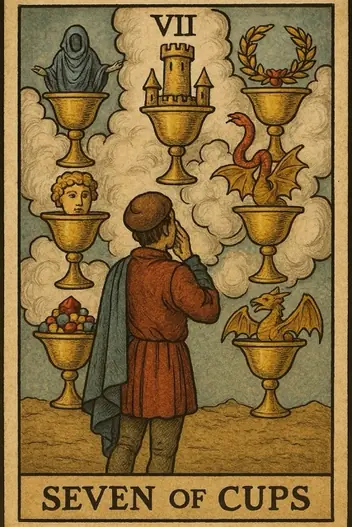
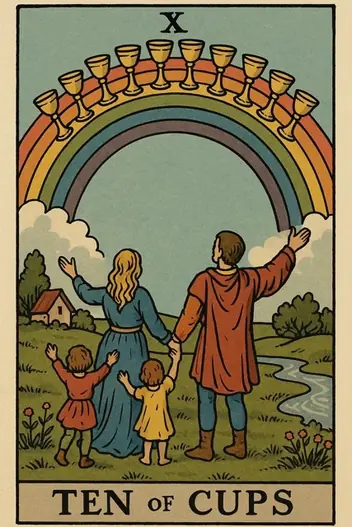
When the Seven of Cups—the archetype of illusion, desire, and scattered daydreams—collides with the Ten of Cups—the pinnacle of emotional fulfillment, harmony, and lasting joy—you are looking at a powerful psychological tension. This pairing represents the gap between your imagined ideal and the reality of what you can actually build. It asks a pragmatic question: Are you chasing a fantasy, or are you laying the groundwork for genuine satisfaction?
In Jungian terms, the Seven of Cups activates the shadow of wishful thinking, where the ego projects its unmet needs onto glittering but empty images. The Ten of Cups, by contrast, embodies the Self archetype—a state of wholeness achieved through integration, not escape. The challenge here is to distinguish between a beautiful vision that motivates you and a delusion that keeps you stuck. The key is reality-testing: turning abstract dreams into concrete actions that align with your deepest values.
Seven of Cups and Ten of Cups: How These Energies Interact
The core dynamic of this combination is a psychological conflict between possibility and probability. The Seven of Cups floods your mind with options—new relationships, career changes, creative projects—each promising a shortcut to happiness. Yet the Ten of Cups demands sustained effort, emotional maturity, and a clear sense of purpose to achieve its version of lasting fulfillment. The danger is that you mistake the idea of happiness for the work of happiness.
This pairing often appears when you are at a crossroads, tempted by glittering distractions that promise quick emotional rewards. The Seven of Cups whispers, “This will make you whole,” while the Ten of Cups reminds you that true wholeness comes from consistent, values-driven choices. In practice, this means you must evaluate each option against a simple benchmark: “Will this bring me closer to authentic connection, or is it feeding a fantasy?” Beware of the cognitive bias known as the “affective forecasting error”—overestimating how much a future event will change your emotional state.
The psychological state here is one of idealization followed by potential disappointment. You may have built a perfect picture in your mind—a soulmate, a dream job, a perfect home—only to find that reality doesn’t match the fantasy. The healthy response is to lower the stakes on any single outcome and instead focus on the process of building emotional security step by step. The Ten of Cups is not a destination you arrive at; it is a practice you maintain.
Ask your question and flip the cards
or simply focus on it
What Do Seven of Cups and Ten of Cups Say About Love?
If you are single:
This combination warns against projecting an idealized version of a new partner onto them. Focus on shared values and consistent behavior over romantic gestures or intense chemistry.
If you are in a relationship:
You may be comparing your partner or relationship to a fantasy standard. Practice radical acceptance of what is real, and invest in improving communication rather than chasing an impossible ideal.
In relationships, the Seven of Cups and Ten of Cups together signal a critical moment of discernment. You may feel torn between a partner who offers stability but lacks excitement, or a new connection that feels thrilling but unstable. The psychological trap is splitting—seeing one option as all good and the other as all bad. The mature path is to integrate both: acknowledge what is missing without devaluing what is present. Bold advice: If you are in a committed partnership, resist the urge to “upgrade” to a fantasy version of love. Instead, schedule a honest conversation about unmet needs, using “I feel” statements to avoid blame. For singles, set a 90-day rule before making any major commitment—let reality test the fantasy before your emotions lock you in.
Ask your specific question
Don't rely on generic meanings. Get a customized reading tailored specifically to your energies.
Career and Finances
Strategic Opportunities:
The Seven of Cups’ imagination can fuel creative problem-solving and innovation. Use this energy to brainstorm multiple revenue streams or career pivots.
Strategic Opportunities:
The Ten of Cups’ stability suggests long-term projects that build emotional satisfaction—like a business aligned with your values or a role with work-life balance.
Calculated Risks:
Beware of over-commitment to multiple ventures that sap your focus. Avoid investments or partnerships that promise “too good to be true” returns.
Professionally, this pairing demands strategic filtering. The Seven of Cups offers a buffet of possibilities—side hustles, promotions, freelance gigs—but the Ten of Cups warns that scattered energy leads to burnout, not fulfillment. The pragmatic approach is to rank your options by two criteria: 1) Does it align with your core values? 2) Does it offer sustainable growth, not just a short-term thrill? Bold financial warning: Do not quit your stable job for a fantasy startup unless you have a 12-month runway and validated market demand. Instead, use the Seven of Cups’ creativity to pilot-test ideas on the side while keeping the Ten of Cups’ foundation intact. In negotiations, ask for what you truly need to feel secure, not what you imagine will make you happy—the latter is often a moving target.
Seven of Cups and Ten of Cups Reversed: What Changes?
When the Seven of Cups is reversed, it indicates blocked potential or, conversely, impulsive, reckless actions. A person may either reject all opportunities out of fear of disappointment, or grab at everything without assessing the risks. Warning: do not let past failures close you off from new opportunities. To correct the situation, return to core values and choose one, the safest option to start with.
If the Ten of Cups is reversed, it indicates an internal resistance to happiness or a fear of stability. A person may sabotage harmonious relationships or a successful project because they feel unworthy of it. Advice: work with feelings of guilt or fear of intimacy. Realize that "perfect happiness" is a process, not a static state.
When BOTH cards are reversed, a complete imbalance arises: a person simultaneously fears illusions (reversed Seven) and rejects real happiness (reversed Ten). This is a state of emotional paralysis and cynicism. A logical way to correct it: start small. Take one concrete action that brings you joy, without demanding "perfection" from it. Break a large goal down into micro-steps.
What Are the Risks of Seven of Cups and Ten of Cups?
The shadow side of this combination is chronic dissatisfaction—a state where no reality ever matches the fantasy. You may find yourself constantly “grass is greener” thinking, leaving jobs or relationships the moment they require effort. This is driven by the hedonic treadmill: the brain’s tendency to return to a baseline level of happiness, making you chase new highs indefinitely. Another pitfall is decision paralysis: the Seven of Cups’ abundance of options can freeze you, while the Ten of Cups’ high standard makes you afraid to choose wrongly. Beware of the “sunk cost fallacy”—staying in a bad situation because you’ve already invested time or energy, hoping it will magically transform into the Ten of Cups. The shadow also manifests as performative happiness: pretending everything is perfect to avoid confronting real issues, which only delays inevitable conflict.
Synthesis: Strategic Conclusion
Constructive use of the Seven of Cups energy to activate the Ten of Cups requires a conscious "choice of scenario." Imagine the Seven of Cups as a menu with a hundred dishes, and the Ten of Cups as your ideal dinner. To enjoy the meal, you must choose one dish, not sample everything at once. Strategic advice: use the "rule of three." From all the possibilities, select three that seem most promising to you. Then test each one for a week, tracking your emotions and results. Keep only the one that brings the greatest feeling of satisfaction and stability.
The second key step is translating fantasies into concrete plans. The Seven of Cups is the energy of ideas, but without structure, it remains chaos. Take one of your dreams (e.g., "ideal relationship" or "successful business") and break it down into 5-10 specific, measurable steps. The Ten of Cups is the result of consistent actions, not magical coincidence. Each completed step brings you closer to harmony.
Finally, it is crucial to accept the imperfection of reality. The Ten of Cups in its archetypal form is a symbol of complete happiness, but in life, it is always accompanied by difficulties. Deep strategic conclusion: true harmony is not the absence of problems, but the ability to cope with them together. Use the energy of the Seven of Cups for creative problem-solving, not for avoidance. This combination grants you clarity: you can have everything, but not all at once.
Applying This to Your Situation
The core message of Seven of Cups and Ten of Cups is this: Dream big, but verify with action. Your fantasies are valuable blueprints, but they become traps when you mistake them for reality. The path to genuine fulfillment requires ruthless self-honesty about what you truly value—not what you think you should want. By testing your options against concrete criteria and committing to the process of building, you transform illusion into lasting joy.
Ready to apply this insight to your exact situation? While this article provides the universal archetype, the true power of Tarot lies in personal context. The Fortune Cards app offers a deep, personalized interpretation of the Seven of Cups and Ten of Cups combination for your specific question—whether about love, career, or a life decision. Use it on the web or download it now to get a tailored reading that cuts through the noise and gives you a clear, actionable path forward. Your unique story deserves more than a generic answer.
Interpretation by the Fortune Cards editorial team, based on the Rider–Waite tradition and Jungian archetypes. About our methodology · Updated: 2026-08-01
Other Combinations with Seven of Cups
Other Combinations with Ten of Cups
Explore Individual Card Meanings
Table of Contents
- Seven of Cups and Ten of Cups: How These Energies Interact
- What Do Seven of Cups and Ten of Cups Say About Love?
- Career and Finances
- Seven of Cups and Ten of Cups Reversed: What Changes?
- What Are the Risks of Seven of Cups and Ten of Cups?
- Synthesis: Strategic Conclusion
- Applying This to Your Situation
Ready to Discover Your Path?
Join thousands of seekers who have found clarity and guidance through our platform. Your cosmic journey awaits.