Seven of Cups and Three of Pentacles Together in Tarot

- Arcana
- Seven of Cups — Minor Arcana, Cups; Three of Pentacles — Minor Arcana, Pentacles
- Elements
- Seven of Cups — Water; Three of Pentacles — Earth
- Elemental interaction
- Friendly elements — energies support each other
- Numerology
- 7 + 3 = 10 → 1
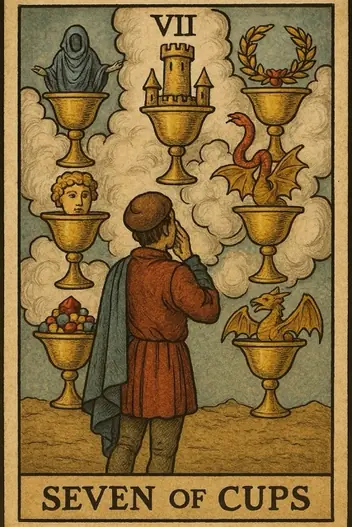
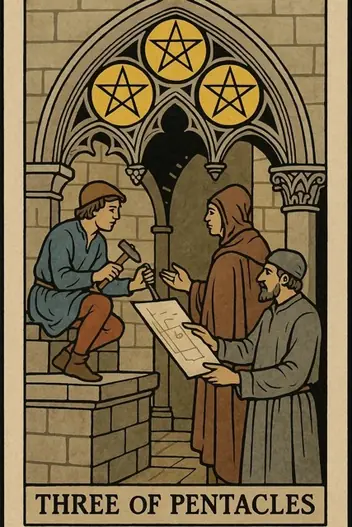
This combination presents a fascinating psychological conflict: the clash between unbounded imagination and disciplined execution. The Seven of Cups represents the realm of fantasy, desire, and multiple possibilities—a state where everything seems possible but nothing is grounded. The Three of Pentacles, conversely, embodies mastery, collaboration, and step-by-step craftsmanship. When these two archetypes collide, you are being asked to filter your grand visions through the lens of practical reality. The core question becomes: Which of your dreams deserves your focused, skilled labor?
Core Dynamics & Interpretation
The psychological state created by this pair is one of creative tension. You likely have an abundance of ideas, projects, or desires swirling in your mind—the Seven of Cups’ hallmark. However, the Three of Pentacles insists that you cannot pursue them all. This is not a time for passive daydreaming; it is a time for strategic selection. The key insight here is that choice is not limitation—it is focus. By committing to one path, you unlock the resources and collaboration needed to build something tangible.
In real-world terms, this combination often appears when someone is juggling multiple offers, career paths, or relationship possibilities. The danger is analysis paralysis—getting lost in the "what ifs" while taking no action. The antidote lies in the Three of Pentacles’ energy: break your vision into small, measurable tasks. Ask yourself: What is the one project or relationship I can commit to building today? This pragmatic approach transforms fantasy into foundation. Your imagination is your blueprint, but your hands must do the work.
Your pair is already on the table. Ask your question and draw the clarifying card
or simply focus on it
What Do Seven of Cups and Three of Pentacles Indicate for Your Career?
Strategic Opportunities:
Identify your top three professional goals and rank them by feasibility. Focus your energy on the one with the clearest path to execution.
Strategic Opportunities:
Seek mentors or collaborators who have complementary skills. The Three of Pentacles thrives in teamwork.
Calculated Risks:
Avoid overcommitting to multiple projects simultaneously. This dilutes your quality and delays results.
In your professional life, this combination signals a critical decision point. You may be tempted by a shiny new opportunity—a side hustle, a career change, or a speculative investment. While the Seven of Cups encourages exploration, the Three of Pentacles demands due diligence. Before saying "yes," ask for data, timelines, and concrete deliverables. Financially, this is not a time for gambling on high-risk ventures. Instead, invest in skill-building and systems that produce consistent, measurable outcomes. The most profitable move is to master one craft rather than dabbling in many. If you are self-employed, this card pair suggests hiring a team or forming a partnership to execute your vision—you cannot do it all alone. Bold warning: Beware of "get rich quick" schemes or projects that promise immediate results without a solid plan.
Uncover hidden insights
Let our advanced Tarot system interpret these archetypes specifically for your personal path.
Seven of Cups and Three of Pentacles in Love Tarot
If you are single:
This pair warns against idealizing potential partners based on superficial traits or fantasies. Focus on observable actions and consistency rather than charm or promises.
If you are in a relationship:
You may be projecting unrealistic expectations onto your partner, or conversely, feeling overwhelmed by their multiple demands. Ground your connection in shared goals and daily effort.
The relationship dynamics here often involve a power imbalance between dreaming and doing. One partner may be the "visionary," constantly proposing new ideas, while the other feels like the "worker," responsible for execution. This can breed resentment or burnout. The healthiest path is collaborative negotiation: agree on one or two shared priorities and commit to building them together over time. Bold emotional honesty is required—ask your partner: Which of our shared dreams are we actually willing to invest time and energy into? Avoid the trap of mistaking excitement for depth. Real intimacy grows through consistent, small acts of collaboration, not through grand fantasies.
What If Seven of Cups or Three of Pentacles Appears Reversed?
When cards appear reversed, the tension between them either weakens or shifts into a destructive channel.
If the Seven of Cups is reversed:
This may indicate blocked potential or recklessness. The person has either completely lost the ability to dream (burnout, depression), or, conversely, grabs at every idea indiscriminately, acting impulsively. Advice: return to the basics — pause and write down one, simplest, and most achievable goal for the week.
If the Three of Pentacles is reversed:
This is a signal of internal resistance and team weakness. The person does not want to learn, ignores feedback, or sabotages collaborative work. Fantasies remain fantasies because there is no discipline to manifest them. Warning: your ego is hindering your growth. Find someone who will tell you the truth, and accept criticism as a tool, not an insult.
If BOTH are reversed:
This is complete imbalance. The person is in a state of chaotic passivity: they do not know what they want (Seven of Cups), and are not ready to work on what exists (Three of Pentacles). A logical way to correct this: start small. Do not think about the "great goal," just do one boring but useful thing: tidy up your desk, pay your taxes, close one debt.
Seven of Cups and Three of Pentacles: Warning Signs
When this energy is blocked or misdirected, it manifests as chronic indecision or perfectionism. You might find yourself researching endlessly, gathering resources, and planning—but never starting. This is the shadow of the Seven of Cups: the fear of choosing wrong paralyzes you into choosing nothing. Alternatively, you may rush into a project based on pure enthusiasm, ignoring the need for structure, feedback, and iteration (the shadow of the Three of Pentacles). Cognitive biases at play include the sunk cost fallacy (sticking with a bad idea because you’ve already invested time) and confirmation bias (only seeing evidence that supports your fantasy). Self-sabotage occurs when you over-idealize a path, then abandon it the moment it requires mundane effort. The antidote is ruthless self-honesty: ask yourself, Am I building something real, or am I just in love with the idea of it?
Seven of Cups and Three of Pentacles Combined Message
Constructive use of this dynamic requires you to become the architect of your own reality. The Seven of Cups is your research and development department. The Three of Pentacles is the production department. Your task is to establish communication between them. Do not kill the fantasy, but do not let it seize power either. Introduce a rule: for every new idea (Seven of Cups), you must create at least a rudimentary three-step plan (Three of Pentacles).
Deep strategic advice:
Use the energy of the Seven of Cups to create a "vision board" or mind map of your desires, but then immediately engage the Three of Pentacles to break that map down into concrete, measurable tasks. For example, "become an expert" is a vague fantasy. "Write 10 articles on the topic and receive 5 reviews from colleagues" is the work of the Three of Pentacles. In this combination, Tarot teaches us that mastery is not the renunciation of a dream, but its disciplined embodiment. Only by passing through the routine can you make the dream a reality.
Your Next Step: Personal Context Matters
The core message of Seven of Cups and Three of Pentacles is this: Your dreams are valid, but they require a blueprint and a work ethic to become real. Choose one vision, commit to the process, and trust that focused effort will yield results far beyond scattered fantasies. The magic is not in the idea—it is in the execution.
Want to know how this combination applies to your specific situation? While this article explains the general archetype, the true power of Tarot comes from personal context. Your unique question—about a relationship, a career move, or a creative project—deserves a reading tailored to you. Use the Fortune Cards app on the web or download it now to get a deep, personalized interpretation of the Seven of Cups and Three of Pentacles for your exact circumstances. Your vision is waiting. Build it.
Interpretation by the Fortune Cards editorial team, based on the Rider–Waite tradition and Jungian archetypes. About our methodology · Updated: 2026-08-26
Other Combinations with Seven of Cups
Other Combinations with Three of Pentacles
Explore Individual Card Meanings
Table of Contents
- Core Dynamics & Interpretation
- What Do Seven of Cups and Three of Pentacles Indicate for Your Career?
- Seven of Cups and Three of Pentacles in Love Tarot
- What If Seven of Cups or Three of Pentacles Appears Reversed?
- Seven of Cups and Three of Pentacles: Warning Signs
- Seven of Cups and Three of Pentacles Combined Message
- Your Next Step: Personal Context Matters
Ready to find answers to your questions?
Start your first reading now and look at your situation with fresh clarity. The cards are ready to reveal deeper meaning.