Seven of Pentacles and Eight of Pentacles Tarot Combination

- Arcana
- Seven of Pentacles — Minor Arcana, Pentacles; Eight of Pentacles — Minor Arcana, Pentacles
- Elements
- Seven of Pentacles — Earth; Eight of Pentacles — Earth
- Elemental interaction
- Same element — energies intensify each other
- Numerology
- 7 + 8 = 15 → 6
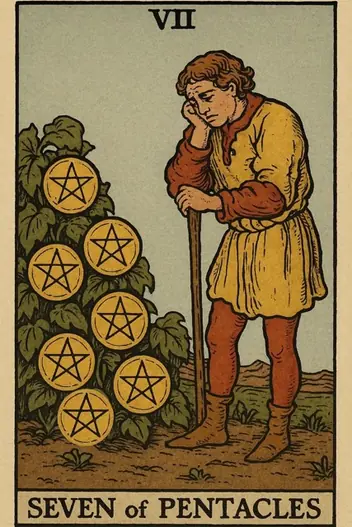
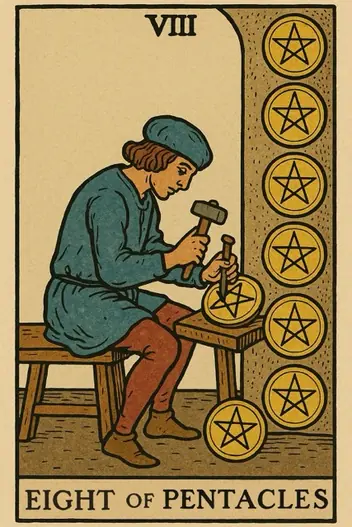
When the Seven of Pentacles meets the Eight of Pentacles, we witness a powerful collision between the archetype of the patient gardener and the dedicated artisan. The Seven represents a moment of pause—a critical evaluation of long-term investments and the fruits of past labor. The Eight represents focused, iterative action—the daily grind of skill-building and meticulous work. Together, they create a psychological tension: you are being asked to step back and assess whether your current efforts are truly aligned with your desired harvest, while simultaneously committing to the disciplined practice required to get there.
This combination is not about instant gratification or dramatic transformation. Instead, it is a strategic recalibration of your workflow and expectations. You may feel a nagging sense of impatience or a desire for faster results, but the cards insist that mastery comes from both honest self-reflection and consistent, deliberate effort. The key is to avoid the trap of all evaluation and no action, or all action and no reflection.
What Do Seven of Pentacles and Eight of Pentacles Mean Together?
The core dynamic here is a feedback loop between assessment and application. The Seven of Pentacles asks: Is this still worth my time? Am I seeing the growth I expected? The Eight of Pentacles answers: Keep refining your process, but only if the foundation is solid. This creates a mindset of calculated persistence—you are not blindly grinding away, but you are not paralyzed by analysis either.
Psychologically, this combination represents the integration of the "Inner Critic" with the "Inner Artisan." The Inner Critic (Seven) wants to judge past results and demand immediate perfection. The Inner Artisan (Eight) wants to practice, make mistakes, and improve incrementally. The healthy outcome is a realistic self-appraisal that fuels targeted skill development, rather than self-flagellation. For example, if you are learning a new language, this pair suggests reviewing your progress after a month of study, identifying weak spots (Seven), and then drilling those specific areas for the next month (Eight).
The most important insight is that this combination warns against two common cognitive biases: the sunk cost fallacy (continuing because you've already invested heavily) and the planning fallacy (underestimating the time and effort required). You must be willing to cut losses on projects that are not yielding returns, but also double down on those that show genuine promise with renewed dedication. The real-world implication is a strategic pivot—not a complete overhaul, but a refined direction.
Your pair is already on the table. Ask your question and draw the clarifying card
or simply focus on it
Love and Relationships
If you are single:
This pair suggests you are in a period of evaluating your dating patterns. You may feel frustrated by slow progress or repeated disappointments. The advice is to stop expecting instant chemistry and instead invest time in getting to know someone through consistent, low-pressure interactions. Assess whether your "type" or approach is actually serving you.
If you are in a relationship:
The message is about balancing patience with effort. You may be feeling that the relationship is stagnating, but instead of giving up, you need to commit to the daily work of communication and shared activities. This is a time to review shared goals (Seven) and then schedule quality time or learn a new skill together (Eight).
In a relationship context, this combination highlights a dynamic where one partner may feel the other is "not trying hard enough" (Eight) or "not seeing the big picture" (Seven). The healthy resolution involves both partners acknowledging the need for both reflection and action. For instance, if you feel your partner is neglecting your emotional needs, the Seven asks you to reflect on whether your expectations are realistic, while the Eight asks you to proactively plan a weekly check-in ritual rather than waiting for them to change. Avoid the shadow of passive-aggressive resentment—where you silently judge your partner's lack of effort without clearly communicating your needs.
Your unique Tarot reading
See how these cards interact with your destiny. Start a free personal reading now.
Seven of Pentacles and Eight of Pentacles: Career and Money
Strategic Opportunities:
Review your current skill set against market demands. Identify one skill that, if improved by 20%, would significantly increase your income or job satisfaction.
Strategic Opportunities:
Create a 90-day learning plan. Dedicate 30 minutes daily to deliberate practice in that skill, tracking your progress weekly.
Calculated Risks:
Avoid starting new projects without a clear ROI assessment. This combination warns against spreading yourself thin. Focus on deepening one area of expertise rather than diversifying prematurely.
In a professional context, this is a powerful signal for career development and financial planning. The Seven of Pentacles urges you to audit your current job, side hustle, or investment portfolio. Are you in a role that offers growth, or are you just collecting a paycheck? The Eight of Pentacles says that if the answer is "no growth," then it is time to invest in yourself—take a course, get a certification, or refine your craft. Financially, this is a time to evaluate your spending habits (Seven) and then automate a savings or investment plan (Eight).
The key strategic warning is to avoid the trap of "busy work." The Eight of Pentacles can become obsessive perfectionism if not guided by the Seven's wisdom. Do not polish a turd. If a project or job is fundamentally flawed, no amount of effort will fix it. Instead, use the Seven's evaluative energy to cut your losses and redirect your energy toward something with higher potential. This is about working smarter, not just harder.
What If Seven of Pentacles or Eight of Pentacles Appears Reversed?
When one or both cards appear reversed, the dynamic is disrupted, creating an imbalance that requires immediate correction.
If the Seven of Pentacles is reversed:
This indicates blocked potential or recklessness. You are either unable to objectively assess the results of your work (self-deception or ignoring obvious failures), or conversely, you are overly critical and devalue real achievements. Advice: Find an external, objective observer (mentor, colleague) to get honest feedback.
If the Eight of Pentacles is reversed:
This is a signal of internal resistance or weakness of will. You lack the discipline for systematic work. You are either procrastinating or abandoning what you've started halfway through due to boredom or fear of failure. Warning: Don't try to "motivate" yourself—create a rigid system of deadlines and external accountability.
If BOTH cards are reversed:
This is a complete imbalance: chaotic action without a plan and evaluation without real effort. You may be simulating intense activity without moving toward your goal, or falling into a stupor from analysis without starting to act. Method of correction: Apply the "5-minute rule." Start doing anything related to your goal for five minutes. This will break the cycle of paralysis and allow you to transition to real work, and then to adequate assessment.
Shadow Side & Pitfalls
The shadow side of this combination is a cognitive trap of "fake productivity" —you may be working incredibly hard (Eight) but on the wrong things, while simultaneously judging yourself harshly for not seeing results (Seven). This leads to burnout and self-doubt. Another pitfall is analysis paralysis: you spend so much time evaluating your progress that you never actually take the next step. You might become a perfectionist who never finishes a project because it's never "good enough" by the Seven's standards.
Self-sabotage can also manifest as a fear of success. You might subconsciously avoid putting in the consistent effort (Eight) because you are afraid of what will happen if you actually achieve your goals (Seven). Alternatively, you might use the Seven's critical voice as an excuse to quit prematurely, telling yourself "this isn't working" when in reality you just need to refine your approach and persist for another cycle. The antidote is to set objective, measurable milestones and to celebrate small wins along the way, rather than waiting for the final harvest.
Seven of Pentacles and Eight of Pentacles: The Combined Message
Constructive use of this card pair's energy requires creating a cycle of "Action → Evaluation → Correction." Do not attempt to choose one over the other. Instead, integrate the rhythm of work and reflection. For example, allocate 5 days per week for intense, focused work (Eight), and one day for strategic planning and result analysis (Seven).
Your primary task is to transform the Seven of Pentacles from a source of anxiety into a calibration tool. When evaluating results, do not ask yourself "Am I good enough?" (a question of self-worth). Ask: "Which specific actions of mine led to this result?" and "What can be improved?" This shifts focus from the person to the process, reducing anxiety and increasing effectiveness.
A deep strategic recommendation: apply the Pareto Principle (80/20). The Eight of Pentacles inclines you toward doing everything perfectly. The Seven of Pentacles helps you understand that 20% of your efforts yield 80% of the results. Focus on that critical 20% of actions. The remaining 80% of tasks can be delegated, automated, or performed to a minimally acceptable standard. This is the path of the master—not doing everything, but doing what truly matters with maximum impact.
Where to Go From Here
The core message of the Seven of Pentacles and Eight of Pentacles is simple: evaluate honestly, then commit deeply. You have the power to transform frustration into mastery by combining critical self-reflection with disciplined practice. This is not a time for grand gestures, but for steady, intelligent effort on a carefully chosen path. The answer to your question lies in the balance between patience and persistence.
Ready to see exactly how this applies to your specific situation? While this article outlines the general archetype, the true power of Tarot lies in personalization. The Fortune Cards app can give you a deep, tailored interpretation of this exact combination for your unique question—whether it's about love, career, or personal growth. Use it on the web or download it now to get the clarity and strategic advice you need to move forward with confidence.
Interpretation by the Fortune Cards editorial team, based on the Rider–Waite tradition and Jungian archetypes. About our methodology · Updated: 2026-08-26
Other Combinations with Seven of Pentacles
Other Combinations with Eight of Pentacles
Explore Individual Card Meanings
Table of Contents
- What Do Seven of Pentacles and Eight of Pentacles Mean Together?
- Love and Relationships
- Seven of Pentacles and Eight of Pentacles: Career and Money
- What If Seven of Pentacles or Eight of Pentacles Appears Reversed?
- Shadow Side & Pitfalls
- Seven of Pentacles and Eight of Pentacles: The Combined Message
- Where to Go From Here
Ready to Discover Your Path?
Join thousands of seekers who have found clarity and guidance through our platform. Your cosmic journey awaits.