Seven of Pentacles
- Arcana
- Minor Arcana, Suit of Pentacles
- Element
- Earth
- Decan
- Saturn in Taurus
- Numerology
- 7
The Seven of Pentacles embodies the archetype of the Patient Cultivator—the part of the psyche that understands value is not instant but accrued through time, effort, and strategic neglect. In Jungian terms, this card represents the tension between the ego’s desire for immediate results and the Self’s longer timeline for maturation. It is a card of suspended judgment, where the outcome of your labor is not yet visible, demanding trust in the process rather than the product.
This card’s central challenge is managing the anxiety of uncertainty. You have planted seeds—in a project, relationship, or skill—and now you must wait. The Seven of Pentacles asks you to resist the impulse to dig up the roots to check their growth. The key psychological resource here is frustration tolerance, the ability to hold space for ambiguity without abandoning your efforts.
Seven of Pentacles: Core Meaning and Interpretation
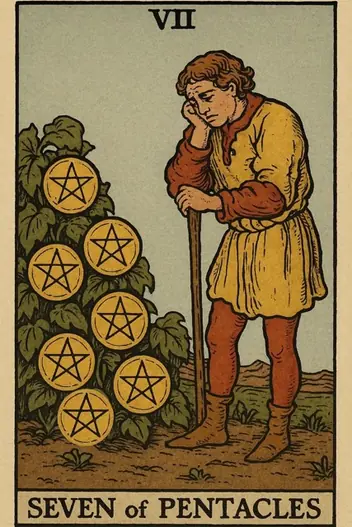
The Seven of Pentacles depicts a figure leaning on a staff, gazing at a flourishing vine of pentacles. The posture is one of contemplation, not action. This is a pause for evaluation: what has been invested, and what is the current yield? The card signals a critical juncture where you must decide whether to continue nurturing a long-term commitment or cut losses. The primary mindset required is strategic patience—not passive waiting, but active monitoring of progress against benchmarks.
Psychologically, this card activates the executive function of delayed gratification, a trait linked to higher long-term success. However, it also exposes the cognitive bias of the sunk cost fallacy: the tendency to continue investing in a failing endeavor simply because you have already invested. The Seven of Pentacles demands you distinguish between productive patience (nurturing a viable asset) and foolish stubbornness (clinging to a dead end). The core insight is that time is a resource, not just a test of endurance.
Ask your question and flip the cards
or simply focus on it
Is Seven of Pentacles a Yes or a No?
Leaning yes.. The Seven of Pentacles represents a period of assessment and patience rather than immediate action or clear-cut results. In a yes/no context, the card suggests the potential for a positive outcome, but only if you are willing to wait and evaluate what has already been sown. The figure in the card gazes at his pentacles with contemplation, not triumph — this is a moment of reckoning, not harvest. In reversed position, the answer shifts toward no or delayed, indicating frustration with wasted effort or a need to abandon a failing investment. The critical caveat: the outcome depends entirely on your willingness to honestly audit your past actions and adjust your strategy before proceeding further.
Get a personalized interpretation
Unlock the combined meaning of your cards in the context of your unique question — for free.
Card of the Day
Today’s energy is one of evaluation and measured patience — the Seven of Pentacles asks you to pause and take stock of your long-term projects. Focus on reviewing what you have built so far: track your progress, note what is growing and what is stagnating, and resist the urge to force immediate results. The trap to avoid is impatience — do not uproot your efforts prematurely out of anxiety or boredom. Also beware of comparison; your neighbor’s harvest may look richer, but their soil and season are different from yours. The day is for quiet reflection, not grand gestures.
Seven of Pentacles in Love and Relationships
If you are not in a relationship:
This card suggests you are in a period of cultivating your own emotional maturity before seeking a partner. The archetype warns against rushing into a connection out of loneliness. Focus on building a foundation of self-worth and clear boundaries; the right partner will appear when your internal garden is ready.
If you are in a relationship:
The Seven of Pentacles points to a phase of taking stock of the relationship’s growth. Are you both investing equally? This card often appears when one partner feels they are doing more work—emotional labor, compromise, or planning—than the other. The practical relationship advice is to schedule an honest, non-confrontational audit of contributions and expectations.
In existing relationships, this card highlights the dynamic of unbalanced investment. One partner may feel they are nurturing the relationship alone while the other reaps the benefits. The healthy path is not to demand immediate reciprocity but to communicate the need for recalibration of effort. Avoid resentment by setting explicit agreements about shared responsibilities. Bold the main practical relationship advice: If you feel overextended, stop giving more and observe how the other person responds to the gap.
What Does Seven of Pentacles Say About Their Feelings?
This person perceives you through the lens of potential and investment — they see you as someone worth waiting for, but they are currently in a phase of evaluation. You evoke in them a sense of cautious hope mixed with scrutiny; they are observing your consistency, your growth, and whether the energy they have put into you is yielding the fruit they expected. Their hidden intention is to determine your long-term viability — they are not ready to commit fully, but they are also not ready to walk away. Their fear is that you may prove to be a slow or unreliable return on their emotional or relational investment. Internally, they are conflicted between their desire for immediate gratification and the knowledge that meaningful connections require time to mature.
Career and Finance
Strategic Opportunities:
This is an ideal time to review your portfolio of projects—identify which ones are yielding returns and which are draining resources. Double down on the top 20% of your efforts.
Resource Management:
Use this pause to invest in skill development that will compound over time, such as learning a new tool or building a professional network. Long-term career capital is built in these quiet periods.
Calculated Risks:
Avoid launching new ventures or making major financial commitments until you have a clear data point on your current investments. The risk is overextending your attention and capital.
In career and finance, the Seven of Pentacles is a strategic reassessment card. It favors prudent resource management over aggressive expansion. If you are a leader, this card advises you to audit team performance without micromanaging—trust the process but verify the metrics. Bold financial warnings or strategic advice: Do not mistake activity for progress. If your bank account or project pipeline is stagnant, the answer is not more frantic effort but a smarter allocation of existing resources. This is a card of compound growth, not quick wins.
Seven of Pentacles Reversed: What Changes
When reversed, the Seven of Pentacles reveals blocked potential and internal resistance. The figure’s patience turns into paralyzing indecision or wasted effort. The core dynamic shifts from strategic waiting to anxiety-driven procrastination. You may be investing time and energy into projects that are clearly failing but you cannot let go, or you may be so afraid of failure that you refuse to start. The reversed card warns of diminishing returns—your efforts are not yielding results because you are either over-analyzing or under-committing.
This reversal manifests as self-sabotage through perfectionism. You delay completing a task because it is not "good enough," or you refuse to delegate because no one can do it as well as you. The psychological correction is to set a hard deadline for a "good enough" version and release it into the world. The warning is clear: Your unwillingness to accept imperfect results is costing you more than any mistake ever could. To correct this imbalance, force yourself to take one small, irreversible action today.
What Are the Pitfalls of Seven of Pentacles?
The shadow of the Seven of Pentacles is the archetype of the Hoarder—the part of you that clings to resources, time, or relationships out of fear of scarcity. This manifests as overprotection: you refuse to share credit, delegate tasks, or invest in others because you believe your value lies in what you possess. The cognitive bias here is the endowment effect, where you overvalue what you already have simply because it is yours.
Another shadow pitfall is avoiding responsibility by retreating into analysis paralysis. You tell yourself you are "evaluating" when you are actually avoiding a decision. This can lead to missed opportunities as the world moves past you. The irrational fear driving this behavior is often fear of regret—the terror of making a wrong choice. The solution is to embrace the concept of "good enough" and practice making decisions with incomplete data. Remember: Inaction is also a choice, and it often carries the highest cost of all.
Synthesis: Strategic Conclusion
The Seven of Pentacles is not a card of rest; it is a card of strategic observation. To use its energy constructively, you must adopt the mindset of a scientist studying an experiment. You have set variables in motion, and now you must collect data without interfering. This requires emotional discipline—the ability to sit with discomfort and trust that your earlier decisions were sound. The key strategic action is to define clear metrics for success before you begin waiting. What does "growth" look like? When will you decide to pivot? Without these benchmarks, patience becomes aimless.
Practically, this card advises you to create a structured review schedule—weekly or monthly—to assess progress without obsessing daily. Use this time to optimize the conditions for growth (e.g., better soil, more water) rather than pulling up the plants. For example, if you are waiting for a business to become profitable, focus on improving your sales funnel rather than checking your bank account every hour. The ultimate lesson of the Seven of Pentacles is that time is a tool, not a test. Use it wisely, and the harvest will come.
Applying This to Your Situation
This psychological and strategic breakdown provides a deep understanding of archetypes. However, Tarot is never universal for everyone. To understand exactly how this dynamic applies to your specific situation, a reading tailored exclusively to you is necessary.
Download the Fortune Cards app or visit our platform to get a deep AI interpretation of your unique spread. Don't just read about the cards—use Fortune Cards to find out exactly what step you need to take next.
Try Tarot Spreads with Seven of Pentacles
Interpretation by the Fortune Cards editorial team, based on the Rider–Waite tradition and Jungian archetypes. About our methodology · Updated: 2026-08-26
Top Combinations with Seven of Pentacles
Discover how Seven of Pentacles interacts with other major cards in the deck to form powerful messages.
All 77 Combinations with Seven of Pentacles
Discover how this card interacts with every other card in the Tarot deck and reveal hidden meanings.
Table of Contents
- Seven of Pentacles: Core Meaning and Interpretation
- Is Seven of Pentacles a Yes or a No?
- Card of the Day
- Seven of Pentacles in Love and Relationships
- What Does Seven of Pentacles Say About Their Feelings?
- Career and Finance
- Seven of Pentacles Reversed: What Changes
- What Are the Pitfalls of Seven of Pentacles?
- Synthesis: Strategic Conclusion
- Applying This to Your Situation
Explore Tarot Universe
Ready to find answers to your questions?
Start your first reading now and look at your situation with fresh clarity. The cards are ready to reveal deeper meaning.