Three of Swords and Seven of Pentacles Reversed in Tarot
- Arcana
- Three of Swords — Minor Arcana, Swords; Seven of Pentacles — Minor Arcana, Pentacles
- Elements
- Three of Swords — Air; Seven of Pentacles — Earth
- Elemental interaction
- Opposing elements — energies create tension
- Numerology
- 3 + 7 = 10 → 1
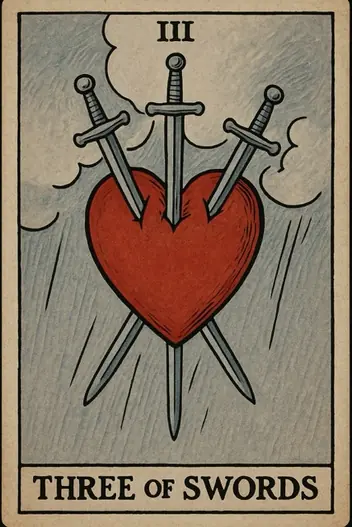
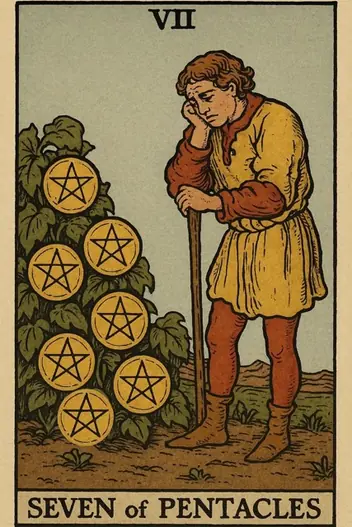
The Three of Swords represents acute emotional pain, betrayal, or the piercing truth of a painful realization. The Seven of Pentacles embodies patience, assessment, and the anxiety of waiting for long-term investments to bear fruit. When these two cards meet, the archetype is not about instant catastrophe, but about the psychological strain of enduring a slow, painful process while questioning whether your efforts have been wasted.
This combination forces you to confront a core tension: you have invested significant time, energy, or emotion into something—a relationship, a project, a career path—and now you are experiencing heartache or disappointment. The Seven of Pentacles asks you to pause and evaluate, while the Three of Swords insists you feel the wound. The pragmatic lesson here is that growth often requires sitting with discomfort before you can make a clear decision. This is not a call to abandon everything, but to diagnose the source of the pain and adjust your strategy accordingly.
Three of Swords and Seven of Pentacles: How These Energies Interact
The psychological state created by this pairing is one of calculated grief. You are not in the throes of a sudden, blinding loss; rather, you are aware of a slow leak of satisfaction or trust. The Seven of Pentacles' energy of deliberate observation collides with the Three of Swords' demand for emotional honesty. You may find yourself analyzing a painful situation with a cold, almost clinical detachment, trying to determine if the pain is a temporary setback or a sign of fundamental failure.
This dynamic often manifests as rumination—the exhausting loop of replaying past events to see where things went wrong. The mind (Swords) tries to dissect the heart (Three of Swords) while the body (Pentacles) feels the weight of time and effort invested. The key insight here is that this combination rarely points to a complete loss. Instead, it suggests a period of strategic reassessment. You are being asked to separate the emotional pain from the practical data. What specifically hurts? And what, objectively, is still growing, albeit slowly?
The real-world implication is about resource allocation. Are you pouring energy into a situation that is actively harming you, or are you simply impatient with a natural growth cycle? The Seven of Pentacles warns against impulsive destruction—cutting ties before you have fully understood the harvest. The Three of Swords warns against masochistic endurance—staying in pain out of a sense of duty or sunk cost fallacy. The balance lies in acknowledging the hurt while maintaining the discipline to observe and wait for clarity.
Your pair is already on the table. Ask your question and draw the clarifying card
or simply focus on it
Three of Swords and Seven of Pentacles Love Outcome
If you are single:
This pair suggests you are evaluating a recent romantic disappointment or a pattern of heartache. Do not rush into a new connection to numb the pain. Instead, use this time to analyze what values were violated and what you truly need from a partner. The slow growth of self-awareness is your priority.
If you are in a relationship:
You are likely experiencing a period of emotional distance or unspoken resentment. One partner may feel the other is not investing enough, while the other feels criticized or misunderstood. The core issue is a misalignment of effort and expectations.
In relationships, the Three of Swords and Seven of Pentacles often point to a relationship that is in a painful but necessary evaluation phase. This is not a card of sudden divorce, but of waking up to a chronic problem. The emotional pain (Three of Swords) stems from the realization that the relationship is not yielding the emotional or practical returns you expected (Seven of Pentacles). The critical relationship advice here is to stop blaming and start measuring. What specific actions or behaviors are causing the hurt? Are they patterns that can be corrected with effort, or are they fundamental incompatibilities?
Boldly, this combination demands that you take ownership of your half of the dynamic. The Seven of Pentacles is about your investment, not your partner's. Ask yourself: Have you been clear about your needs? Have you been over-investing out of fear of being alone? The solution is not to demand immediate change, but to set a clear, time-bound observation period—perhaps a month—where you both consciously adjust your contributions and then reassess. This turns emotional chaos into a manageable experiment.
Three of Swords and Seven of Pentacles for Career and Money
Strategic Opportunities:
Identify the specific bottleneck. Is it a lack of skills, resources, or support? Pinpointing the exact cause of the stagnation allows you to target your next move.
Strategic Opportunities:
Leverage the pain as data. A deal falling through or a project failing can reveal a market need or a process flaw. Use the emotional sting to fuel a more intelligent strategy.
Calculated Risks:
Avoid the "sunk cost" trap. Do not throw good money or time after bad simply because you have already invested heavily. If the core value is broken, cut your losses.
In the professional realm, this combination is a powerful signal to audit your long-term projects. The Three of Swords indicates that a specific outcome—a promotion, a client, a product launch—has caused you disappointment or even betrayal. The Seven of Pentacles asks you to look at the overall health of the garden, not just one wilting flower. You may have been too attached to a single result, ignoring the slow, steady growth happening elsewhere.
Financially, this is a warning against emotionally driven decisions. Do not sell a long-term investment because of a short-term market dip that stings your ego. Do not quit a job you have been building at because of one harsh critique. Instead, treat the pain as a diagnostic tool. The Three of Swords reveals where your values are being violated—perhaps you feel undervalued or exploited. The Seven of Pentacles reveals the practical timeline. Your strategic move is to create a 90-day plan to address the specific pain point (e.g., request a performance review, renegotiate a contract, or skill up for a lateral move). If the situation does not improve within that timeframe, then the data supports a change.
Ask your specific question
Don't rely on generic meanings. Get a customized reading tailored specifically to your energies.
Three of Swords and Seven of Pentacles Reversed Meaning
When cards are reversed, constructive energy becomes blocked, and destructive patterns intensify.
If the Three of Swords is reversed:
Pain is denied or repressed. You refuse to acknowledge the problem, yet continue to invest energy (the Seven) into a situation that is clearly a dead end. Result: chronic fatigue with no apparent cause. Advice: acknowledge the fact of the damage, even if it feels humiliating.
If the Seven of Pentacles is reversed:
Inner resistance and laziness. You are aware of the problem (the Three), but refuse to work on a solution. Trap: self-sabotage through procrastination. Advice: lower the bar. Start with 15 minutes of conscious action per day, instead of trying to do everything perfectly.
If BOTH are reversed:
Complete imbalance. You do not see the pain (Three reversed) and do not want to work (Seven reversed). This is a state of "freeze" and apathy. Correction: forced contact with reality. Do the thing you fear most — for example, admit a mistake to your partner or quit a job you hate. Only this will restore your sensitivity and will.
Negative Meaning of Three of Swords and Seven of Pentacles
The shadow side of this combination is paralyzing cynicism or victimhood. The seeker may become so focused on the pain of the past that they refuse to see any future potential. The cognitive bias at play is the negativity bias—overweighting the painful data and ignoring the signs of slow, positive growth. This can lead to a self-fulfilling prophecy where you sabotage the very project or relationship you are trying to save, simply because you cannot tolerate the uncertainty.
Another pitfall is emotional martyrdom. The Three of Swords' pain can feel noble, and the Seven of Pentacles' patience can feel like a virtue. But when combined, they can create a toxic story: "I am suffering, and I am waiting, therefore I am a good person." This allows you to avoid taking decisive action. The real shadow is inaction disguised as patience. You are not waiting for clarity; you are avoiding the uncomfortable confrontation or the hard decision. Be brutally honest with yourself: Are you truly assessing, or are you just hiding from the truth?
Three of Swords and Seven of Pentacles: Tarot Advice
How to constructively use this energy? The Three of Swords is your "X-ray," and the Seven of Pentacles is your "surgical instrument." Do not try to dull the pain—use it as a signal for precise action. Your task is to legitimize suffering, but not let it become your identity. Acknowledge: "Yes, I am in pain, and that is normal. Now I know exactly where it hurts, and I can purposefully work on that spot."
Strategic advice: divide your efforts into two phases. Phase 1 (1-2 weeks): Total diagnosis. Write down all sources of your pain and dissatisfaction. Do not try to fix them—just observe. Phase 2 (3-6 months): Targeted therapy. Choose 1-2 key problems from the list and begin working on them slowly but consistently. Do not spread yourself thin. The Seven of Pentacles does not tolerate haste. The quality of your attention matters more than the number of hours spent on "working on yourself."
This combination teaches us the courage to be imperfect. You cannot avoid pain, but you can choose how to respond to it. Your strength lies not in ignoring problems, but in patiently and consciously solving them. Use this period to build something stable that will not collapse at the first blow of fate.
Where to Go From Here
The core message of the Three of Swords and Seven of Pentacles is this: Pain is data. Patience is a tool. Use them together wisely. You are in a season of evaluation where emotional honesty must guide your practical decisions, not replace them. Do not rush to cut the cord, but do not ignore the bleeding. The answer lies in a disciplined, time-bound observation of what is truly growing in your life.
While this article provides the universal archetype, the true power of Tarot lies in its application to your unique situation. To get a deep, personalized interpretation of this exact combination for your specific question—whether about a relationship, a career move, or a personal dilemma—use the Fortune Cards app. You can access it on the web or download it now. Let the cards speak directly to your life, not just to a general pattern.
Interpretation by the Fortune Cards editorial team, based on the Rider–Waite tradition and Jungian archetypes. About our methodology · Updated: 2026-08-26
Other Combinations with Three of Swords
Other Combinations with Seven of Pentacles
Explore Individual Card Meanings
Table of Contents
- Three of Swords and Seven of Pentacles: How These Energies Interact
- Three of Swords and Seven of Pentacles Love Outcome
- Three of Swords and Seven of Pentacles for Career and Money
- Three of Swords and Seven of Pentacles Reversed Meaning
- Negative Meaning of Three of Swords and Seven of Pentacles
- Three of Swords and Seven of Pentacles: Tarot Advice
- Where to Go From Here
Ready to find answers to your questions?
Start your first reading now and look at your situation with fresh clarity. The cards are ready to reveal deeper meaning.