Eight of Cups and Seven of Pentacles Reversed in Tarot
- Arcana
- Eight of Cups — Minor Arcana, Cups; Seven of Pentacles — Minor Arcana, Pentacles
- Elements
- Eight of Cups — Water; Seven of Pentacles — Earth
- Elemental interaction
- Friendly elements — energies support each other
- Numerology
- 8 + 7 = 15 → 6
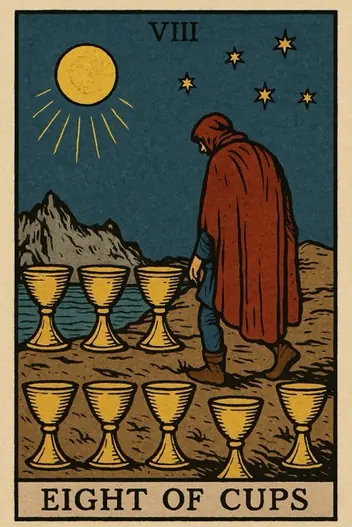
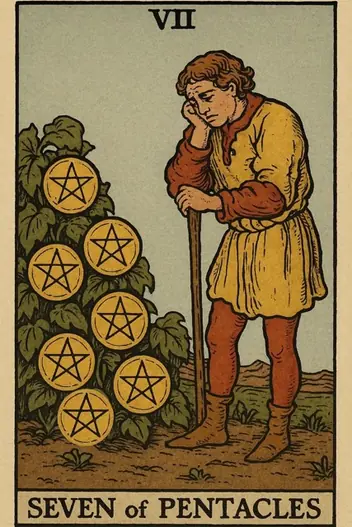
When the Eight of Cups—the archetype of emotional withdrawal and deliberate departure—meets the Seven of Pentacles—the archetype of patient investment and assessment—you face a critical psychological crossroads. This combination represents the moment when you must decide whether to continue nurturing a long-term effort or to cut your losses and move on. It is not about impulsive flight; it is about calculated abandonment after a period of honest evaluation.
The tension here is between sunk cost fallacy and strategic disengagement. The Seven of Pentacles asks you to review what you’ve built, while the Eight of Cups questions whether that foundation still serves your deeper purpose. This pairing often appears when you have invested significant time, energy, or resources into a situation—be it a relationship, career path, or personal project—and now realize that further effort yields diminishing returns. The key psychological insight is that leaving is not failure; it is a form of resource reallocation.
Eight of Cups and Seven of Pentacles: How These Energies Interact
The core dynamic of Eight of Cups and Seven of Pentacles is a deliberate pivot point. You are not fleeing in panic; you are conducting a cost-benefit analysis of your emotional and material investments. The Seven of Pentacles provides the data—the results, the growth, the stagnation—while the Eight of Cups provides the courage to act on that data, even if it means leaving behind something you’ve worked hard to build.
This combination demands ruthless self-honesty. Ask yourself: Am I staying because of genuine potential, or because I’m afraid to admit my effort was misplaced? The Eight of Cups energy is not about giving up; it is about redirecting your finite energy toward more fertile ground. The Seven of Pentacles reminds you that time is a non-renewable resource, and continuing to pour it into a barren field is a decision, not an inevitability.
Psychologically, this pairing highlights the conflict between attachment and growth. The seeker may experience cognitive dissonance—knowing rationally that a situation is unfulfilling, yet feeling emotionally bound by the investment already made. The path forward requires emotional regulation and strategic foresight: acknowledging the loss of what was built, but recognizing that future returns depend on present choices, not past efforts.
Eight of Cups and Seven of Pentacles: Career and Money
Strategic Opportunities:
Reassess your current project or role. Are you spending time on tasks that no longer align with your long-term goals? This is the moment to cut low-return activities.
Strategic Opportunities:
Consider a career pivot that leverages your existing skills but targets a more promising market or industry. Your past investment is not wasted; it’s a foundation for a smarter move.
Calculated Risks:
Avoid the sunk cost trap. Do not stay in a job or business venture just because you’ve already invested years. Objectively evaluate the next 12 months—if growth is flat, leaving is the smarter financial decision.
In career and finance, this combination is a strategic retreat, not a resignation. It suggests you have been patiently cultivating a professional path, but the harvest is not matching your expectations. Perhaps you’ve been loyal to a company that doesn’t reward loyalty, or you’ve poured capital into a side project that isn’t gaining traction. The Eight of Cups here is about redirecting your resources—your time, energy, and money—toward a venture with better prospects.
Important financial warning: Do not let pride dictate your decisions. The Seven of Pentacles shows that you have worked hard, but hard work alone does not guarantee returns. If the data says “diminishing returns,” the most financially mature move is to exit gracefully and reinvest elsewhere. For entrepreneurs, this may mean sunsetting a product line; for employees, it may mean updating your resume and networking while still employed.
Your pair is already on the table. Ask your question and draw the clarifying card
or simply focus on it
Eight of Cups and Seven of Pentacles in Love and Relationships
If you are single:
This combination suggests you are evaluating a potential partner through a pragmatic lens. You may sense that the emotional investment required outweighs the potential reward. Trust this assessment—walking away early saves future pain.
If you are in a relationship:
You and your partner may be at a tipping point. One or both of you are questioning whether the long-term effort is yielding the intimacy or growth you need. Honest, non-accusatory communication is essential.
In relationships, this pairing often signals a quiet, deliberate withdrawal rather than a dramatic breakup. One partner may have been over-functioning—carrying the emotional and logistical weight—while the other remains passive or unresponsive. The Eight of Cups energy here is about setting boundaries and choosing to stop compensating for the other’s lack of effort. The Seven of Pentacles asks: Has the relationship been growing, or have you just been maintaining it?
Key advice: Do not confuse comfort with connection. If you feel you are the only one investing, your departure is a rational act of self-preservation. For couples, this is a moment to renegotiate terms—not to force the other to change, but to decide if the current dynamic is worth sustaining. Boldly name the imbalance and see if your partner is willing to meet you halfway.
Eight of Cups and Seven of Pentacles Reversed: How to Read It
When the Eight of Cups is reversed, the dynamic shifts dramatically. Withdrawal is blocked by fear or guilt. You know you need to leave, but you cannot. This is a state of "frozen decision" — you remain in a toxic environment because you fear loneliness or judgment. Advice: seek an external consultant (psychologist, mentor) who can help you separate rational fear from irrational fear.
If the Seven of Pentacles is reversed, it points to internal resistance to evaluation. You refuse to see reality, preferring to live in the illusion that "everything will work out soon." This is a classic deferred life syndrome. Warning: this position leads to complete resource depletion — you risk being left with nothing when the illusion collapses.
If BOTH cards are reversed, a complete imbalance arises: you can neither leave nor stay, nor adequately assess the situation. This is the trap of chronic uncertainty. Remedy: artificially create a deadline. Give yourself 30 days to make a decision. During this time, gather objective data (numbers, facts, feedback) and make a decision. Use the "burn your bridges" technique — after the deadline, do not return to analysis.
Ask your specific question
Don't rely on generic meanings. Get a customized reading tailored specifically to your energies.
Negative Meaning of Eight of Cups and Seven of Pentacles
The shadow side of this combination is paralyzed indecision or premature abandonment. The seeker may become stuck in the Seven of Pentacles’ assessment phase, endlessly analyzing without acting. This leads to analysis paralysis, where you keep waiting for a sign that never comes, while the Eight of Cups’ energy turns into resentful stagnation. Alternatively, you might impulsively walk away (the shadow of the Eight of Cups) without doing the necessary evaluation (the Seven of Pentacles), burning bridges you might later need.
Another pitfall is self-deception about your motives. Are you leaving because the situation is truly barren, or because you fear the hard work of commitment? The Seven of Pentacles can mask avoidance as wisdom. Similarly, the Eight of Cups can mask fear of vulnerability as a strategic move. Cognitive bias to watch for: Confirmation bias—you may only see evidence that supports leaving, ignoring signs that the situation could still bear fruit with more effort or a different approach.
Overall Meaning of Eight of Cups and Seven of Pentacles
How can the energy of the Eight of Cups be used constructively to balance the Seven of Pentacles? The key lies in separating the processes. First, you conduct an audit (Seven of Pentacles), but you do it coldly and rationally, without emotion. Record the facts: how much was invested, what the result is, what the potential is. Then, based on this data, you make a decision. The Eight of Cups is not an emotional impulse, but the execution of a verdict handed down by reason.
The main strategic mistake is trying to combine these processes. You cannot evaluate and leave at the same time. You risk either leaving too early (out of fear) or staying too long (out of hope). A clear algorithm: one week of analysis — one day for decision-making — one week for implementing the departure or a new investment.
This combination teaches us the courage to admit our mistakes and the discipline not to repeat them. If you see that your "investment" is not working, do not wait for a miracle. The Seven of Pentacles gives you a map of the terrain, and the Eight of Cups gives you a compass. Your task is not to ask "should I leave?", but to ask "how can I leave with minimal losses and maximum experience?" The answer to this question is your strategy for the coming quarter.
Where to Go From Here
The Eight of Cups and Seven of Pentacles together deliver a clear message: Honestly assess what you’ve built, then have the courage to leave if it no longer serves your growth. This is not about quitting; it is about strategic disinvestment in areas that drain you, so you can reinvest in areas that fulfill you. Your past effort is not wasted—it has taught you what doesn’t work, which is invaluable data for your next move.
To get a truly personalized reading that factors in your specific question, life situation, and other cards in your spread, use the Fortune Cards app. This article gives you the archetypal framework, but the real insight comes when the cards speak to your unique story. Open the app on the web or download it now to receive a deep, customized interpretation of this combination for your exact question—whether it’s about love, career, or a major life decision. The answer is waiting for you.
Interpretation by the Fortune Cards editorial team, based on the Rider–Waite tradition and Jungian archetypes. About our methodology · Updated: 2026-08-26
Other Combinations with Eight of Cups
Other Combinations with Seven of Pentacles
Explore Individual Card Meanings
Table of Contents
- Eight of Cups and Seven of Pentacles: How These Energies Interact
- Eight of Cups and Seven of Pentacles: Career and Money
- Eight of Cups and Seven of Pentacles in Love and Relationships
- Eight of Cups and Seven of Pentacles Reversed: How to Read It
- Negative Meaning of Eight of Cups and Seven of Pentacles
- Overall Meaning of Eight of Cups and Seven of Pentacles
- Where to Go From Here
Ready to find answers to your questions?
Start your first reading now and look at your situation with fresh clarity. The cards are ready to reveal deeper meaning.