Six of Swords and Six of Pentacles Together in Tarot
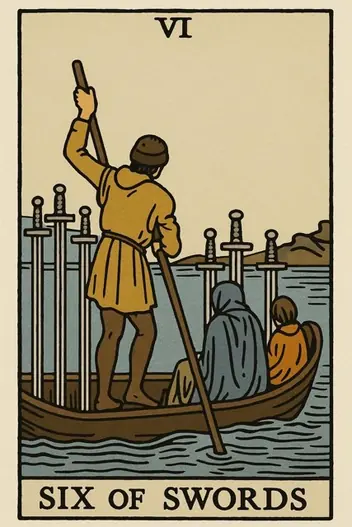
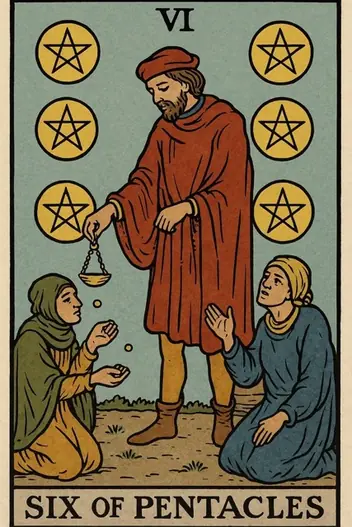
- Arcana
- Six of Swords — Minor Arcana, Swords; Six of Pentacles — Minor Arcana, Pentacles
- Elements
- Six of Swords — Air; Six of Pentacles — Earth
- Elemental interaction
- Opposing elements — energies create tension
- Numerology
- 6 + 6 = 12 → 3
When the Six of Swords—the card of moving through troubled waters toward calmer shores—meets the Six of Pentacles—the card of balanced giving and receiving—we encounter a powerful psychological moment. This is not a random collision of energies. It represents the intersection of deliberate emotional transition and tangible resource exchange. In Jungian terms, we are witnessing the integration of the Puer Aeternus (the eternal youth seeking escape) with the Senex (the wise elder who manages material reality). The result is a pragmatic, albeit vulnerable, strategy for navigating change.
This combination suggests the seeker is not merely drifting away from a problem. They are actively negotiating the terms of their departure. The Six of Swords provides the motivation to leave a stagnant or painful situation. The Six of Pentacles provides the framework for doing so with dignity, fairness, and a clear-eyed assessment of what is owed—and what is being offered. This is a calculated retreat, not a desperate flight.
What Do Six of Swords and Six of Pentacles Mean Together?
The core dynamic here is managed vulnerability. The Six of Swords archetype is inherently passive—you are a passenger in a boat, moving forward but not rowing. The Six of Pentacles injects agency into this passivity by focusing on the transaction of support. Psychologically, this creates a state of strategic dependence. You are allowing yourself to be helped, but you are also setting clear terms for that help. This is not charity; it is an investment in your transition.
The key insight is that you must accept help without sacrificing your autonomy. The Six of Pentacles warns against creating a permanent power imbalance. If you are the one receiving resources (money, advice, emotional support), you must have a plan to eventually become the giver. If you are the one giving, you must ensure your generosity is not enabling the other person’s stagnation. The boat of the Six of Swords cannot be rowed by someone else forever.
This combination forces a confrontation with the shadow of entitlement. The seeker must ask: Am I moving forward because I am owed something, or because I am ready to earn my passage? The answer dictates whether this is a healthy transition or a disguised form of codependency. Real-world implications include negotiating a severance package, accepting a loan for a career change, or moving in with a partner while you rebuild your finances. The energy is practical, but it requires ruthless honesty about the terms of the exchange.
Your pair is already on the table. Ask your question and draw the clarifying card
or simply focus on it
Career and Finances
Strategic Opportunities:
Leverage your network for introductions and referrals. Someone in your professional circle is willing to open a door for you, but you must be ready to demonstrate your value.
Strategic Opportunities:
Negotiate a phased exit or a transition plan. If you are leaving a job, ask for a severance, a reference, or a consulting arrangement. This is a graceful departure that preserves relationships.
Calculated Risks:
Do not accept a “helping hand” that ties you to a bad situation. A loan or favor from a boss or colleague can create an obligation that compromises your future decisions. Beware of strings attached.
In the professional realm, this combination is a blueprint for strategic resource management. You are likely in a period of career recalibration—changing industries, roles, or even starting a business. The Six of Pentacles urges you to audit your assets: What skills, connections, or financial reserves can you draw upon? The Six of Swords tells you to use those assets to move toward a better position, not just away from a bad one.
A critical financial warning: Do not confuse generosity with investment. If someone offers you money or a job, understand their motivation. Are they investing in your potential, or are they trying to control your trajectory? Treat every transaction as a data point. If the terms are unclear, ask for clarity. This is not about being ungrateful; it is about protecting your long-term autonomy. The boat you are in must eventually become your own.
Six of Swords and Six of Pentacles in Love Tarot
If you are single:
This pair suggests you are attracted to stability, not passion. Evaluate a potential partner based on their reliability and willingness to share resources, not their emotional intensity. You are in a phase of healing, not thrill-seeking.
If you are in a relationship:
You are navigating a power dynamic that needs rebalancing. One partner may feel like the “rescuer” or the “charity case.” Open a conversation about fairness and long-term reciprocity.
In relationships, this combination reveals a transitional phase driven by practical needs. You may be moving in together, combining finances, or supporting a partner through a crisis. The emotional intelligence required here is high: you must distinguish between genuine support and enabling behavior. The Six of Pentacles warns against creating a savior complex. If you are the one giving more, ask yourself if you are doing so out of love or out of a need to feel needed. If you are the one receiving, ask if you are taking without a plan to reciprocate.
The key relationship advice is to codify the terms of your support. This is not about contracts; it is about clear, honest communication. Say: “I am happy to help you through this transition, but I need to know your timeline for getting back on your feet.” This removes ambiguity and resentment. The Six of Swords energy means you are moving away from something—make sure you are not also moving away from each other.
Your unique Tarot reading
See how these cards interact with your destiny. Start a free personal reading now.
Six of Swords and Six of Pentacles: Warning Signs
The shadow of this combination manifests as transactional dependency. The seeker may rationalize staying in a bad situation because the “price” of leaving seems too high, or they may accept help with no intention of reciprocating. This is the shadow of the victim (Six of Swords) meeting the shadow of the benefactor (Six of Pentacles). The cognitive bias at play is the sunk cost fallacy—you may feel you have invested too much (time, money, emotion) to leave, so you stay and accept “help” that actually keeps you trapped.
Another pitfall is performative generosity. The giver in this dynamic may be using their resources to create a sense of moral superiority or to avoid dealing with their own emotional baggage. This is a form of psychological control disguised as kindness. If you feel indebted or ashamed when receiving help, examine whether the giver is truly acting in your best interest. Self-sabotage can also arise: you may refuse perfectly good help because you feel you don’t deserve it, or you may take on too much debt to prove your independence.
The key to avoiding these pitfalls is to maintain a ledger of reciprocity. This is not about keeping score; it is about ensuring the exchange remains healthy. If you receive, plan how and when you will give back. If you give, set boundaries to prevent resentment. The Six of Swords journey is about moving forward, not about who owes whom. Keep the focus on the destination, not the transaction.
Reversed Positions: What Changes?
When the cards are reversed, a controlled transit turns into chaotic flight or paralysis.
If the Six of Swords is reversed:
You are stuck in the past. You know you need to leave, but you sabotage the process. You may irrationally cling to an old job or relationship, despite obvious toxicity. The upright Six of Pentacles here will tempt you with a "gilded cage"—you may be offered money or comfort to stay put. Advice: refuse the "carrot" that keeps you in the swamp.
If the Six of Pentacles is reversed:
Resources are either absent or misused. You are either being stingy and not investing in your transition, or conversely, squandering your last reserves on illusory attempts to leave. The upright Six of Swords says the path is correct, but you have no fuel. Advice: seek barter, ask for a payment plan, or take a pause to accumulate. Do not start the journey with an empty tank.
If BOTH are reversed:
Complete imbalance. You are in a state of acute crisis, where there is neither clear direction nor resources. This is a point where any movement is better than standing still. Warning: do not try to solve the problem with money (reversed Six of Pentacles) if you do not understand where you are going (reversed Six of Swords). First, restore the compass, then look for the coins.
Synthesis: Strategic Conclusion
Constructive use of this combination requires discipline and cold calculation from you. The energy of the Six of Swords is a vector, the direction of your movement. The energy of the Six of Pentacles is the force of traction, your engine. For the system to work, you must synchronize them.
The first step is to write a list of "what I take with me" and "what I leave behind". This is not a metaphor. Take a sheet of paper and divide it into two columns: "Resources for the new stage" (money, skills, useful contacts) and "Ballast" (toxic obligations, debts, people who hold you back). The Six of Swords demands ruthlessness: if something does not serve your future, it must be cut off.
The second step is to create a "road map" with a budget. The Six of Pentacles in its positive form is about investment. You need to understand how many units of resource (time, money, effort) each stage of your transition costs. This alliance does not tolerate spontaneity. It requires a strategy, broken down by weeks and expense items.
The third step is to learn to accept help. The Six of Pentacles is not only about giving, but also about taking. Your pride (the shadow of the Six of Swords) may prevent you from accepting resources from others. Remember: asking for support during a period of transition is not weakness, but strategic wisdom. You will not remain a debtor forever; you are simply taking a "credit of trust" that you will repay once you are back on your feet.
Your Next Step: Personal Context Matters
The Six of Swords and Six of Pentacles combination ultimately tells you that transition is possible, but it requires a clear-eyed negotiation of resources. You are not alone in your journey, but you must be an active participant in the terms of your support. Whether you are leaving a relationship, changing careers, or healing from a loss, the path forward is built on practical exchanges and mutual respect. The boat will carry you, but you must decide who rows and who navigates.
While this article provides a deep archetypal understanding, the true power of Tarot lies in its application to your specific situation. To get a personalized, interactive reading of this exact combination for your unique question, use the Fortune Cards app. You can access it on the web or download it now. The app will analyze your context—your love life, career, or personal growth—and give you a tailored strategy to navigate this transition with clarity and confidence. Your journey is unique; let the cards guide you through it.
Interpretation by the Fortune Cards editorial team, based on the Rider–Waite tradition and Jungian archetypes. About our methodology · Updated: 2026-09-24
Other Combinations with Six of Swords
Other Combinations with Six of Pentacles
Explore Individual Card Meanings
Table of Contents
Ready to find answers to your questions?
Start your first reading now and look at your situation with fresh clarity. The cards are ready to reveal deeper meaning.