Six of Wands and Nine of Wands Reversed in Tarot
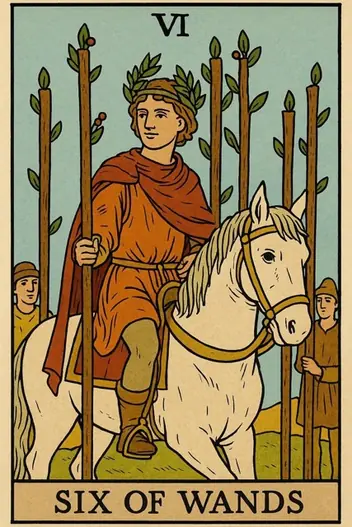

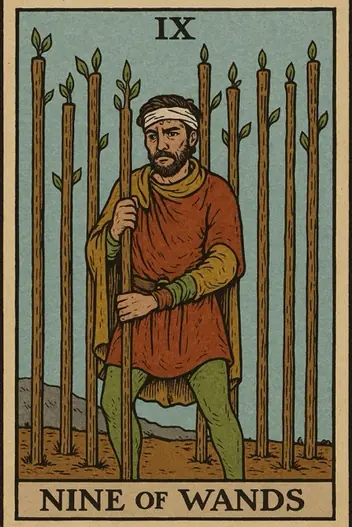
- Arcana
- Six of Wands — Minor Arcana, Wands; Nine of Wands — Minor Arcana, Wands
- Elements
- Six of Wands — Fire; Nine of Wands — Fire
- Elemental interaction
- Same element — energies intensify each other
- Numerology
- 6 + 9 = 15 → 6
The intersection of the Six of Wands and Nine of Wands creates a powerful psychological tension: you are on the verge of public recognition, yet you feel the weight of an unresolved threat. The Six of Wands represents a moment of triumph, validation, and social approval—the archetype of the hero returning home to applause. The Nine of Wands, however, embodies the defensive survivor, battle-worn and hyper-vigilant, still bracing for the next attack.
This combination suggests you have earned your success, but your nervous system hasn't caught up. You may be standing on the podium while simultaneously scanning the horizon for enemies. The core dynamic here is the conflict between external validation and internal exhaustion. Psychologically, this mirrors the Jungian tension between the Persona (the victorious public self) and the Shadow (the wounded, paranoid protector). The practical challenge is to integrate these two states without letting fear sabotage your moment of glory.
Six of Wands and Nine of Wands Together: Meaning
When the Six of Wands meets the Nine of Wands, the central narrative is success under duress. You have achieved something significant—perhaps a promotion, a public win, or a long-sought milestone—but the journey has left you bruised and defensive. The Nine of Wands warns that the battle isn't over; there is one more obstacle to overcome, one more critic to silence, or one more test of your resilience. This is not a time to relax completely, but it is also not a time to live in constant siege mentality.
The psychological state here is cautious optimism with a backup plan. You know you can win, but you also know how easily victory can slip away. This is a pragmatic mindset: you are willing to accept the accolades, but you keep your shield raised. The key insight is that your defensiveness is both your strength and your limitation. It has gotten you this far, but if left unchecked, it can prevent you from fully enjoying your success or trusting the support of others.
In real-world terms, this combination often appears when someone has just completed a major project or survived a crisis, only to face a final, unexpected challenge. The advice is clear: acknowledge your achievement, but stay strategically alert. Use the momentum of the Six of Wands to shore up your defenses, not to drop your guard. The danger is not in celebrating, but in celebrating prematurely.
Your pair is already on the table. Ask your question and draw the clarifying card
or simply focus on it
Six of Wands and Nine of Wands Love Outcome
If you are single:
This pair suggests you may be attracting interest from someone who admires your confidence, but you are hesitant due to past emotional wounds. Be honest about your boundaries, but don't let fear of rejection prevent you from exploring a promising connection.
If you are in a relationship:
You and your partner may be experiencing a period of public recognition or social validation as a couple, yet there is an underlying tension or unresolved conflict. One of you may feel defensive or guarded, even as things appear to go well externally.
In relationships, this combination often reveals a power dynamic where one partner is more publicly celebrated while the other feels exhausted from emotional labor. The Six of Wands energy might manifest as one person receiving praise from friends or family, while the Nine of Wands partner feels they are constantly "holding the line" at home. The psychological challenge is to validate each other's contributions without competing for recognition.
Key relationship advice:
Create space for honest vulnerability. The Nine of Wands partner needs to feel safe enough to lower their defenses, while the Six of Wands partner must resist the urge to bask in external approval at the expense of internal connection. Schedule a time to discuss lingering resentments—not to win an argument, but to rebuild trust. If you can acknowledge that both triumph and fatigue are valid, this combination can deepen your bond rather than fracture it.
Six of Wands and Nine of Wands for Career and Money
Strategic Opportunities:
Leverage your recent success to negotiate for better terms. You have proof of your value, so ask for a raise, a promotion, or more resources. The Six of Wands gives you leverage.
Strategic Opportunities:
Use your credibility to form alliances. The Nine of Wands suggests you need backup, so network with colleagues or mentors who can support your next move.
Calculated Risks:
Do not overextend yourself financially. The Nine of Wands warns of hidden costs or last-minute setbacks. Keep an emergency fund and avoid major debt right now.
In your professional life, this combination signals a critical transition point. You have likely just delivered a major result or received public recognition for your work. However, the Nine of Wands indicates that this success is not the finish line—it is a checkpoint. You may be asked to defend your position, handle a crisis, or prove your worth again sooner than expected. This is not a reflection of failure, but of the sustained demand for high performance.
Important financial warning:
Do not mistake temporary acclaim for permanent stability. The Nine of Wands is a card of residual risk. Consider the possibility that your current income stream is vulnerable to disruption. Diversify your revenue sources and avoid large, non-essential expenditures for the next 3-6 months. The strategic play here is to use your victory to strengthen your foundation, not to celebrate by spending. If you are in a negotiation, ask for what you deserve, but also secure protections (like a contract clause or a performance bonus) that account for potential obstacles.
Your unique Tarot reading
See how these cards interact with your destiny. Start a free personal reading now.
Six of Wands and Nine of Wands Reversed: What Changes?
If the Six of Wands is reversed:
Public recognition is blocked or devalued. You may achieve a result, but it goes unnoticed or is claimed by others. Warning: do not try to "prove" your victory through force. This will only provoke aggression. The strategy is to change your audience or postpone the presentation.
If the Nine of Wands is reversed:
The defense has collapsed. You are either too relaxed after success, or conversely, so exhausted that you cannot maintain your guard. Advice: urgently seek allies. You cannot hold your position alone. Delegate some control.
If BOTH are reversed:
Complete imbalance. You simultaneously feel like a loser and are under attack. This is a state of "post-battle paralysis." The logical way to correct the dynamic is to abandon external validation (stop chasing recognition) and temporarily capitulate (acknowledge vulnerability) in order to regroup.
Negative Meaning of Six of Wands and Nine of Wands
The shadow of this combination is paranoid triumphalism—the tendency to let past wounds poison present success. You may find yourself unable to accept compliments, dismissing praise as insincere, or picking fights with allies who genuinely support you. This is a cognitive bias known as "defensive pessimism", where you prepare for the worst so aggressively that you sabotage the good. Alternatively, the shadow can manifest as hubris: you become so intoxicated by the Six of Wands' victory that you ignore the Nine of Wands' warning signs, rushing into a trap.
Another common pitfall is burnout from chronic hypervigilance. You may have been in "survival mode" for so long that you don't know how to stop. This leads to exhaustion, irritability, and a diminished capacity for joy. Psychologically, this is the inflation of the Warrior archetype—you identify so strongly with being a fighter that you forget you are also allowed to be at peace. The antidote is conscious integration: schedule deliberate rest, delegate tasks, and practice gratitude for what you have achieved. If you cannot celebrate your own success, the victory is hollow.
Overall Meaning of Six of Wands and Nine of Wands
How can the energy of the Six of Wands be used constructively to balance the Nine of Wands? The key lies in ritualizing completion. The Six of Wands demands celebration, while the Nine demands preparation. Find an action that unites both impulses. For example, hold a strategic session with your team where you not only celebrate the victory (Six) but also draft a plan to defend against future risks (Nine). This transforms anxiety into planned work.
The second strategic move is shifting focus from "survival" to "management." As long as you remain in the mode of the Nine of Wands, you are reacting to threats. The Six of Wands grants you the right to dictate terms. Use your new status to change the rules of the game. If you've received a promotion, don't wait for subordinates or competitors to attack. Initiate changes yourself that make your position invulnerable. Deep advice: your primary task now is not to hold the fortress, but to expand the boundaries of influence so that the fortress lies at the center of your territory, not on its edge.
The third, most important conclusion: acknowledge your fatigue. Psychologically, the Six and Nine together often signal chronic stress. Success does not cure burnout; it masks it. Your next step is neither attack nor defense, but reorganization. Reduce the number of fronts on which you are fighting. Keep only those that bring genuine recognition and resources. This is the true victory—not over enemies, but over your own chaos.
Applying This to Your Situation
The Six of Wands and Nine of Wands together tell a story of hard-won progress that requires vigilant stewardship. You have earned the right to stand tall, but you must also respect the wounds that got you here. The core message is: you can be both proud and cautious. Do not let your past battles define your future, but do not dismiss the lessons they taught you. Your next step is to find the balance between celebration and preparation, trusting that you have the resilience to handle whatever comes next.
For a truly personalized interpretation, the general archetype only goes so far. Your specific situation—your question, your emotional state, and the other cards in your spread—changes the meaning entirely. Use the Fortune Cards app to get a deep, tailored reading of this exact combination for your unique question. Whether you're navigating a relationship decision, a career move, or a personal crossroads, the app applies Jungian psychology and Tarot wisdom to your specific context. Try it now on the web or download it to unlock the full power of your reading.
Interpretation by the Fortune Cards editorial team, based on the Rider–Waite tradition and Jungian archetypes. About our methodology · Updated: 2026-10-01
Other Combinations with Six of Wands
Other Combinations with Nine of Wands
Explore Individual Card Meanings
Table of Contents
- Six of Wands and Nine of Wands Together: Meaning
- Six of Wands and Nine of Wands Love Outcome
- Six of Wands and Nine of Wands for Career and Money
- Six of Wands and Nine of Wands Reversed: What Changes?
- Negative Meaning of Six of Wands and Nine of Wands
- Overall Meaning of Six of Wands and Nine of Wands
- Applying This to Your Situation
Ready to find answers to your questions?
Start your first reading now and look at your situation with fresh clarity. The cards are ready to reveal deeper meaning.