Six of Wands and Seven of Wands Together in Tarot
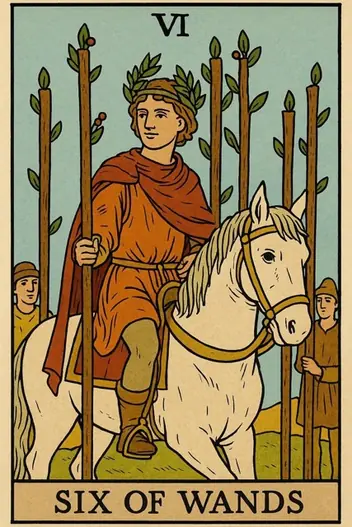

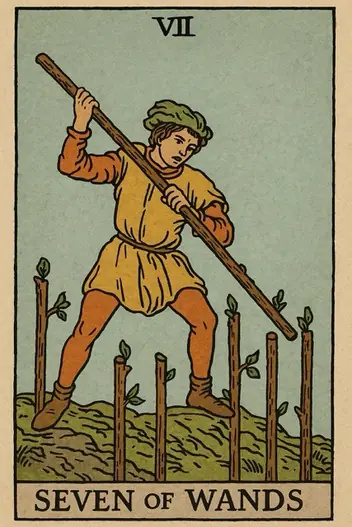
- Arcana
- Six of Wands — Minor Arcana, Wands; Seven of Wands — Minor Arcana, Wands
- Elements
- Six of Wands — Fire; Seven of Wands — Fire
- Elemental interaction
- Same element — energies intensify each other
- Numerology
- 6 + 7 = 13 → 4
The Six of Wands and Seven of Wands create a powerful psychological tension between external validation and defensive resilience. The Six represents a moment of public recognition—a victory lap where others acknowledge your competence. The Seven, by contrast, signals that this success is immediately contested; you must now hold your ground against challengers, critics, or competitors.
This pairing reveals a fundamental truth about achievement: recruitment often triggers resistance. The moment you step into the spotlight, forces emerge that test your legitimacy. The psychological archetype here is the "guardian of the summit"—someone who has climbed high but must now defend their position with strategic poise rather than aggression.
Six of Wands and Seven of Wands Combination Meaning
The core dynamic is a shift from celebration to vigilance. The Six of Wands provides a temporary boost in confidence and social capital, but the Seven of Wands demands that this confidence be put to practical use. You cannot rest on your laurels; the applause fades quickly, and you must now prove that the recognition was earned.
Psychologically, this combination activates the "imposter syndrome" defense mechanism—but in a productive way. Instead of self-doubt, you experience a healthy skepticism about your position. This is adaptive paranoia: you recognize that success attracts scrutiny, and you prepare accordingly. The key is to channel the pride of the Six into the strategic vigilance of the Seven, rather than letting it become arrogance.
In practical terms, this means you are in a transitional phase where external validation must be converted into internal resilience. You have the resources—the praise, the track record, the momentum—but you must use them to fortify your position. Do not overcommit based on early success. Instead, treat every new opportunity as a potential battleground requiring preparation.
What Do Six of Wands and Seven of Wands Say About Love?
If you are single:
This pairing suggests you are attracting attention but must vet potential partners carefully. Someone may be drawn to your success or confidence, but their motives require scrutiny. Avoid rushing into commitment based on flattery alone.
If you are in a relationship:
You and your partner may be navigating external pressures—family opinions, social comparisons, or career demands—that test your unity. The dynamic requires clear boundaries and mutual support.
For relationships, this combination highlights a power dynamic where one partner feels publicly validated while the other feels defensive. The Six of Wands partner may be enjoying social recognition, while the Seven of Wands partner feels the need to protect the relationship from outside interference. Emotional intelligence is critical here: acknowledge your partner's need for security without dismissing your own achievements.
Key relationship advice: Use your social capital to strengthen, not threaten, the bond. If you are the one receiving praise, bring your partner into the spotlight rather than leaving them in the shadows. If you are the one defending the relationship, communicate your concerns as protective, not accusatory. The goal is to turn external pressure into a shared mission, not a wedge.
Your pair is already on the table. Ask your question and draw the clarifying card
or simply focus on it
Career and Finances
Strategic Opportunities:
Leverage recent recognition to negotiate better terms—salary increases, project leadership, or resource allocation. Your credibility is at its peak.
Strategic Opportunities:
Build alliances with colleagues who supported you during the climb. Their loyalty is your best defense against future challenges.
Calculated Risks:
Avoid overextending into new ventures based solely on early success. The Seven of Wands warns that each new frontier invites new resistance.
In your professional life, this combination signals a pivotal moment where you must decide how to capitalize on momentum without burning out. The Six of Wands suggests you have clear evidence of competence—a promotion, a successful project, positive feedback. The Seven of Wands warns that others will now test your authority. This is not a time for humility; it is a time for assertive boundary-setting.
Financially, resist the temptation to spend your winnings prematurely. The recognition may bring short-term opportunities, but the Seven of Wands indicates unexpected costs or competition that could erode gains. Reinvest in your foundation—skills, tools, or savings—rather than indulging in status symbols. A key financial warning: do not let ego drive investment decisions; the market will not care about your recent win.
Shadow Side & Pitfalls
The shadow side of this pairing emerges when the ego of the Six overrides the caution of the Seven. You may become defensive to the point of paranoia, seeing threats where none exist, or arrogant to the point of blindness, ignoring real risks. Cognitive biases like the Dunning-Kruger effect (overestimating your competence after early success) or confirmation bias (only seeing evidence that supports your victory) can lead to poor judgment.
Another pitfall is burnout from constant vigilance. The Seven of Wands can create a siege mentality, where every interaction feels like a battle. This exhausts your emotional reserves and alienates potential allies. Self-sabotage may occur if you unconsciously provoke conflicts to test your strength, or if you withdraw from opportunities to avoid the pressure of defending your position.
Poor judgment manifests when you mistake defensiveness for strength. True resilience is not about fighting every battle; it is about choosing which hills are worth dying on. If you find yourself arguing with critics who have no real power, or defending positions that no longer serve you, you are in the shadow of this combination.
Uncover hidden insights
Let our advanced Tarot system interpret these archetypes specifically for your personal path.
Reversed Positions: What Changes?
Six of Wands Reversed:
Recognition is blocked or devalued. You are doing the work but receiving no feedback. Psychologically, this causes frustration, which forces you to aggressively demand praise (a distortion of the Seven). Advice: stop seeking approval from outside. Stabilize your self-worth first, otherwise your defense will look like a tantrum.
Seven of Wands Reversed:
You are surrendering your position without a fight. Internal resistance is broken. Combined with the upright Six, this means you were given a chance but are afraid to hold onto it. This is a state of capitulation in the face of difficulty. You urgently need to restore a sense of inner grounding, otherwise success will be short-lived.
BOTH Reversed:
Complete imbalance. Neither recognition nor the strength to defend it. The person is in a state of "learned helplessness." They either assert themselves aggressively without foundation or fall into apathy. The logical way to correct this: take a step back. Acknowledge your current situation without embellishment. Focus on "architecture"—build one small, unshakable result to regain a sense of control.
What Is the Overall Message of Six of Wands and Seven of Wands?
Constructive use of this dynamic requires a paradigm shift: stop perceiving success as a fortress to be defended. Perceive it as a platform from which to launch new projects. The energy of the Six of Wands is the inertia of success and social capital. Use it not to fend off critics, but to attract allies and delegate defense.
Psychologically, you need to separate self-worth from external attacks. Criticism does not negate your past achievement. Strategic advice: develop an "escalation plan." The Seven of Wands indicates that competition is inevitable. Instead of reacting to every jab, create a system that makes your position invulnerable to isolated attacks. For example, diversify your income sources or build a team that shares responsibility for the outcome.
Your task is to transform the defensive energy of the Seven into constructive ambition. Not "I must hold onto this position," but "I will create such value that I will be impossible to replace." This shifts the focus from defense to attack, but a creative attack. Remember: a true leader is not one who fends off the crowd, but one who leads it.
Where to Go From Here
The Six of Wands and Seven of Wands together deliver a clear message: you have earned your place, but you must now actively protect it. This is not a time for passive enjoyment of success. It is a time for strategic consolidation: reinforce your strengths, anticipate challenges, and convert public recognition into lasting authority. The victory is real, but it is fragile—handle it with the same discipline that earned it.
While this article provides a general archetype, the true power of Tarot lies in its application to your unique situation. Your specific question, life context, and emotional state will shape how these cards manifest. To get a deep, personalized interpretation of this exact combination for your relationship, career, or personal growth, use the Fortune Cards app. Available on the web or for download, it analyzes your cards in the context of your specific query, offering actionable insights tailored to you. Don't settle for generic meaning—get your personalized reading now.
Interpretation by the Fortune Cards editorial team, based on the Rider–Waite tradition and Jungian archetypes. About our methodology · Updated: 2026-09-24
Other Combinations with Six of Wands
Other Combinations with Seven of Wands
Explore Individual Card Meanings
Table of Contents
Ready to find answers to your questions?
Start your first reading now and look at your situation with fresh clarity. The cards are ready to reveal deeper meaning.