Three of Wands and Two of Pentacles Reversed in Tarot
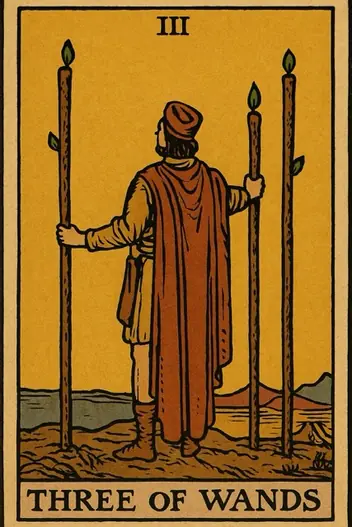
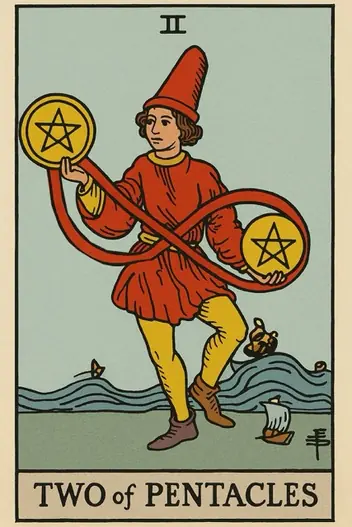
- Arcana
- Three of Wands — Minor Arcana, Wands; Two of Pentacles — Minor Arcana, Pentacles
- Elements
- Three of Wands — Fire; Two of Pentacles — Earth
- Elemental interaction
- Neutral elements — energies coexist without conflict
- Numerology
- 3 + 2 = 5
When the Three of Wands—a card of foresight, expansion, and strategic planning—meets the Two of Pentacles—a card of juggling resources, adaptability, and maintaining equilibrium—the result is a powerful psychological tension. You are being called to hold a long-term vision while simultaneously managing the immediate, often chaotic, demands of your daily life. This combination represents the archetype of the "Strategic Juggler": someone who must keep multiple balls in the air without losing sight of the horizon.
The collision here is between scale (Three of Wands) and stability (Two of Pentacles). You may feel stretched thin, as if your grand plans are being undermined by mundane obligations. However, this pairing is not a warning to abandon your ambitions. Instead, it is a pragmatic invitation to develop better systems of prioritization and resource allocation. The key insight is that your vision can only succeed if you master the art of managing competing priorities—without burning out.
Three of Wands and Two of Pentacles Together: Meaning
The psychological state created by this combination is one of controlled fluidity. The Three of Wands provides the why—the compelling, future-oriented goal that gives your efforts meaning. The Two of Pentacles provides the how—the flexible, adaptive mindset needed to navigate the complexities of execution. Together, they demand that you shift from passive dreaming to active, iterative planning. This is not a time for rigid adherence to a single plan; it is a time for dynamic recalibration.
In practice, this means you will likely experience a series of small, manageable crises that test your ability to stay calm and resourceful. The core dynamic is a feedback loop: your long-term vision (Three of Wands) should inform your daily decisions (Two of Pentacles), and your daily experiences should, in turn, refine your vision. Cognitive flexibility is your greatest asset here. Avoid the trap of perfectionism or over-commitment. Instead, adopt a "triage" mindset: identify what absolutely must be done today to keep the long-term plan alive, and let the rest wait.
This combination also highlights the importance of boundary management. The Two of Pentacles often warns against saying "yes" to everything. When paired with the Three of Wands, the message is clear: your ambition does not require you to be a martyr. You must delegate, negotiate, and sometimes say "no" to preserve your energy for the tasks that truly move the needle. The psychological payoff is a sense of mastery over chaos—the quiet confidence that comes from knowing you can handle the unpredictable while still steering toward your goal.
Three of Wands and Two of Pentacles: Career and Money
Strategic Opportunities:
Expanding into new markets or projects—the Three of Wands supports growth, but the Two of Pentacles warns you to start small and test the waters before scaling.
Strategic Opportunities:
Improving your workflow and time management—this is an ideal time to implement systems (like batching tasks or using project management software) that help you juggle multiple responsibilities.
Calculated Risks:
Avoid over-leveraging yourself financially or professionally. Taking on too many commitments at once will lead to burnout and poor performance. Beware of the "shiny object syndrome"—the temptation to chase every new opportunity.
In your professional life, this combination is a call to strategic prioritization. You may be at a crossroads where you need to decide which projects to accelerate and which to put on hold. The most important financial warning is to avoid making large, irreversible commitments (like signing a lease or taking on a major loan) until you have a clearer picture of your cash flow and capacity. Instead, focus on short-term, low-risk experiments that align with your long-term vision. For example, if you are considering a career change, take on a freelance project first to test the waters. Resource management is the central theme: treat your time, energy, and money as finite assets that must be allocated with precision. The strategic tip is to create a "buffer"—both in your schedule and your budget—to absorb unexpected demands.
Your pair is already on the table. Ask your question and draw the clarifying card
or simply focus on it
Three of Wands and Two of Pentacles Love Outcome
If you are single:
This pairing suggests you are evaluating a new connection while juggling other life priorities. Do not treat love as another task on your to-do list. Instead, assess whether this person fits into your long-term vision without requiring you to sacrifice your current stability.
If you are in a relationship:
You and your partner may be in a period of negotiating competing schedules and shared goals. The dynamic is about balancing individual ambitions with the relationship's needs. Open communication about time and energy limits is crucial.
In relationships, this combination often points to a power dynamic around resource management. One partner may be more focused on the "big picture" (Three of Wands), while the other is managing the "day-to-day" (Two of Pentacles). The risk is resentment if these roles become unbalanced. The key relationship advice is to create a shared calendar of priorities. Discuss not only your individual goals but also how you can support each other's vision without feeling overwhelmed. Emotional intelligence here means recognizing when your partner needs you to step back from your planning and be present. The healthiest outcome is a partnership of mutual flexibility: both individuals are willing to adjust their schedules and expectations to maintain the relationship's equilibrium.
Three of Wands and Two of Pentacles Reversed: How to Read It
When one or both cards are reversed, the constructive dynamic transforms into a destructive one.
Three of Wands reversed:
Blocked potential. You are building grandiose plans but lack the resources or courage to implement them. This is the state of the "eternal planner" who fears the first step. Advice: Lower the bar. Start with one concrete action, not a perfect scenario.
Two of Pentacles reversed:
Inner resistance or chaos. You are losing control over current affairs. Juggling turns into dropping all the balls. Warning: Risk of financial losses due to carelessness. Urgently audit your commitments and let go of everything that is not critically important.
BOTH reversed:
Complete imbalance. Ambitions exist but are not backed by action, and routine is completely falling apart. This is a state of paralysis. Way to correct: An artificial stop. Take a 48-hour pause, turn off all notifications, and answer in writing the question: "Which of my plans and tasks can I cancel without serious loss?". Recovery will begin with clearing out.
Deepen your understanding
Find out exactly what this reading means for your current life situation with our oracle.
The Shadow Side of Three of Wands and Two of Pentacles
When this energy is blocked or misapplied, the shadow manifests as chronic overwhelm and indecision. You may find yourself stuck in a cycle of "busy work"—constantly juggling tasks that feel urgent but are ultimately irrelevant to your long-term goals. This is a form of cognitive avoidance: staying busy to avoid making the hard decisions about what to cut. Another common pitfall is over-planning without execution—spending all your energy on the "big picture" (Three of Wands) while neglecting the daily discipline needed to get there (Two of Pentacles). This leads to analysis paralysis and a sense of futility.
Psychologically, the shadow side reveals a fear of missing out (FOMO) or a need for control. You may be trying to hold onto too many options, fearing that letting go of one will close a door forever. This is a cognitive bias known as "sunk cost fallacy"—continuing to invest in a path because you've already invested time, even if it's no longer viable. Self-sabotage can also appear as a refusal to ask for help, leading to exhaustion and resentment. The antidote is ruthless prioritization: ask yourself, "If I could only accomplish one thing today that moves my vision forward, what would it be?" Then do that first.
Three of Wands and Two of Pentacles: The Combined Message
Constructive use of this energy requires creating a clear hierarchy of goals. Imagine the Three of Wands as a ship's helm, setting the course toward a distant island, and the Two of Pentacles as a chart of winds and currents, allowing real-time maneuvering. Without the helm, you will drift; without the chart, you will hit the reefs.
Your task is to integrate these two modes of thinking into a single cycle. Dedicate the morning (or the start of the week) to strategy: write down one primary goal for the day or week. The rest of the time is pure tactics: solve tasks without being distracted by re-evaluating plans. In the evening, engage in brief reflection: what brought you closer to your goal, and what was unnecessary.
Deep strategic advice:
Apply the "80/20" rule to resources. 80% of your time and money should work toward one main goal (the Three), while 20% should maintain stability and flexibility (the Two). If the proportion is off, you are either risking everything for a single idea or scattering your efforts on trivialities. This combination teaches us that true strategy is not only about "where to go" but also about "what not to do." Letting go of the superfluous is the most powerful tool for achieving balance.
Where to Go From Here
The core message of Three of Wands and Two of Pentacles is that vision without execution is a fantasy, and execution without vision is a treadmill. You are being asked to find the sweet spot between dreaming and doing. This combination rewards those who can adapt without losing direction and who understand that flexibility is a strength, not a weakness. Your next step is to take one concrete action today that aligns with your long-term goal, while also giving yourself permission to let go of what is not essential.
While this article provides the general archetype, the true power of Tarot lies in its application to your unique situation. The Fortune Cards app allows you to input your specific question—whether about a relationship, career decision, or personal challenge—and receive a deeply personalized interpretation of this exact combination. You can use the app on the web or download it to get a reading that speaks directly to your context, helping you turn archetypal insight into practical, actionable wisdom. Click here to start your personalized reading now.
Interpretation by the Fortune Cards editorial team, based on the Rider–Waite tradition and Jungian archetypes. About our methodology · Updated: 2026-08-26
Other Combinations with Three of Wands
Other Combinations with Two of Pentacles
Explore Individual Card Meanings
Table of Contents
- Three of Wands and Two of Pentacles Together: Meaning
- Three of Wands and Two of Pentacles: Career and Money
- Three of Wands and Two of Pentacles Love Outcome
- Three of Wands and Two of Pentacles Reversed: How to Read It
- The Shadow Side of Three of Wands and Two of Pentacles
- Three of Wands and Two of Pentacles: The Combined Message
- Where to Go From Here
Ready to find answers to your questions?
Start your first reading now and look at your situation with fresh clarity. The cards are ready to reveal deeper meaning.