Two of Pentacles and Four of Pentacles Meaning in Tarot
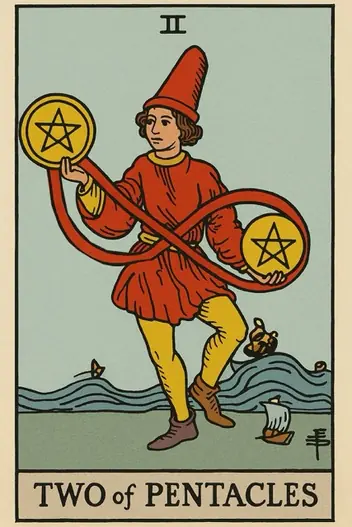
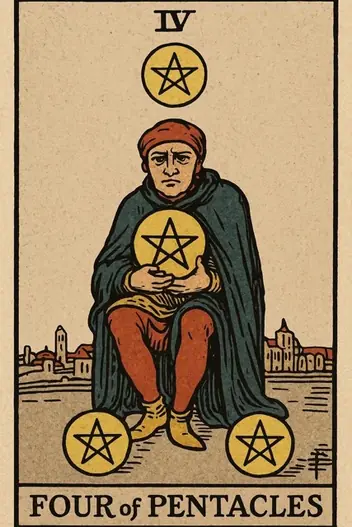
- Arcana
- Two of Pentacles — Minor Arcana, Pentacles; Four of Pentacles — Minor Arcana, Pentacles
- Elements
- Two of Pentacles — Earth; Four of Pentacles — Earth
- Elemental interaction
- Same element — energies intensify each other
- Numerology
- 2 + 4 = 6
When the Two of Pentacles meets the Four of Pentacles in a reading, we witness a psychological tug-of-war between adaptive resource management and rigid security-seeking. The Two represents the juggler—someone managing multiple priorities, debts, or projects with agility. The Four embodies the miser—a figure clinging tightly to what they have, often out of fear of scarcity. In real life, this collision manifests as a person who is simultaneously overextended and overprotective: taking on too much while refusing to delegate or release any control.
This combination highlights a core Jungian tension: the shadow of the perfectionist administrator. You may be trying to hold everything together with sheer willpower, yet the Four’s grip suggests you are also hoarding resources, time, or emotional energy to compensate for feeling overwhelmed. The key question becomes: Are you juggling out of necessity, or out of a refusal to trust others with your responsibilities?
Two of Pentacles and Four of Pentacles Card Meaning Explained
The psychological state created by the Two and Four of Pentacles is one of controlled chaos. You are likely operating in a high-stakes environment where every decision feels consequential, yet you resist any structural change that might reduce your workload. This is the mindset of a hyper-vigilant manager—someone who checks their bank account obsessively, micromanages team members, or refuses to take vacation because “the system can’t run without me.”
The core dynamic is a conflict between efficiency and rigidity. The Two of Pentacles demands flexibility: you must adapt to changing circumstances, rebalance your priorities, and accept that some balls will drop. The Four of Pentacles insists on holding on tighter, believing that control equals safety. In practice, this creates a cycle: you take on more (Two) to prove your competence, then clamp down on resources (Four) to prevent loss. This paradox often leads to burnout, because you are spending energy on maintaining the illusion of stability rather than building actual resilience.
A pragmatic Jungian lens would interpret this as the Puer Aeternus (eternal youth) clashing with the Senex (old man) archetype. The Two is the youthful juggler who enjoys the thrill of balancing; the Four is the fearful elder who hoards for survival. The integration requires you to become the mature adult who can delegate tasks and set healthy boundaries—without resorting to either frantic activity or miserly withdrawal.
Two of Pentacles and Four of Pentacles in Love and Relationships
If you are single:
This pair suggests you may be over-managing your dating life—juggling multiple prospects while simultaneously guarding your heart so tightly that no real connection can form. The advice is to choose quality over quantity and release the need to control every outcome.
If you are in a relationship:
The dynamic points to a power struggle over resources, whether time, money, or emotional availability. One partner may feel they are doing all the work (Two) while the other clings to their own space or savings (Four).
In relationships, the Two and Four of Pentacles often indicate a transactional mindset masked as practicality. You might find yourself keeping a mental ledger: “I cooked dinner three times this week, so you should handle the weekend errands.” While fairness is important, this combination warns against turning love into a cost-benefit analysis. The Four’s grip can manifest as financial control or emotional withholding, while the Two’s juggling may represent over-functioning to avoid vulnerability.
Key relationship advice: practice deliberate vulnerability. The antidote to this dynamic is to share your fears of scarcity openly with your partner. If you feel overwhelmed, say so explicitly rather than compensating with more work. If you feel insecure about resources, negotiate transparent agreements rather than hoarding control. The goal is to move from “my resources vs. your resources” to “our shared stability.”
Your pair is already on the table. Ask your question and draw the clarifying card
or simply focus on it
Two of Pentacles and Four of Pentacles for Career and Money
Strategic Opportunities:
Audit your current workload and identify tasks that can be automated, delegated, or eliminated. The Two’s agility is wasted on low-value activities.
Strategic Opportunities:
Create a financial buffer (the Four’s strength) for planned transitions—like a career change or a business pivot—rather than using it as a fortress against all risk.
Calculated Risks:
Avoid over-committing to new projects just to prove your worth. The Two’s juggling can lead to dropped deadlines if you don’t say no.
Professionally, this combination is a red flag for micromanagement and burnout. You may be the “go-to person” who is drowning in tasks, yet you refuse to train others because “it’s faster to do it myself.” This is a false economy. The Four’s hoarding of knowledge or authority is particularly dangerous in leadership roles—it stifles team growth and creates single points of failure.
Financially, the cards suggest a paradox of overwork and underinvestment. You might be earning well (Two) but saving excessively (Four) to the point of missing growth opportunities. The pragmatic advice is to separate safety from stagnation. A healthy savings account is wise; refusing to invest in tools, education, or team expansion because of fear is not. Calculate the true cost of your rigidity: is your “security” costing you more in missed revenue or personal energy than it saves?
Get a personalized interpretation
Unlock the combined meaning of your cards in the context of your unique question — for free.
The Shadow Side of Two of Pentacles and Four of Pentacles
The shadow manifestation of this pair is compulsive self-reliance. When blocked, the juggler (Two) becomes a workaholic who cannot delegate, and the miser (Four) becomes a control freak who cannot trust. This creates a cognitive bias called “illusion of control”—you believe that if you just work harder or hold on tighter, you can prevent chaos. In reality, this behavior invites chaos by exhausting your capacity to adapt.
Self-sabotage appears as over-optimization. You might spend hours reorganizing a spreadsheet (Two) while ignoring the strategic decision that would render the spreadsheet obsolete (Four’s refusal to pivot). Another pitfall is financial anxiety masquerading as prudence—saving for a “rainy day” that never comes, while sacrificing present quality of life. The shadow asks: What are you actually afraid of losing? Often, it’s not money or time, but the identity of being the competent, indispensable one.
Two of Pentacles and Four of Pentacles Reversed: How to Read It
Two of Pentacles Reversed:
Blocked Potential. You have stopped juggling because one of the "spheres" has fallen. This is a state of learned helplessness. You avoid multitasking because past experiences of failure have paralyzed you. Advice: return to one, the simplest task. Do not try to restore balance — start from scratch.
Four of Pentacles Reversed:
Extreme Insecurity. The fear of loss has turned into panic. You are not just holding onto resources, but starting to spend them irrationally or, conversely, bury them. This can manifest as impulsive purchases or a refusal of any, even profitable, investments. Warning: this is a state of affect. Do not make any financial decisions for 48 hours.
BOTH Reversed:
Complete Imbalance. This is a scenario of "burnout" or "collapse." Chaos (reversed Two) meets recklessness (reversed Four). You are simultaneously unable to manage resources and afraid of losing them. The logical way to correct this: a complete stop. Cease all current projects for 24-48 hours. Restore your sleep and eating schedule. Only after this should you begin to rebuild your priorities from scratch.
Overall Meaning of Two of Pentacles and Four of Pentacles
How to constructively use the energy of the Two of Pentacles to balance the Four of Pentacles? The key lies in a paradigm shift: perceive flexibility not as a threat to stability, but as its sole guarantor. In the modern world, static stability (the Four) is an illusion. The only way to hold onto what you have is to learn to move at the same speed as the external environment. The Two of Pentacles is not chaos; it is the adaptive immunity of your system.
Your strategic task is to create "managed chaos." Define a rigid core (the Four) — that which cannot be changed under any circumstances (e.g., core values, health, key assets). Everything else (methods of earning, routines, daily plans) should be made flexible (the Two). A profound piece of advice: use the technique of "anxiety budgeting." Allocate a specific time each day (e.g., 15 minutes) for worrying about resources and control. The rest of the time, act according to the Two of Pentacles' plan: quickly, adaptively, without looking back at fear. This will allow you to maintain stability without falling into paralysis.
Where to Go From Here
The core message of the Two and Four of Pentacles is that true stability comes from flexibility, not rigidity. You are being called to balance your responsibilities without suffocating them, and to protect your resources without hoarding them. The archetype of the wise steward—not the frantic juggler or the fearful miser—is what you must embody.
But general archetypes only go so far. The real insight comes when you apply this wisdom to your specific situation—your unique workload, your particular fears, your exact financial picture. That’s where the Fortune Cards app becomes invaluable. Instead of guessing how these energies play out in your life, you can get a personalized reading that accounts for your question, your context, and your other cards. Use the app on the web or download it now to discover the precise message these two cards hold for you today.
Interpretation by the Fortune Cards editorial team, based on the Rider–Waite tradition and Jungian archetypes. About our methodology · Updated: 2026-10-01
Other Combinations with Two of Pentacles
Other Combinations with Four of Pentacles
Explore Individual Card Meanings
Table of Contents
- Two of Pentacles and Four of Pentacles Card Meaning Explained
- Two of Pentacles and Four of Pentacles in Love and Relationships
- Two of Pentacles and Four of Pentacles for Career and Money
- The Shadow Side of Two of Pentacles and Four of Pentacles
- Two of Pentacles and Four of Pentacles Reversed: How to Read It
- Overall Meaning of Two of Pentacles and Four of Pentacles
- Where to Go From Here
Ready to find answers to your questions?
Start your first reading now and look at your situation with fresh clarity. The cards are ready to reveal deeper meaning.