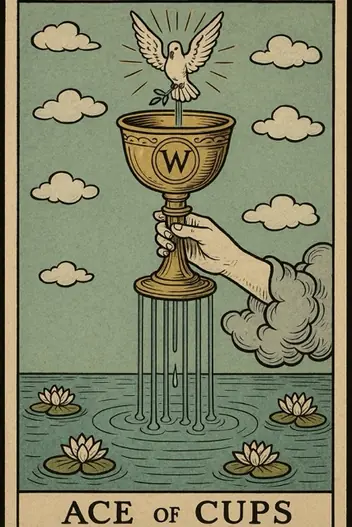
Ace of Cups
- Arcana
- Minor Arcana, Suit of Cups
- Element
- Water
- Numerology
- 1
The Ace of Cups represents the Jungian archetype of the Self in its nascent, receptive state—the pure potential for emotional connection, compassion, and intuitive knowing. It is the psychological moment when the unconscious presents a new feeling, a new relationship, or a new creative impulse to the conscious mind. This is not about achieving emotional stability; it is about the raw, unformed energy of love and vulnerability knocking at your door.
The main challenge of this card is the temptation to either drown in the feeling or to intellectualize it away. It carries the core idea of an invitation: you must choose to open your psychological container to receive this new emotional data, which will inevitably disrupt your existing structures. The reward is profound growth; the risk is emotional overwhelm or missed opportunity.
Main Dynamics and Interpretation
The Ace of Cups signals a period of heightened emotional receptivity where your internal compass is recalibrating. Psychologically, this manifests as a clear, unblocked channel for empathy and self-compassion. In practical terms, this means your decisions should be guided by a felt sense of "rightness" rather than purely logical calculation. The mind may resist, but the body and heart are leading the way.
This card provides a strategic resource: the ability to start fresh emotionally. It is the perfect time to initiate a new creative project, begin a sincere apology, or open a difficult conversation from a place of genuine care. The key is to treat this feeling as actionable data, not just a pleasant experience. Ask yourself: What concrete action does this feeling of openness compel me to take?
The core mindset here is one of radical acceptance. You are being given permission to feel without judgment. This is not weakness; it is the foundation of emotional intelligence and resilience. The decision-making framework is simple: if a path fills you with a sense of authentic connection and life, it is aligned with the Ace of Cups. If it drains you or feels forced, it is not.
Ask your question and flip the cards
or simply focus on it
Ace of Cups: Yes or No?
Yes. The Ace of Cups overflows with emotional potential, representing a definitive opening of the heart and a clear "yes" to matters of love, intuition, and authentic connection. Psychologically, this card signals that your unconscious is aligned with receptivity; the cup is full, meaning the other party or situation is primed for emotional investment without resistance. In reversed, the answer shifts to Leaning No, indicating blocked emotions, fear of vulnerability, or a withdrawal of emotional energy—the cup is tipped, spilling instead of receiving. The critical caveat: this "yes" is conditional on your own emotional availability—if you approach with guardedness or intellectual over-analysis, the flow cannot reach you. The outcome depends on whether you can meet this energy with equal openness, not whether it exists.
Ask your specific question
Don't rely on generic meanings. Get a customized reading tailored specifically to your energies.
What Does Ace of Cups Mean for Your Day?
Today’s vector is pure emotional receptivity and the birth of feeling—the Ace of Cups announces a day where your heart will be touched, often unexpectedly. Focus on allowing yourself to be moved: say yes to a sincere gesture, cry at a song, or reach out to someone you’ve been withholding from. The trap is intellectualizing your emotions—do not analyze why you feel something; just feel it, or you will kill the magic before it blooms. Avoid numbing behaviors (scrolling, overworking) that block the cup’s overflow. Instead, take one small action that opens you to connection: pour a glass of water mindfully, write a gratitude note, or sit in silence for three minutes.
Love and Relationships
If you are not in a relationship:
This card indicates you are psychologically ready for a new connection. The risk is projecting your idealized "love potential" onto a stranger. Focus on observing how they make you feel in their presence, not the story you tell yourself about them.
If you are in a relationship:
The Ace of Cups offers a chance for emotional renewal. This is the time to drop old grievances and initiate a vulnerable conversation about unmet needs. The strategic move is to lead with curiosity, not accusation.
The behavioral pattern to cultivate is emotional generosity. This does not mean ignoring your own boundaries; it means offering your authentic emotional presence without the need for immediate reciprocation. The practical relationship advice is to schedule a "check-in" conversation where you both share one thing you are grateful for and one thing you need. This turns the abstract potential of the Ace into a concrete, bonding ritual. Beware of the trap of emotional rescue—offering love to "fix" someone else is not the same as connecting to them.
Ace of Cups as Feelings: What They Think of You
This person perceives you as the vessel of their own unexpressed emotional depth—you evoke in them a sense of primal, unconditional acceptance that they may not feel anywhere else. Psychologically, you represent the archetype of the Mother or the Lover in its purest form: a safe harbor where their tears, joy, and vulnerability are not just allowed but welcomed. Their hidden intention is to merge with this feeling you give them, yet they may fear that you will eventually close the faucet, leaving them dry. There is an internal conflict between their desire to surrender to you completely and a shadow fear that such openness will drown their ego. They see you not as a person with flaws, but as a symbol of emotional wholeness—which means they may unconsciously project their own capacity for love onto you, rather than seeing you clearly. This idealization is both a gift and a burden: it means they are deeply moved by you, but they may not yet see your full humanity.
What Does Ace of Cups Mean for Work and Money?
Strategic Opportunities:
Initiate a collaborative project based on shared values. This is an excellent time to network with people who share your mission, not just your industry.
Resource Management:
Invest in your emotional labor. This could mean hiring a coach, funding a team-building retreat, or spending time on a passion project that fuels your creativity.
Calculated Risks:
Avoid signing contracts that feel "off" in your gut. The Ace of Cups warns against rationalizing away your intuition for a short-term financial gain.
Professionally, the Ace of Cups suggests that your greatest asset right now is your ability to build trust and rapport. Leadership under this card is not about authority but about serving the emotional needs of your team or clients. The decision-making framework is to prioritize projects that feel meaningful and align with your personal values over those that only promise profit. Financial warning: Do not make a major investment purely because it "feels right." You must pair this emotional openness with rigorous due diligence. The feeling is the signal to investigate, not the signal to commit.
Reversed Positions: What Changes?
When reversed, the Ace of Cups represents blocked emotional potential or internal resistance. The feeling of openness is there, but it is being suppressed by fear, cynicism, or a rigid ego structure. This manifests as emotional constipation—you know you need to express something, but you cannot. The warning is clear: you are isolating yourself from the very connections you desire.
This state is often caused by a fear of vulnerability that has been rationalized into a philosophy of self-reliance. The logical way to correct this imbalance is to perform a small, low-risk act of emotional expression. Send the email you've been drafting. Say "I appreciate you" to a colleague. The goal is not a grand gesture, but to unblock the channel by proving to your psyche that the world will not collapse when you let your guard down.
The Shadow Side of Ace of Cups
The shadow of the Ace of Cups is emotional inflation and codependency. When this archetype is unintegrated, you may believe that your love or compassion can save everyone, leading to martyrdom and burnout. The cognitive bias is the Pollyanna principle—overlooking red flags because you are so focused on the potential for good. This is not open-heartedness; it is avoiding the responsibility of setting boundaries.
Another pitfall is emotional perfectionism. You may wait for the "perfect" feeling or the "pure" connection, refusing to engage with messy, imperfect reality. This leads to chronic disappointment and inaction. The shadow error is treating the Ace of Cups as a destination, not a starting point. It is a beginning, not a finished product. You must act before you feel fully ready.
Synthesis: What It All Adds Up To
The Ace of Cups is a call to action, not a state of passive bliss. To constructively use its energy, you must treat this emotional opening as a finite resource that must be channeled. Your strategic task is to identify one area of your life where you have been holding back your authentic feelings—be it a creative project, a relationship, or a career move—and take one concrete, small step forward.
The optimal mindset is one of "disciplined vulnerability." You must be both open and strategic. This means feeling the fear of rejection and sending the message anyway. It means sensing the pull toward a new venture and creating a business plan. The Ace of Cups gives you the raw material of emotional energy; your job is to shape it into a structure that can hold it without breaking. Do not waste this opportunity by staying in your head. The clarity you seek will only come through action.
Your Next Step: Personal Context Matters
This psychological and strategic breakdown provides a deep understanding of archetypes. However, Tarot is never universal for everyone. To understand exactly how this dynamic applies to your specific situation, a reading tailored exclusively to you is necessary.
Download the Fortune Cards app or visit our platform to get a deep AI interpretation of your unique spread. Don't just read about the cards—use Fortune Cards to find out exactly what step you need to take next.
Try Tarot Spreads with Ace of Cups
Interpretation by the Fortune Cards editorial team, based on the Rider–Waite tradition and Jungian archetypes. About our methodology · Updated: 2026-08-26
Top Combinations with Ace of Cups
Discover how Ace of Cups interacts with other major cards in the deck to form powerful messages.
All 77 Combinations with Ace of Cups
Discover how this card interacts with every other card in the Tarot deck and reveal hidden meanings.
Table of Contents
- Main Dynamics and Interpretation
- Ace of Cups: Yes or No?
- What Does Ace of Cups Mean for Your Day?
- Love and Relationships
- Ace of Cups as Feelings: What They Think of You
- What Does Ace of Cups Mean for Work and Money?
- Reversed Positions: What Changes?
- The Shadow Side of Ace of Cups
- Synthesis: What It All Adds Up To
- Your Next Step: Personal Context Matters
Explore Tarot Universe
Ready to find answers to your questions?
Start your first reading now and look at your situation with fresh clarity. The cards are ready to reveal deeper meaning.