Ace of Cups and Nine of Swords Meaning in Tarot
- Arcana
- Ace of Cups — Minor Arcana, Cups; Nine of Swords — Minor Arcana, Swords
- Elements
- Ace of Cups — Water; Nine of Swords — Air
- Elemental interaction
- Neutral elements — energies coexist without conflict
- Numerology
- 1 + 9 = 10 → 1
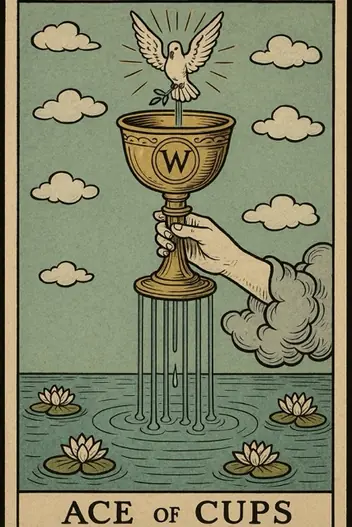
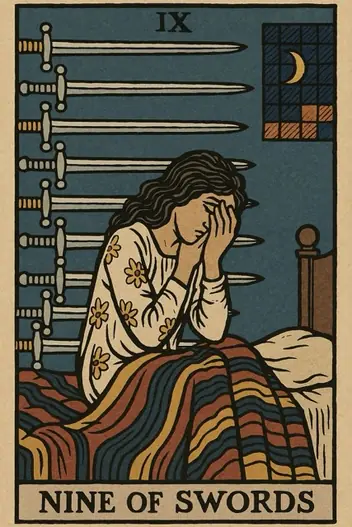
The Ace of Cups represents a raw, unfiltered surge of emotional potential—a new love, a creative breakthrough, or a deep spiritual connection. The Nine of Swords, in stark contrast, depicts the torment of anxiety, insomnia, and catastrophic thinking. When these two archetypes collide, the result is a powerful psychological tension: a heart full of feeling trapped in a mind full of worry.
This combination often appears when a person is experiencing a flood of powerful emotions—perhaps a new relationship or a creative passion—but their internal narrative is dominated by fear, self-doubt, or past trauma. The core conflict is between emotional openness and mental paralysis. The pragmatic question becomes: how do you honor the new emotional beginning without letting the anxious mind sabotage it?
Ace of Cups and Nine of Swords Card Meaning Explained
The psychological state of this pairing is one of high emotional sensitivity coupled with cognitive distortion. The Ace of Cups opens the floodgates of feeling, while the Nine of Swords interprets these feelings through a lens of worst-case scenarios. For example, a person might feel intense love for a new partner (Ace of Cups) but immediately worry that they will be abandoned or hurt (Nine of Swords). This is not a prediction of doom; it is a description of an internal conflict.
From a Jungian perspective, the Nine of Swords often represents the Shadow of the Ace of Cups. The positive, nurturing potential of the cup is being poisoned by an overactive inner critic, likely rooted in unmet childhood needs or past betrayals. The key insight is that the anxiety is not a warning sign from the universe, but a defense mechanism of the ego. The mind is trying to protect the heart from vulnerability by creating fear. The strategic action here is to separate the feeling from the thought. You can feel deep emotion without believing every catastrophic story your mind tells you about it.
In real-world terms, this combination demands emotional risk management. The goal is not to suppress the Ace of Cups (which would lead to emotional numbness) nor to indulge the Nine of Swords (which leads to paralysis). Instead, the mature path is to acknowledge the anxiety as a secondary reaction to the primary emotional opening. Labeling the fear as "the part of me that is scared to trust" rather than "the truth of the situation" is a powerful cognitive reframe.
Your pair is already on the table. Ask your question and draw the clarifying card
or simply focus on it
Ace of Cups and Nine of Swords: Career and Money
Strategic Opportunities:
Channel emotional energy into a creative project or startup. The Ace of Cups gives you the passion and intuition to innovate. Use the Nine of Swords' hyper-awareness to anticipate potential obstacles, not to abandon the project.
Strategic Opportunities:
Negotiate from a place of value, not desperation. The Ace of Cups gives you the confidence to ask for what you deserve, but the Nine of Swords may make you fear rejection. Prepare your talking points in advance to override the anxious mind.
Calculated Risks:
Avoid making major financial or career decisions when you are in a state of acute anxiety. The Nine of Swords distorts risk perception. If you feel panic, sleep on it for 48 hours. Do not quit a job or make a large investment solely based on an emotional impulse (Ace) or a fearful thought (Nine).
Professionally, this combination signals a time of high creative potential mixed with performance anxiety. You may have a brilliant idea (Ace of Cups) but fear it will be criticized or fail (Nine of Swords). The pragmatic approach is to prototype and test, rather than seek approval. The Nine of Swords thrives on abstract worry; concrete action is its antidote. If you are in a negotiation, the Ace of Cups gives you the emotional intelligence to read the room, while the Nine of Swords makes you hypervigilant to rejection. The strategic tip is to write down your non-negotiables and your walk-away point before the meeting. This creates a logical framework that the anxious mind cannot easily dismantle. Financially, be wary of "emotional spending" to soothe anxiety, or "fear-based hoarding" that stifles growth.
Ask your specific question
Don't rely on generic meanings. Get a customized reading tailored specifically to your energies.
Ace of Cups and Nine of Swords as Feelings
If you are single:
This pairing suggests you are drawn to someone new, but your mind is already creating scenarios of rejection or disappointment. Focus on objective reality—their actions, not your imagined fears. Ask yourself: "What evidence do I have that this will end badly?"
If you are in a relationship:
You or your partner may be feeling a deep emotional connection while simultaneously worrying about the relationship's stability. This is a call for honest, vulnerable communication to break the cycle of silent anxiety.
In relationships, the Ace of Cups and Nine of Swords often manifest as one partner being emotionally expressive while the other is anxious and withdrawn. The dynamic can become a loop: the anxious partner's worries trigger the expressive partner to feel rejected, which then amplifies the anxiety. The critical relationship advice is to name the pattern aloud. Say, "I feel love for you, but my mind is spinning with fears. Can we talk about it?" This externalization of the Nine of Swords reduces its power. Do not try to "fix" your partner's anxiety with reassurance alone. Instead, create a container where both the emotional openness (Ace) and the fear (Nine) can coexist without judgment. A weekly check-in where each person shares one feeling and one fear can be a practical tool.
When Ace of Cups and Nine of Swords Signal Trouble
The shadow of this combination is emotional self-sabotage. The most common cognitive bias is confirmation bias: the anxious mind will actively seek out evidence to support its fears, ignoring the positive signals from the Ace of Cups. For example, a person might interpret a partner's busy day as a sign of disinterest, while dismissing a week of loving attention. This leads to a self-fulfilling prophecy where the person withdraws or acts out, causing the very rejection they feared.
Another pitfall is emotional flooding—becoming so overwhelmed by the intensity of the Ace of Cups that the Nine of Swords takes over as a coping mechanism. The mind creates a "catastrophe narrative" to try and control the uncontrollable feeling. Poor judgment manifests as impulsive confessions (dumping all feelings at once) or paranoid accusations (projecting fear onto others). The shadow path is a cycle of intense connection followed by painful withdrawal, leaving the person feeling emotionally exhausted and distrustful of their own heart.
Ace of Cups and Nine of Swords Reversed Meaning
Reversed cards often indicate a suppressed or distorted energy of the archetype.
If the Ace of Cups is reversed:
The potential for love or creativity is blocked. You are either suppressing your emotions, afraid of appearing vulnerable, or, conversely, becoming emotionally reckless, using feelings for manipulation. Paired with the upright Nine of Swords, this creates a dangerous combination: anxiety is reinforced by the feeling that "it won't work out anyway."
If the Nine of Swords is reversed:
This indicates an internal resistance to acknowledging the problem. The person refuses to recognize their anxiety, projecting it onto others or falling into paranoia. Instead of fear for oneself, there is fear of the external world. The energy of the Ace of Cups is wasted in this case on attempts to calm someone who does not want to be calmed.
If BOTH are reversed:
Complete imbalance. Emotional potential is perverted, and anxiety is not recognized. This can manifest as toxic relationships where one partner constantly blames the other for their problems. Advice: a complete reassessment of life values is necessary, and likely professional psychotherapy to restore connection with one's own feelings and separate reality from fiction.
Overall Meaning of Ace of Cups and Nine of Swords
Constructive use of this combination requires the courage to be vulnerable while remaining rational. Your task is not to let the Nine of Swords kill the impulse of the Ace of Cups, but also not to allow emotions to cloud reality. Strategically, this means: accept your anxiety as an inevitable companion to any significant step into the unknown. The Ace of Cups is not a guarantee of success; it is permission to try.
Use the energy of the Ace of Cups as a tool for "grounding" anxiety. When the Nine of Swords begins to paint catastrophic scenarios, ask yourself: "What am I feeling right now, not what am I thinking about the future?" Return to the body, to sensation. This will shift you from "mental spasm" mode to "emotional presence" mode. Only from this state can you make balanced decisions.
A deep strategic advice: do not try to defeat the Nine of Swords with the force of the Ace of Cups. This is not a war, but an integration. Your anxiety is not an enemy, but an overly caring, albeit destructive, protector. Thank it for trying to shield you from pain, and then say: "Thank you, I can handle this." This inner dialogue is the true magic of Tarot: transforming fear into awareness, and potential into action.
Applying This to Your Situation
The Ace of Cups and Nine of Swords together reveal a profound inner battle between your heart's desire and your mind's fear. The core message is not to choose one over the other, but to understand that the anxiety is a guardian, not a guide. Your next step is to observe your emotional state without acting on it, and then make decisions based on objective evidence and core values.
While this article provides the general archetype, the true power of Tarot lies in its application to your unique situation. The Fortune Cards app can give you a deep, personalized interpretation of this exact combination for your specific question right now. Whether you are navigating a new love, a career pivot, or a personal crisis, the app analyzes the interplay of these cards in the context of your life. Use it on the web or download it to transform this psychological insight into a concrete action plan tailored just for you.
Interpretation by the Fortune Cards editorial team, based on the Rider–Waite tradition and Jungian archetypes. About our methodology · Updated: 2026-08-26
Other Combinations with Ace of Cups
Other Combinations with Nine of Swords
Explore Individual Card Meanings
Table of Contents
- Ace of Cups and Nine of Swords Card Meaning Explained
- Ace of Cups and Nine of Swords: Career and Money
- Ace of Cups and Nine of Swords as Feelings
- When Ace of Cups and Nine of Swords Signal Trouble
- Ace of Cups and Nine of Swords Reversed Meaning
- Overall Meaning of Ace of Cups and Nine of Swords
- Applying This to Your Situation
Ready to find answers to your questions?
Start your first reading now and look at your situation with fresh clarity. The cards are ready to reveal deeper meaning.