Ace of Cups Paired with Four of Pentacles — Tarot Combination Explained

- Arcana
- Ace of Cups — Minor Arcana, Cups; Four of Pentacles — Minor Arcana, Pentacles
- Elements
- Ace of Cups — Water; Four of Pentacles — Earth
- Elemental interaction
- Friendly elements — energies support each other
- Numerology
- 1 + 4 = 5
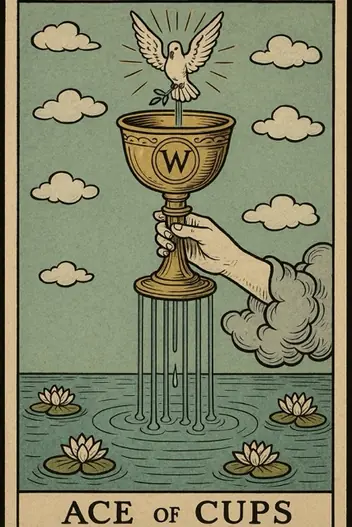
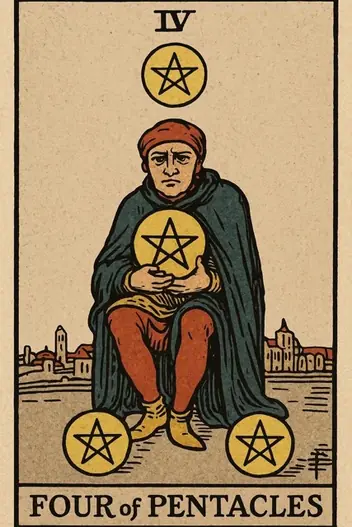
The Ace of Cups represents an opening of emotional flow—a new wave of love, compassion, or creative inspiration that demands expression. In contrast, the Four of Pentacles embodies the psychological impulse to hold tight, conserve resources, and build defensive walls around what we value most. When these two archetypes collide, the core tension becomes clear: you are experiencing a powerful emotional opening, but your instinct is to grip it tightly, fearing loss or vulnerability.
This combination reveals a pragmatic conflict between generosity and self-protection. You may feel a genuine desire to connect, give, or express love, yet simultaneously, a part of you is calculating the risks—guarding your time, energy, or material security. The psychological task here is not to choose one over the other, but to integrate emotional openness with strategic boundaries without letting fear freeze your heart.
What Do Ace of Cups and Four of Pentacles Mean Together?
The psychological state created by this pairing is one of cautious receptivity—you are open to receiving love or inspiration, but you are also bracing for potential loss. This is not coldness; it is self-preservation acting as a brake on emotional momentum. The Ace of Cups wants to flow freely, while the Four of Pentacles wants to hoard that emotional energy as a finite resource. In practice, this manifests as someone who feels a deep connection but hesitates to fully commit, or who has a brilliant creative idea but fears sharing it.
The key insight here is that emotional security does not come from clutching—it comes from knowing when to release and when to hold. This combination often appears when you are at a threshold: you have the capacity for profound connection or generosity, but you are also acutely aware of past disappointments. The mind creates a false dichotomy: "If I open up, I will lose control." Your task is to differentiate between prudent boundaries and defensive hoarding. A healthy boundary says "I will give this much, and no more." A defensive hoard says "I will give nothing, because I might lose everything."
Real-world implications are clear: you may be holding back a gift—whether it's a kind word, a financial gesture, or a creative offering—because you are calculating the cost. Ask yourself: Is the risk of vulnerability truly greater than the cost of emotional stagnation? The answer often lies in whether you are guarding a treasure or protecting a wound.
Ask your question and flip the cards
or simply focus on it
Love and Relationships
If you are single:
This pairing suggests you may be attracting a potential partner who offers genuine emotional depth, but your instinct is to test their loyalty or hold back affection to avoid being hurt. Evaluate whether your caution is realistic or a pattern of self-sabotage.
If you are in a relationship:
You or your partner may be experiencing a surge of love or desire for intimacy, but one of you is clinging to material security or personal space as a defense mechanism. This creates a push-pull dynamic that needs honest dialogue.
In relationships, the core dynamic is emotional generosity versus possessive control. One partner may feel a wellspring of love and want to give freely, while the other is tightening their grip on time, money, or independence. The most common pitfall is misinterpreting the other's need for security as a lack of love. The Four of Pentacles person is not rejecting the Ace of Cups; they are afraid of being overwhelmed or taken advantage of.
The strategic advice here is to negotiate explicit emotional boundaries. For example, agree on how much time you need for yourself versus together, or discuss financial contributions without guilt. Do not let the fear of scarcity poison the gift of love. If you are the one holding back, ask yourself: "What do I think I will lose if I open up?" If you are the one giving, ask: "Am I giving freely, or am I expecting something in return?" The healthiest relationships balance the Ace's flow with the Four's structure.
Uncover hidden insights
Let our advanced Tarot system interpret these archetypes specifically for your personal path.
Ace of Cups and Four of Pentacles: Career and Money
Strategic Opportunities:
Leverage your emotional intelligence to build trust with colleagues or clients. Your genuine care for the work or team can differentiate you in negotiations.
Strategic Opportunities:
Invest in a creative project that requires both passion and careful resource allocation. This combination favors ventures that blend heart with discipline.
Calculated Risks:
Avoid over-committing financially out of fear of missing out. The Four of Pentacles warns against hoarding resources, but also against reckless spending driven by emotional highs.
Professionally, this combination signals a time to balance generosity with fiscal discipline. You may feel inspired to launch a passion project, donate to a cause, or mentor a junior colleague—but you must also protect your bottom line and time. The Ace of Cups gives you the emotional fuel to connect deeply with your work, while the Four of Pentacles reminds you to set clear contracts, boundaries, and budgets.
The biggest financial warning here is against "emotional spending" —making purchases or investments based on a fleeting sense of abundance or guilt. Conversely, do not let fear of loss prevent you from investing in your own growth. A strategic approach: allocate a specific percentage of your income or time to "heart-led" initiatives, and the rest to security. This gives you both the flow and the fortress. Remember: hoarding resources without purpose is just as wasteful as reckless generosity.
What If Ace of Cups or Four of Pentacles Appears Reversed?
When cards appear reversed, the internal conflict becomes overt and destructive.
If the Ace of Cups is reversed:
The potential is blocked. Instead of new love, there is emotional impotence and cynicism. You reject feelings before they arise because you fear disappointment. Advice: stop analyzing your feelings — just act, even if it seems illogical.
If the Four of Pentacles is reversed:
This is an extreme degree of instability and wastefulness. The fear of loss turns into panic, and the person begins to squander resources (money, time, emotions), trying to buy love or attention. Warning: this is a path to financial and emotional dependency.
If BOTH are reversed:
Complete imbalance. A chaotic situation where there are neither feelings nor structure. The person simultaneously wants love and fears it, spends money to numb the emptiness, and cannot settle on anything. Advice: an emergency pause. Cease all active actions for 48 hours. Restore your basic regime (sleep, food, physical activity) before making any decisions.
Shadow Side & Pitfalls
When this energy is blocked or acted upon irrationally, the shadow manifests as emotional stinginess or possessive love. You may become the person who feels a deep connection but refuses to say "I love you" because it feels like a loss of control. Or you might hoard affection, praise, or resources, believing they are finite—creating a scarcity mindset that suffocates the very connection you crave.
Cognitive biases at play include loss aversion (overvaluing what you have and undervaluing what you might gain) and the endowment effect (treating emotional investments like property). This can lead to self-sabotage: you push away a potential partner because you fear they will leave anyway, or you refuse to share a creative idea because someone might steal it. The irrational belief is that holding tighter will make things last longer, but in reality, it often chokes the life out of them.
Another pitfall is using material security as a substitute for emotional intimacy. You may focus on saving money or collecting possessions to fill an emotional void, mistaking control for safety. This combination warns you: do not let the fortress become a prison. The shadow of the Four of Pentacles is isolation; the shadow of the Ace of Cups is emotional overwhelm. Together, they can create a person who feels everything but expresses nothing—a dangerous state for long-term well-being.
Ace of Cups and Four of Pentacles: The Combined Message
How to constructively use the energy of the Ace of Cups to balance the Four of Pentacles? A paradigm shift from "resource protection" to "flow management" is necessary. The Four of Pentacles tries to create a static reservoir. The Ace of Cups is a spring. If a spring does not flow, it turns into a swamp.
Your strategic task is to create an "emotional fund." This does not mean dispensing feelings left and right. It means clearly defining how much emotional investment (time, attention, vulnerability) you are willing to put into a specific area (relationship, project) and doing so consciously. Security is not a wall; it is the ability to open the sluice gate at the right time.
A deep strategic piece of advice: invest in yourself as a "brand." In your career, this means not being afraid to ask for fair compensation for your feelings and ideas (Ace), while simultaneously offering real value, not just "presence" (Four). In relationships, learn to say "yes" to feelings, but "no" to the violation of your personal boundaries. Clarity arrives when you stop fearing the loss of what you do not possess and begin creating what you wish to own.
Where to Go From Here
The core message of the Ace of Cups and Four of Pentacles is this: you have a gift to give, but you must learn to hold it wisely, not tightly. Emotional openness without boundaries leads to burnout; boundaries without openness leads to loneliness. The real skill is knowing when to pour out your heart and when to keep the lid on. This balance is not theoretical—it is deeply personal, depending on your history, fears, and current circumstances.
While this article provides the general archetype, the true magic happens when Tarot is applied to your unique situation. To get a deep, personalized interpretation of this exact combination for your specific question right now, use the Fortune Cards app. Whether on the web or downloaded, the app offers tailored readings that consider your exact context—relationship stage, career crossroads, or personal growth challenge. Don't settle for generic advice; let the cards speak directly to your life.
Interpretation by the Fortune Cards editorial team, based on the Rider–Waite tradition and Jungian archetypes. About our methodology · Updated: 2026-08-01
Other Combinations with Ace of Cups
Other Combinations with Four of Pentacles
Explore Individual Card Meanings
Table of Contents
Ready to Discover Your Path?
Join thousands of seekers who have found clarity and guidance through our platform. Your cosmic journey awaits.