Love Tarot: Ace of Cups and Page of Swords
- Arcana
- Ace of Cups — Minor Arcana, Cups; Page of Swords — Minor Arcana, Swords
- Elements
- Ace of Cups — Water; Page of Swords — Air
- Elemental interaction
- Neutral elements — energies coexist without conflict
- Numerology
- 1 + 11 = 12 → 3
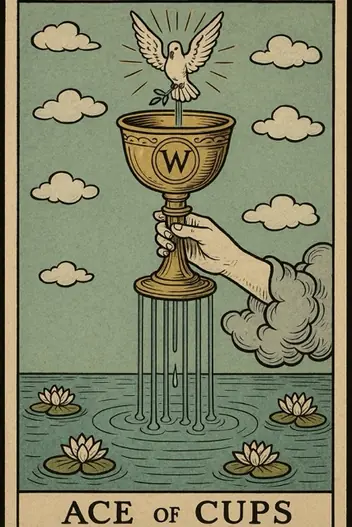
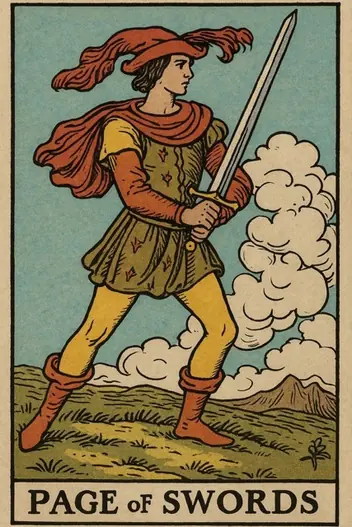
The Ace of Cups represents a raw, unbounded flood of emotional potential—the birth of love, intuition, and compassion. In contrast, the Page of Swords embodies a restless, analytical mind, driven by curiosity, communication, and a thirst for truth. When these two cards appear together, they signal a dynamic tension between feeling and thinking. You are being called to channel emotional openness into disciplined inquiry, not to suppress the heart but to question its motives and protect its boundaries.
Psychologically, this pairing mirrors the Jungian dialogue between the Feeling and Thinking functions. The Ace of Cups offers the raw material of emotional experience, while the Page of Swords insists on clarity, logic, and a plan. In real life, this might manifest as a sudden crush that demands rational analysis, or a creative idea that requires a strategic framework to succeed. The challenge is to integrate the heart’s truth with the mind’s precision—without letting one dominate the other.
What Do Ace of Cups and Page of Swords Mean Together?
The central dynamic here is a creative friction between emotional openness and intellectual vigilance. The Ace of Cups provides the motivation and intuitive direction—a sense of what feels right, what is worth pursuing. The Page of Swords supplies the tools of discernment: questioning, researching, and testing hypotheses. Together, they create a powerful cycle: the heart generates a hypothesis (I feel this connection is meaningful), and the mind tests it (Is this based on reality or projection?). This is not a conflict but a collaborative process.
Psychologically, this combination often appears when a person is entering a new emotional territory—such as a budding romance, a creative project, or a spiritual exploration—but feels the need to establish mental clarity before committing fully. The risk is that the Page of Swords’ skepticism can prematurely shut down the Ace of Cups’ vulnerability. The reward, however, is a relationship or endeavor built on both authentic feeling and clear-eyed understanding. To succeed, you must hold both energies simultaneously: feel the emotion, but question its source.
Your pair is already on the table. Ask your question and draw the clarifying card
or simply focus on it
Career and Finances
Strategic Opportunities:
This is an excellent time to pitch a creative idea that requires both emotional resonance and logical structure. For example, a marketing campaign that appeals to feelings but is backed by data.
Strategic Opportunities:
Use your intuition to identify emerging trends or unmet needs (Ace of Cups), then deploy the Page of Swords’ research skills to validate and exploit them.
Calculated Risks:
Beware of overcommitting to a project based on excitement alone. The Page of Swords warns: do your due diligence before signing contracts or allocating significant resources.
In your professional life, this combination points to a period of innovative thinking fueled by emotional engagement. You may feel a strong sense of purpose or passion for a new idea (Ace of Cups). However, the Page of Swords insists that you frame that passion within a clear, actionable strategy. Avoid making decisions based solely on “gut feeling”—instead, write a pros/cons list, gather competitive intelligence, or run a small pilot test. Financial planning requires both vision and verification. If you’re considering a career change, this pair suggests it’s driven by genuine desire (not escape), but you must research the market, update your skills, and network strategically. The best move is to prototype your passion.
Get a personalized interpretation
Unlock the combined meaning of your cards in the context of your unique question — for free.
What Do Ace of Cups and Page of Swords Say About Love?
If you are single:
This combination suggests you are entering a phase of curious attraction—you feel a pull toward someone, but you need to gather more information before acting. Use your mind to vet your heart’s impulses, but don’t let overanalysis paralyze you. A first conversation or date is your laboratory.
If you are in a relationship:
The dynamic may involve one partner being more emotionally expressive and the other more analytical. Create space for both feelings and facts. If you feel a surge of love, articulate it, but also ask: “What do we need to communicate about next?”
In relationships, the Ace of Cups and Page of Swords together indicate a phase of emotional exploration guided by intellectual curiosity. You may find yourself wanting to deepen intimacy (Ace of Cups) while simultaneously needing to clarify boundaries, expectations, or misunderstandings (Page of Swords). Honest, direct communication is your strongest asset. Avoid passive-aggressive hints or emotional withdrawal; instead, state your feelings and then ask a clarifying question. For example: “I feel close to you, and I want to understand how you see our future.” This pairing warns against emotional impulsivity—don’t declare love without first checking for mutual understanding. Balance vulnerability with vigilance.
What Are the Risks of Ace of Cups and Page of Swords?
The shadow of this combination emerges when the Page of Swords’ critical mind overruns the Ace of Cups’ emotional wisdom. You may become cynical, overly analytical, or dismissive of your own feelings—rationalizing why you shouldn’t trust a positive intuition. Conversely, the shadow can manifest as emotional impulsivity masked as “following your heart” —acting on a feeling without any reality check. Cognitive biases like confirmation bias (seeking only data that supports your emotional desire) or analysis paralysis (endlessly questioning a clear emotional truth) are common pitfalls. Self-sabotage occurs when you either feel too much to think, or think too much to feel. The key is to recognize that both energies are valid but must be held in conscious balance.
What If Ace of Cups or Page of Swords Appears Reversed?
When cards appear reversed, constructive dialogue turns into chaos.
Ace of Cups reversed:
Emotional suppression or toxic rationalization. You are not allowing yourself to feel, blocking any emotional breakthrough. The Page of Swords in this situation becomes a cruel inner critic who mocks any display of vulnerability. Advice: Allow yourself "emotional chaos" for 15 minutes a day. Don't analyze, just feel.
Page of Swords reversed:
Weakness of thought and inability to defend your boundaries. You feel you are being used (Ace of Cups), but cannot find the words to fight back. This is a state of "silent suffering" where emotions overwhelm the mind. Advice: Write down three points you are afraid to say. Speak them out loud in front of a mirror. This will give you back your voice.
Both reversed:
Complete imbalance: emotional chaos without intellectual control. This resembles a tantrum or panic attack, where feelings have no outlet and thoughts have no structure. Corrective strategy: Full stop. No decisions, conversations, or actions for 24 hours. Only physical activity (sports, a walk) to flush out cortisol.
What Is the Overall Message of Ace of Cups and Page of Swords?
Constructive use of this pair requires discipline of the emotions. The Ace of Cups gives you energy and direction, while the Page of Swords provides the map and compass. But you must not let the compass dictate where you go. Your strategy is "First feel, then think, but only then act."
Practical algorithm:
- Anchor the impulse (Ace). What do you feel? Joy? Anger? Inspiration? Simply name it.
- Activate the observer (Page). Ask one question: "What action would be ecological for me and others right now?" Do not ask ten questions — that leads to paralysis.
- Make a decision. Act based on synthesis, not on the dominance of one archetype. If feeling says "yes" but the mind only finds risks — this is a signal for caution, not refusal. If the mind says "profitable" but feelings are silent — this is a signal to check the moral cost.
This union teaches us that true wisdom is not a choice between heart and head, but the ability to make them work as a single mechanism. Do not suppress the analyst within you, but do not let it kill your capacity for genuine experience.
Where to Go From Here
The Ace of Cups and Page of Swords combination ultimately asks you to marry your heart’s openness with your mind’s clarity. It is a call to feel deeply and think clearly, to trust your intuition while verifying it with facts. This is not a card of hesitation, but of informed emotional action. The answer lies in the specific question you hold—are you navigating a new love, a career pivot, or a creative project?
While this article provides the general archetype, the true power of Tarot lies in its application to your unique situation. Use the Fortune Cards app to get a deep, personalized interpretation of this exact combination for your specific question right now. Whether you access it on the web or download it, the app will guide you through the nuances of your own emotional and intellectual landscape. Your next step is to ask the right question—and let the cards speak to your life.
Interpretation by the Fortune Cards editorial team, based on the Rider–Waite tradition and Jungian archetypes. About our methodology · Updated: 2026-08-26
Other Combinations with Ace of Cups
Other Combinations with Page of Swords
Explore Individual Card Meanings
Table of Contents
- What Do Ace of Cups and Page of Swords Mean Together?
- Career and Finances
- What Do Ace of Cups and Page of Swords Say About Love?
- What Are the Risks of Ace of Cups and Page of Swords?
- What If Ace of Cups or Page of Swords Appears Reversed?
- What Is the Overall Message of Ace of Cups and Page of Swords?
- Where to Go From Here
Ready to find answers to your questions?
Start your first reading now and look at your situation with fresh clarity. The cards are ready to reveal deeper meaning.