Ace of Pentacles + Four of Pentacles: What This Tarot Pairing Means
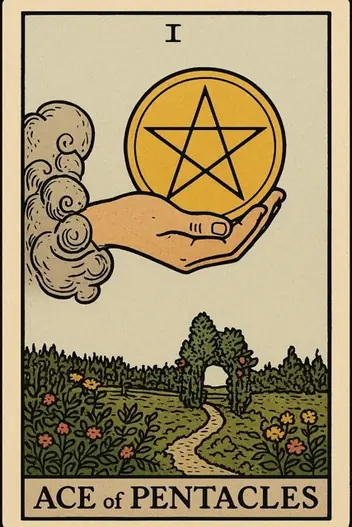

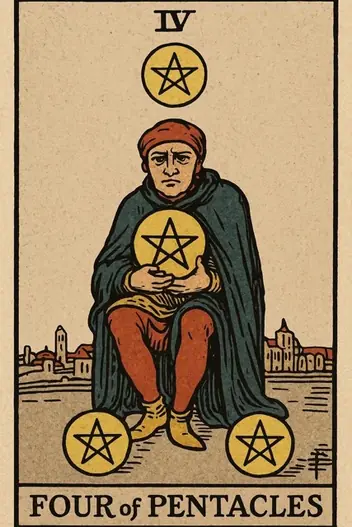
- Arcana
- Ace of Pentacles — Minor Arcana, Pentacles; Four of Pentacles — Minor Arcana, Pentacles
- Elements
- Ace of Pentacles — Earth; Four of Pentacles — Earth
- Elemental interaction
- Same element — energies intensify each other
- Numerology
- 1 + 4 = 5
When the Ace of Pentacles—a card of raw potential, new beginnings, and tangible opportunity—meets the Four of Pentacles—a card of hoarding, stability, and defensive control—we confront a fundamental psychological conflict. You are being offered a seed of prosperity, but your instinct is to lock it in a vault. This pairing represents the critical junction between expansion and contraction, where the fear of losing what you have can actively prevent you from receiving what you truly need.
In practical terms, this combination often appears when a person is presented with a clear, material chance to improve their life—a new job offer, a financial investment, a relationship foundation—yet they hesitate, paralyzed by the risk of instability. The archetypal energy here is not about laziness or lack of vision; it is about a deep-seated anxiety around resource security. The Ace says "plant the seed," while the Four says "guard the storehouse." Your task is to reconcile these drives without sabotaging either.
Core Dynamics & Interpretation
The core dynamic of the Ace of Pentacles and Four of Pentacles is a paradox of abundance and scarcity. Psychologically, this reflects a mindset where the seeker recognizes a potential windfall but simultaneously fears that accepting it will destabilize their current safety net. This is less about external circumstances and more about an internal conflict between the "entrepreneur" and the "accountant" within you. The Ace represents a growth-oriented, trusting attitude toward the future; the Four represents a risk-averse, control-oriented focus on the present.
The key insight here is that the Four of Pentacles is not inherently negative. In a healthy expression, it provides the discipline to manage the Ace's new opportunity wisely—saving capital before investing, researching before committing, or setting boundaries before starting a new relationship. The problem arises when the Four's energy becomes rigid, possessive, or fearful, turning a prudent pause into a permanent blockade. You must ask yourself: Am I protecting my assets, or am I protecting my fear of change?
To navigate this combination effectively, you need to differentiate between strategic caution and irrational hoarding. A practical step is to set a specific, time-limited period for evaluation. For example, give yourself 72 hours to research a new opportunity before making a decision. This honors the Four's need for security without allowing it to indefinitely stall the Ace's momentum. The goal is not to eliminate caution but to transform it from a barrier into a filter.
Ask your question and flip the cards
or simply focus on it
Ace of Pentacles and Four of Pentacles in Love and Relationships
If you are single:
This combination suggests you may be overly guarded when a promising connection appears. You might analyze compatibility to the point of paralysis, or demand too many guarantees before allowing emotional investment. The risk is mistaking self-protection for self-sabotage.
If you are in a relationship:
The dynamic may involve one partner feeling financially or emotionally controlled, while the other clings to routines or resources out of fear. The core issue is trust—do you believe your partner will honor your boundaries without you needing to enforce them rigidly?
In a relationship context, the Ace of Pentacles and Four of Pentacles often reveals a power struggle over security and autonomy. One partner may be eager to build something new together—a shared home, a financial plan, a deeper commitment—while the other resists, fearing loss of control or independence. This is not a lack of love; it is a conflict between two valid psychological needs: the need for growth and the need for stability.
The most effective relationship strategy here is to negotiate boundaries explicitly. Instead of assuming what your partner wants, have a direct conversation about what "security" means to each of you. For the Ace-driven partner, security might mean shared progress; for the Four-driven partner, it might mean maintaining separate accounts or personal space. Finding a middle ground—such as a joint savings goal with individual discretionary funds—can honor both energies. Remember, the Four of Pentacles is not about selfishness; it is about fear of loss. Address the fear, and the grip will loosen.
Ask your specific question
Don't rely on generic meanings. Get a customized reading tailored specifically to your energies.
What Do Ace of Pentacles and Four of Pentacles Indicate for Your Career?
Strategic Opportunities:
Diversify your income streams carefully. The Ace offers a new venture, but the Four warns against putting all your eggs in one basket. Use the new opportunity to supplement, not replace, your current stability.
Strategic Opportunities:
Negotiate for control, not just compensation. When considering a job offer or contract, prioritize clauses that protect your autonomy and long-term security—like a guaranteed minimum or a performance-based bonus structure.
Calculated Risks:
Avoid the "all-or-nothing" trap. Do not reject a promising opportunity simply because it requires initial sacrifice. Instead, create a phased plan where you test the waters before committing fully.
In your career, this combination signals a moment of financial decision-making that requires both courage and discipline. You may be sitting on a cash reserve, a savings account, or a stable job, while a new opportunity—a side business, a promotion with more responsibility, or a risky investment—presents itself. The Four of Pentacles urges you to protect your base, but the Ace demands you take a calculated risk. The solution is to apply the Four's discipline to the Ace's potential.
A concrete financial warning here:
Do not let the fear of losing what you have prevent you from investing in what could grow. This is a classic "opportunity cost" scenario. The cost of inaction (staying in a dead-end job, refusing a partnership, sitting on cash) may be greater than the cost of a well-managed risk. A practical tip: set aside a specific "growth fund" (e.g., 10-20% of your savings) that is designated exclusively for new ventures. This satisfies the Four's need for security while actively funding the Ace's potential.
Reversed Positions: What Changes?
When cards are reversed, the conflict between potential and control intensifies or becomes distorted, shifting from the internal to the external plane.
If the Ace of Pentacles is Reversed:
Potential is blocked. This can manifest as recklessness (attempting to grab a windfall without a plan) or, conversely, complete apathy and disbelief in one's own abilities. Paired with the upright Four, this creates a situation where a person clings fiercely to what no longer serves them, out of fear that nothing better will come along. Advice: Acknowledge that your current security strategy is failing. You must release the old resource to make space for the new, even if it is not yet visible.
If the Four of Pentacles is Reversed:
Control is collapsing. This can manifest as internal resistance to any rules or structure (financial anarchy) or extreme vulnerability (the person cannot hold onto a penny; everything "slips through their fingers"). Paired with the upright Ace, this means you have an excellent opportunity, but you catastrophically lack the discipline and self-control to seize it. Advice: Start small. Create one simple ritual for managing resources (e.g., daily tracking of small expenses) to regain a sense of control.
If BOTH are Reversed:
Complete imbalance. This is a state of "neither for oneself nor for others." Potential exists but cannot be realized due to internal chaos, while resources are either squandered or frozen in toxic assets. This signals the need for a complete reset of your financial and personal strategy. A logical way to correct this: Seek an external consultant (therapist, financial advisor) to gain an objective perspective, as your own assessment mechanisms are entirely distorted.
The Shadow Side of Ace of Pentacles and Four of Pentacles
The shadow side of this combination is a cognitive bias known as "loss aversion" —the tendency to prefer avoiding losses over acquiring equivalent gains. Psychologically, the seeker may overvalue what they currently possess (the Four) and undervalue what they could gain (the Ace). This can manifest as stinginess, micromanagement, or a refusal to delegate in professional settings, and as emotional withholding, jealousy, or a "my way or the highway" attitude in relationships.
Another shadow manifestation is self-sabotage through over-preparation. You might research endlessly, build complex spreadsheets, or demand perfect conditions before acting. This is a defense mechanism: if you never commit, you never risk failure. The Four of Pentacles, in its shadow form, becomes a fortress of excuses. You may tell yourself you're being "responsible" when you are actually being fearful. To counteract this, ask yourself: "If I had full confidence in my ability to handle failure, what would I do right now?" The answer is often the path the Ace is pointing toward.
What Is the Overall Message of Ace of Pentacles and Four of Pentacles?
Constructive use of this pair requires paradoxical thinking. Your task is not to choose between potential and control, but to integrate them. The energy of the Ace of Pentacles should be directed not at breaking the defenses of the Four, but at "cultivating" its fear. Imagine the Four as a fortress wall and the Ace as a seed. A seed cannot sprout through stone, but it can grow in the soil that this wall protects from the wind. Your strategy: use your tendency toward control to create a safe space for growth, not for stagnation.
How to do this in practice? Start with small, but regular investment. Do not try to immediately invest all your savings in a risky startup. Allocate a fixed, small percentage of your income (satisfying the Four), and invest it in a new opportunity (activating the Ace). This could be a course, a consultation, the purchase of a tool, or simply a date. The main strategic advice: stop thinking in terms of "all or nothing." The Ace of Pentacles does not demand total risk from you; it offers you a point of entry. The Four of Pentacles does not demand total isolation; it demands respect for your basic needs for security. Your task is to find a balance between protecting what you have and having the courage to create what you do not yet have.
This union of cards is an invitation to maturity. It teaches that true strength lies neither in a death grip nor in mindless squandering. True strength lies in the ability to consciously choose what and how much to invest in, understanding that the only way to preserve a resource is to put it into circulation, but wisely.
Your Next Step: Personal Context Matters
The Ace of Pentacles and Four of Pentacles together deliver a clear message: you have the seed of something valuable, but your grip on what you already hold may be preventing it from growing. The solution is not to abandon caution but to use it strategically—as a tool for smart investment, not as a shield against change. Whether in love, career, or personal growth, the key is to open your hand just enough to let the new opportunity in, while keeping your core security intact.
To truly unlock the meaning of this combination for your unique situation, you need a reading that considers your specific question, timing, and personal context. While this article provides the archetypal dynamics, the real insight comes when Tarot is applied to your life. Use the Fortune Cards app to get a deep, personalized interpretation of the Ace of Pentacles and Four of Pentacles for your exact question. Simply open the app, select these two cards, and receive a tailored analysis that addresses your specific relationship, career, or personal growth challenge. Available on web and mobile.
Interpretation by the Fortune Cards editorial team, based on the Rider–Waite tradition and Jungian archetypes. About our methodology · Updated: 2026-08-01
Other Combinations with Ace of Pentacles
Other Combinations with Four of Pentacles
Explore Individual Card Meanings
Table of Contents
- Core Dynamics & Interpretation
- Ace of Pentacles and Four of Pentacles in Love and Relationships
- What Do Ace of Pentacles and Four of Pentacles Indicate for Your Career?
- Reversed Positions: What Changes?
- The Shadow Side of Ace of Pentacles and Four of Pentacles
- What Is the Overall Message of Ace of Pentacles and Four of Pentacles?
- Your Next Step: Personal Context Matters
Ready to Discover Your Path?
Join thousands of seekers who have found clarity and guidance through our platform. Your cosmic journey awaits.