The Meaning of Eight of Cups and Ten of Cups Together in a Tarot Reading

- Arcana
- Eight of Cups — Minor Arcana, Cups; Ten of Cups — Minor Arcana, Cups
- Elements
- Eight of Cups — Water; Ten of Cups — Water
- Elemental interaction
- Same element — energies intensify each other
- Numerology
- 8 + 10 = 18 → 9
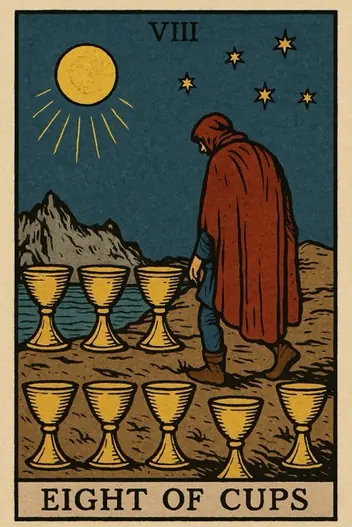
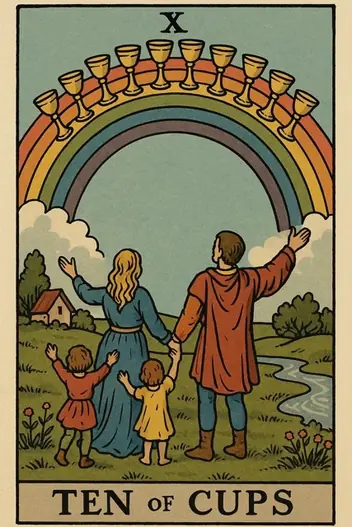
When the Eight of Cups and Ten of Cups appear together, we witness a profound psychological tension: the decision to walk away from a known, comfortable situation (Eight of Cups) in pursuit of a deeper, more authentic emotional fulfillment (Ten of Cups). This is not a card of sudden catastrophe, but of calculated emotional risk-taking. The Eight of Cups represents the sober, often lonely act of leaving behind what no longer serves our growth—a job, a relationship, or a belief system. The Ten of Cups promises the reward: a state of lasting emotional security, family harmony, and spiritual contentment. Together, they map a journey from the discomfort of stagnation to the peace of authentic connection.
In practical terms, this combination signals a strategic retreat from a situation that, while superficially stable, lacks the emotional depth required for long-term satisfaction. The seeker is not acting out of impulse, but out of a pragmatic recognition that staying is a form of self-betrayal. The Ten of Cups validates this move, suggesting that the emotional payoff—a sense of belonging, mutual respect, and inner peace—is not only possible but probable. The key psychological insight here is differentiation: the ability to separate one’s own emotional needs from the expectations of others, and to act on that knowledge with courage and clarity.
Eight of Cups and Ten of Cups: How These Energies Interact
The core dynamic of Eight of Cups and Ten of Cups is a paradox of departure and arrival. The Eight of Cups represents active disengagement—a conscious decision to leave a situation that has become emotionally barren, even if it is physically comfortable. This card often appears when the seeker has exhausted all efforts to repair or improve a relationship, career path, or personal habit. The Ten of Cups, in contrast, embodies emotional completion—the fulfillment of deep-seated needs for love, family, and community. When these cards combine, the message is clear: you must leave behind the familiar to create space for genuine happiness.
Psychologically, this pairing activates the individuation process described by Carl Jung. The seeker is called to sacrifice the persona—the social mask that maintains external harmony—in favor of authentic self-expression. The Eight of Cups is the shadow work of acknowledging what is missing, while the Ten of Cups is the integration of those insights into a new, more coherent life structure. Bold strategic action is required: the seeker must map out the emotional costs of staying versus leaving, and then execute a plan that minimizes collateral damage. This is not a time for impulsive decisions, but for cold-eyed assessment of what truly supports one’s long-term well-being.
Ask your question and flip the cards
or simply focus on it
What Do Eight of Cups and Ten of Cups Say About Love?
If you are single:
This combination suggests you may be over-idealizing a past relationship or a potential partner who represents an "emotional shortcut" to fulfillment. The Eight of Cups warns against repeating a pattern of abandonment—walking away too quickly when discomfort arises.
If you are in a relationship:
The Eight of Cups indicates a critical decision point: either you and your partner need to address a fundamental emotional gap together, or one partner is considering leaving. The Ten of Cups promises that honest communication and mutual effort can rebuild a deeper connection.
In relationships, this pairing often surfaces during transitional phases—moving in together, marriage, or after a major betrayal. The Eight of Cups represents the psychological distance that has grown between partners, often due to unspoken resentments or unmet needs. The Ten of Cups is the potential for renewal, but only if both parties are willing to acknowledge the void and take deliberate steps to fill it. Bold advice: schedule a "relationship audit" where each partner writes down three things they need to feel emotionally secure, then trade lists and negotiate compromises. This transforms the Eight of Cups' exit impulse into a structured reintegration process. If one partner is already emotionally checked out, the Ten of Cups may indicate that letting go with dignity is the most loving act—freeing both to find fulfillment elsewhere.
Ask your specific question
Don't rely on generic meanings. Get a customized reading tailored specifically to your energies.
Career and Finances
Strategic Opportunities:
Pivot from a draining role to one that aligns with your core values—even if it means a temporary pay cut. The Ten of Cups rewards long-term vision over short-term comfort.
Strategic Opportunities:
Build a network of like-minded collaborators who share your emotional and professional goals. This is a time to invest in relationships, not just transactions.
Calculated Risks:
Avoid quitting without a plan. The Eight of Cups can tempt rash exits. Secure a new opportunity or build a financial cushion before making the leap.
In career and financial contexts, the Eight of Cups and Ten of Cups combination signals a necessary career transition driven by emotional burnout rather than financial necessity. The seeker may feel disconnected from their work’s purpose, experiencing a void of meaning that no salary can fill. The Ten of Cups suggests that the right move will lead to greater work-life balance, a supportive team culture, or a role that serves a cause you believe in. Bold financial warning: do not mistake the Eight of Cups’ escape energy for a license to burn bridges. Leave professionally—give notice, train a successor, and maintain relationships. The Ten of Cups rewards graceful exits that preserve your reputation and network. Financially, prioritize liquidity over luxury during this transition; the emotional payoff of the Ten of Cups takes time to materialize as material gain.
Eight of Cups and Ten of Cups Reversed: What Changes?
If the Eight of Cups is reversed:
This indicates a blocked potential for departure. You recognize that a relationship or job is toxic, but you are afraid to act. Warning: This state leads to psychosomatic issues and depression. Advice: Start small—set a physical boundary (e.g., rearrange furniture or change your route) to initiate the separation process.
If the Ten of Cups is reversed:
Internal resistance to happiness. You may sabotage objectively good relationships due to fear of intimacy or guilt. Weakness: You confuse "boring stability" with "absence of love." Advice: Seek not drama, but depth in what you already have.
If BOTH are reversed:
Complete imbalance—paralysis of will. You are stuck between the desire to leave and the fear of losing the illusion. Logical method of correction: A forced time-out. Take a vacation, cease communication for a week, to hear your inner voice without external noise. This is not a solution, but a diagnosis.
What Are the Risks of Eight of Cups and Ten of Cups?
The shadow of this pairing is emotional avoidance masked as self-improvement. The Eight of Cups can become a justification for chronic quitting—a pattern of walking away the moment a relationship or job requires difficult emotional labor. The seeker may convince themselves they are pursuing "true fulfillment" (Ten of Cups) when they are actually fleeing from intimacy, responsibility, or self-confrontation. This is the Peter Pan syndrome: refusing to grow up and commit to the messy work of building lasting bonds.
Cognitive biases at play include optimism bias (overestimating the ease of the new situation) and hindsight bias (romanticizing what was left behind). The seeker may also fall into all-or-nothing thinking, believing that only a perfect, conflict-free future (Ten of Cups) is acceptable, while devaluing the imperfect but salvageable present. Pragmatic self-check: ask, "Am I leaving because this situation is truly irreparable, or because I am afraid of the effort required to heal it?" If the answer is the latter, the Eight of Cups becomes a self-sabotaging loop, not a path to growth.
Synthesis: Strategic Conclusion
Constructive use of this pair's energy requires disciplined reflection. The Eight of Cups is not merely a retreat, but a strategic exit with reconnaissance. The Ten of Cups is not a reward, but a test of the stage you have completed. Your task is not to seek a new "ideal home," but to create a space for silence and observation. Deep strategic advice: before you leave, complete all unfinished gestalts. Write a letter (do not send it), perform a ritual of gratitude for the lessons of the Ten. This will allow you not to drag old grievances into the new stage.
The energy of the Eight of Cups activates the Ten only if you leave with a clear intention. Do not depart into nothingness—depart into a search. Use this period as an "emotional sabbatical." Study yourself, your true desires, not the expectations of others. Remember: happiness lies not in the destination, but in the quality of your journey. If you feel the cup is empty, fill it first with yourself—only then will the new Ten of Cups become a reality, not an illusion.
Applying This to Your Situation
The Eight of Cups and Ten of Cups together map a courageous journey from emotional emptiness to authentic fulfillment. The core message is this: honor your need for deeper connection, but do not mistake escape for growth. Your specific situation—the relationship, career, or belief system you are considering leaving—holds unique nuances that general interpretations cannot capture. The true meaning emerges only when these archetypes are applied to your personal timeline, fears, and desires.
To unlock that personalized insight, use the Fortune Cards app. While this article provides the archetypal map, the app offers a deep, AI-driven interpretation of this exact combination for your specific question—whether about love, career, or inner transformation. Download it now on the web or your device, and get the clarity you need to act with confidence.
Interpretation by the Fortune Cards editorial team, based on the Rider–Waite tradition and Jungian archetypes. About our methodology · Updated: 2026-08-01
Other Combinations with Eight of Cups
Other Combinations with Ten of Cups
Explore Individual Card Meanings
Table of Contents
- Eight of Cups and Ten of Cups: How These Energies Interact
- What Do Eight of Cups and Ten of Cups Say About Love?
- Career and Finances
- Eight of Cups and Ten of Cups Reversed: What Changes?
- What Are the Risks of Eight of Cups and Ten of Cups?
- Synthesis: Strategic Conclusion
- Applying This to Your Situation
Ready to Discover Your Path?
Join thousands of seekers who have found clarity and guidance through our platform. Your cosmic journey awaits.