Five of Cups and Page of Swords Tarot Combination
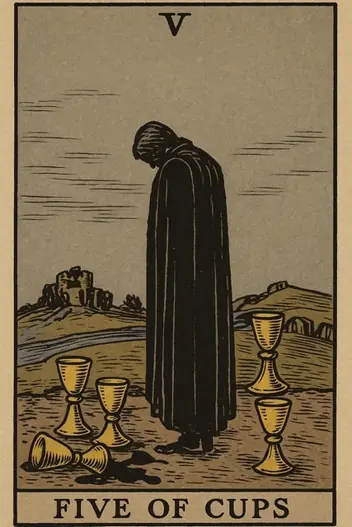
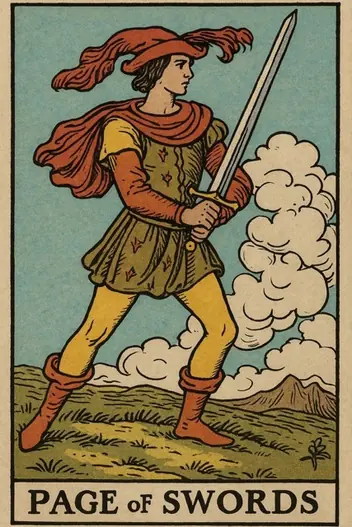
- Arcana
- Five of Cups — Minor Arcana, Cups; Page of Swords — Minor Arcana, Swords
- Elements
- Five of Cups — Water; Page of Swords — Air
- Elemental interaction
- Neutral elements — energies coexist without conflict
- Numerology
- 5 + 11 = 16 → 7
When the Five of Cups—the card of loss, regret, and emotional withdrawal—collides with the Page of Swords—the archetype of sharp intellect, curiosity, and defensive communication—we witness a powerful psychological tension. The seeker is stuck in the past, mourning what has been lost, while simultaneously being prodded by a restless, analytical mind to investigate, question, and move forward. This combination represents the moment grief becomes a catalyst for inquiry, rather than a permanent state.
The core conflict is between emotional inertia and intellectual urgency. The Five of Cups wants to dwell; the Page of Swords wants to dissect. The pragmatic challenge is to harness the Page’s mental energy not to rationalize away the pain, but to strategically rebuild from the ashes. This is not a card of healing through softness, but through focused, often uncomfortable, self-examination.
Five of Cups and Page of Swords Card Meaning Explained
The psychological state created here is one of cognitive dissonance: you feel the weight of disappointment, yet your mind is already scanning for data, patterns, and exits. The Five of Cups represents the shadow of attachment—clinging to a specific outcome that has already failed. The Page of Swords, however, is the archetype of the skeptic: it demands evidence, asks "why," and refuses to accept emotional narratives at face value.
In practice, this means the seeker may be over-analyzing a recent loss (a breakup, a failed project, a betrayal) while simultaneously ignoring the emotional root of their pain. The mind races with questions: "What could I have done differently?" "Was it my fault?" "How do I prevent this from happening again?" The danger is intellectualizing the wound without processing the grief. The growth opportunity is to use the Page’s clarity to identify actionable lessons without becoming trapped in a loop of self-criticism.
The key insight is that this combination demands a structured emotional audit. You cannot think your way out of grief, but you can use thought to map the terrain of your loss. The Page of Swords provides the mental tools (logic, observation, communication) to excavate the truth from the rubble of the Five of Cups. The result is not instant healing, but a clearer roadmap for recovery.
Five of Cups and Page of Swords Love Outcome
If you are single:
This pair suggests you are overthinking a past rejection or disappointment. You may be analyzing every detail of a failed connection, but this mental energy is keeping you from feeling the loss and moving on. Stop trying to "solve" the past; instead, ask one question: "What boundary do I need to set for my next relationship?"
If you are in a relationship:
You or your partner may be using logic as a shield against emotional vulnerability. Arguments become debates, and past hurts are dissected rather than held. The dynamic risks becoming cold and critical unless you consciously balance analysis with empathy.
In a relationship reading, the Five of Cups and Page of Swords often signal a communication breakdown rooted in unresolved grief. One partner may feel unheard or unseen in their sadness, while the other retreats into intellectual defense. The core advice is to stop debating and start listening. The Page of Swords energy, when directed outward, can become harsh, judgmental, or accusatory. Bold key relationship advice: Set a "no analysis" safe zone where you can simply express feelings without being questioned or corrected. Use the Page’s sharpness to solve practical problems (e.g., scheduling, logistics), not to dissect emotional wounds. The relationship can survive this phase only if both partners agree to be vulnerable first, and analytical second.
Your pair is already on the table. Ask your question and draw the clarifying card
or simply focus on it
Five of Cups and Page of Swords for Career and Money
Strategic Opportunities:
Use the Page of Swords' curiosity to investigate why a project failed. Conduct a post-mortem without blame. This is a powerful moment to gather data for a new strategy.
Strategic Opportunities:
Leverage your analytical skills to identify a niche market or a gap that competitors have overlooked. Your recent loss (Five of Cups) may have revealed a weakness in your industry that you can now exploit.
Calculated Risks:
Avoid making impulsive decisions out of frustration. The Page of Swords can be impatient and quick to speak. Do not send that critical email or resign in a fit of intellectual pride. Objectively avoid any move that burns bridges without a clear, data-backed alternative.
Professionally, this combination signals a pivot point driven by disappointment. You may have lost a client, missed a promotion, or seen a business plan fail. The Page of Swords energy pushes you to re-strategize immediately, but the Five of Cups warns that emotional recovery is a prerequisite. Bold financial warning: Do not invest new capital into a venture that is still tainted by unresolved failure. Use the Page’s research skills to audit your finances with brutal honesty, but do not act until you have processed the emotional cost of the previous loss. The most pragmatic move is to gather intelligence, write a new plan, and wait 48 hours before executing. This delay allows the grief to settle and the intellect to sharpen.
Uncover hidden insights
Let our advanced Tarot system interpret these archetypes specifically for your personal path.
Five of Cups and Page of Swords Reversed: How to Read It
If the Five of Cups is reversed:
This signals that emotional trauma is being denied or suppressed. The person refuses to acknowledge the pain, pretending that "everything is fine." Combined with the upright Page of Swords, this creates a dangerous mixture: intellect is used for rationalizing denial. You are not analyzing the problem, but proving it does not exist. Advice: Acknowledge your disappointment. Without an honest admission of loss, analysis is meaningless.
If the Page of Swords is reversed:
The energy of the intellect becomes passive or directed towards self-destruction. Instead of constructive criticism, you only hear an inner saboteur whispering, "You are not smart enough to fix this." This leads to intellectual laziness and avoidance of difficult conversations. Advice: Force yourself to ask questions out loud. Verbalizing the problem is the only way to activate this archetype.
If BOTH are reversed:
Complete imbalance. Emotional trauma is ignored, and the intellect is devalued. This is a state of apathy and helplessness. The person neither feels nor thinks. The only way to correct the situation is to start small. Advice: Return to basics. First, acknowledge one specific emotion (e.g., "I am sad"). Then, ask one specific question (e.g., "What exactly went wrong?"). Recovery, step by step.
When Five of Cups and Page of Swords Signal Trouble
The shadow of this pairing is intellectual arrogance masking emotional fragility. The seeker may use the Page of Swords' sharp tongue to blame others, deflect responsibility, or launch into a defensive monologue about "why it wasn't my fault." This is a cognitive bias called "the just-world hypothesis" —a desperate need to make sense of loss by finding a logical culprit. The result is self-sabotage through over-analysis: you pick apart every detail except the one that matters most—your own emotional avoidance.
Another pitfall is perpetual victimhood disguised as investigation. The Five of Cups’ grief can become a comfortable identity, and the Page of Swords’ questions become tools to keep the wound open. "Why did this happen to me?" becomes a mantra rather than a genuine inquiry. The shadow asks: Are you truly seeking answers, or are you seeking validation for your pain? If your analysis leads to more bitterness and less action, you are trapped in this shadow. The antidote is ruthless self-honesty: ask yourself, "Is this thought helping me move forward, or keeping me stuck?"
Overall Meaning of Five of Cups and Page of Swords
The Five of Cups and the Page of Swords are not a sentence to eternal sorrow, but an instruction manual for assembling a new self from the shards of the past. The energy of the Five of Cups is the fuel (motivation based on pain), while the energy of the Page of Swords is the engine (a tool for analysis and planning). Your task is not to let the engine break the fuel system.
The strategically correct use of this combination implies a strict regimen. Allocate a specific time for an "audit of the past"—for example, one hour a day or one day a week. During this time, you have the right to grieve, analyze, and ask uncomfortable questions. As soon as the timer goes off, you must switch into a mode of constructive planning. Make a list of three actions you will take tomorrow, based on today's analysis.
The main conclusion: do not let your intellect become the jailer of your emotions. The Page of Swords should be not a prosecutor, but an advocate for your future. Use its sharpness to cut away useless regrets and keep only the lessons that work for you. Accept the fact that two cups are still full—these are your knowledge and the new experience gained through pain. The synthesis of these cards is a path from "Why me?" to "What can I do to ensure this doesn't happen again?".
Applying This to Your Situation
The Five of Cups and Page of Swords combination is a pragmatic call to transform grief into strategy. It asks you to honor the loss without letting it define you, and to use your sharpest mental faculties not to escape pain, but to navigate through it. The core message is simple: feel the sadness, then ask the hard questions. Your next step is not to find the perfect answer, but to take one small, data-informed action that moves you toward a new direction.
This article provides the general archetype, but the true power of Tarot lies in applying it to your unique situation. To get a deep, personalized interpretation of this exact combination for your specific question—whether it’s about love, career, or inner growth—use the Fortune Cards app. Available on the web or as a download, it analyzes your cards in the context of your life, giving you the clarity you need to act with confidence. Try it now for your own reading.
Interpretation by the Fortune Cards editorial team, based on the Rider–Waite tradition and Jungian archetypes. About our methodology · Updated: 2026-09-17
Other Combinations with Five of Cups
Other Combinations with Page of Swords
Explore Individual Card Meanings
Table of Contents
- Five of Cups and Page of Swords Card Meaning Explained
- Five of Cups and Page of Swords Love Outcome
- Five of Cups and Page of Swords for Career and Money
- Five of Cups and Page of Swords Reversed: How to Read It
- When Five of Cups and Page of Swords Signal Trouble
- Overall Meaning of Five of Cups and Page of Swords
- Applying This to Your Situation
Ready to find answers to your questions?
Start your first reading now and look at your situation with fresh clarity. The cards are ready to reveal deeper meaning.