Four of Cups and Six of Pentacles Reversed in Tarot

- Arcana
- Four of Cups — Minor Arcana, Cups; Six of Pentacles — Minor Arcana, Pentacles
- Elements
- Four of Cups — Water; Six of Pentacles — Earth
- Elemental interaction
- Friendly elements — energies support each other
- Numerology
- 4 + 6 = 10 → 1
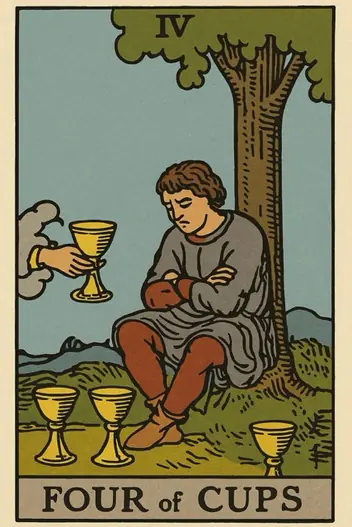
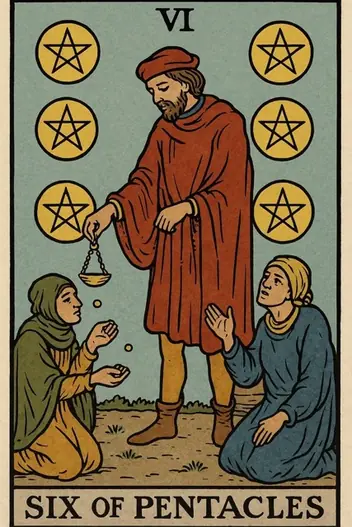
This pairing presents a critical psychological tension between passive discontent and conditional generosity. The Four Of Cups archetype embodies a state of emotional withdrawal, dissatisfaction, and the refusal to engage with new opportunities. The Six Of Pentacles represents a transactional power dynamic—the conscious giving and receiving of resources, often with an implicit expectation of gratitude or reciprocity. When these collide, the seeker is likely stuck in a loop where they feel undervalued yet are unable to accept genuine help, or where they are the giver but feel their efforts are met with indifference.
Four of Cups and Six of Pentacles Card Meaning Explained
The core dynamic here is a blocked feedback loop of value. The energy of the Six Of Pentacles requires a clear flow: one party offers support, and the other receives it with acknowledgment. The Four Of Cups, however, disrupts this flow by creating a psychological barrier of apathy or resentment. The seeker may be in a position where they are receiving resources (money, time, advice) but feel it is not enough, or they are entitled to more. This leads to a quiet, passive-aggressive refusal to appreciate what is being given.
Alternatively, the seeker might be the one giving. They are offering help from a place of duty or social obligation, but the recipient’s lack of enthusiasm (the Four Of Cups) drains their motivation. This creates a cycle of conditional generosity: “I will give, but only if you show the right amount of gratitude.” The psychological risk is that the seeker confuses their unmet emotional needs with a material deficit. They are not lacking resources; they are lacking a sense of meaning or genuine connection to what they already have. The strategic action is to identify whether you are rejecting a valid offer because of internal dissatisfaction, or whether your giving is a covert attempt to control another’s emotional state.
Your pair is already on the table. Ask your question and draw the clarifying card
or simply focus on it
Four of Cups and Six of Pentacles Love Outcome
If you are single:
This combination suggests you may be overlooking a genuine suitor because they don’t fit a fantasy image, or you feel you “deserve” a more dramatic gesture. Examine whether your standards are about values or about ego.
If you are in a relationship:
A power imbalance in emotional labor or finances is likely. One partner may feel they are giving more, while the other feels controlled or resentful of the obligation to show gratitude.
In relationships, the Four Of Cups and Six Of Pentacles often point to a stagnant dynamic of unspoken resentment. One partner may be the primary giver—whether of time, affection, or money—while the other partner has become complacent, taking these resources for granted. The giver then feels used, while the receiver feels suffocated by the expectation of constant appreciation. The key psychological insight is that the “giver” may be using generosity as a form of control, and the “receiver” is using apathy as a form of passive rebellion. To break this cycle, both parties must explicitly renegotiate the terms of their exchange without blame. The receiver needs to acknowledge the value of what they receive, and the giver must release the need for external validation of their actions. Bold relationship advice: Stop keeping score. Instead, agree on a baseline of mutual contribution that feels fair to both, and then give freely without expecting a specific reaction.
Four of Cups and Six of Pentacles: Career and Money
Strategic Opportunities:
Look for mentorship or training programs that offer tangible skills. The Six Of Pentacles suggests a resource is available, but the Four Of Cups warns you must actively choose to engage.
Strategic Opportunities:
Re-evaluate your current compensation package or role. You may be undervaluing existing benefits (flexibility, stability) because you are fixated on a perceived lack.
Calculated Risks:
Avoid accepting a bailout or loan from a superior unless you can clearly define the repayment terms. This card pair warns of financial dependency with unspoken strings attached.
In your professional life, this combination signals a critical decision point about resource allocation. The Four Of Cups indicates you are feeling stuck, bored, or underappreciated in your current role. However, the Six Of Pentacles reveals that a solution is literally being offered to you—perhaps a promotion, a new project, or a chance to delegate tasks. The trap is rejecting this opportunity out of spite or a sense of entitlement (“I shouldn’t have to ask for this, they should just give it to me”). The pragmatic truth is that resources in the workplace are rarely offered without a request. You must articulate your needs clearly. Conversely, if you are the manager or leader, this pair warns against micromanaging or hoarding resources to maintain power. Bold financial warning: Do not confuse a lack of motivation with a lack of resources. You have enough—the issue is your willingness to utilize what is in front of you.
Get a personalized interpretation
Unlock the combined meaning of your cards in the context of your unique question — for free.
The Shadow Side of Four of Cups and Six of Pentacles
The shadow of this pairing is a dangerous cocktail of entitlement and passive aggression. The seeker may adopt a victim mentality, believing they are being “given” inadequate resources while refusing to take ownership of their own needs. This manifests as self-sabotage: ignoring a genuine job offer, rejecting a partner’s affection, or failing to cash a check because “it’s not enough.” On the flip side, the giver’s shadow emerges as covert narcissism, where generosity is used as a weapon to create indebtedness. The cognitive bias at play is the “spotlight effect”—the seeker believes everyone is noticing their dissatisfaction, when in reality, others are simply unaware. The greatest risk is confusing a temporary emotional slump with a permanent structural problem. You are not trapped; you are refusing to move.
Four of Cups and Six of Pentacles Reversed: What Changes?
When cards appear reversed, the dynamic becomes distorted, revealing the shadow aspects of the personality.
If the Four of Cups is reversed:
Apathy gives way to a reckless impulse for novelty. You are ready to seize any opportunity, just to escape boredom. The risk is accepting unfavorable terms or entering toxic relationships. Advice: introduce a 24-hour "cooling-off period" before any significant decision.
If the Six of Pentacles is reversed:
This points to internal resistance and a fear of dependency. You either refuse help, afraid of being indebted, or, conversely, use generosity for control and manipulation. Warning: you risk ending up in isolation. Remember that asking for help is an act of strength, not weakness.
If BOTH are reversed:
A complete imbalance arises — a cycle of "wasted resources." You either rush into new ventures without a plan or fall into a stupor when facing the first difficulties. A logical way to correct this: return to basics. Create a simple budget (of time and money) and strictly adhere to it. Eliminate any spontaneous spending and decisions for a month.
Overall Meaning of Four of Cups and Six of Pentacles
The energy of this combination serves as a powerful catalyst for transitioning from a reactive state to a proactive one. The Four of Cups symbolizes a "dead point," while the Six of Pentacles represents the "first impulse." Your task is not to wait for the impulse to arise on its own, but to create it artificially, leveraging the power of duty and social exchange.
The strategic advice is as follows: begin giving in order to start receiving. This may sound paradoxical to someone feeling empty, yet it works. Find one area where you can be useful—even without compensation. This could be helping a colleague, volunteering, or simply offering a sincere compliment. The act of giving (Six of Pentacles) will break the cycle of apathy (Four of Cups), triggering a mechanism of external recognition and gratitude.
This is not about "flows" or "energy." It is about neuroscience: action changes state. When you begin to act like a "generous" person, your brain receives a signal that resources are available, and your anxiety level drops. Use this combination as a tool for cognitive-behavioral therapy: change your behavior, and your feelings will follow. Key takeaway: your apathy is not a life sentence, but merely a signal that you have stopped being part of the exchange system. Return to it.
Where to Go From Here
The Four Of Cups and Six Of Pentacles ultimately asks you to distinguish between a genuine lack of resources and a lack of appreciation for what you have. Your next step is to honestly audit your current situation: Are you rejecting a valid opportunity because of pride or fear? Or are you giving too much without setting boundaries? This general interpretation provides the archetypal framework, but your specific life context—your history, your fears, your relationships—will determine the exact meaning.
Get your own personalized Tarot reading now. Use the Fortune Cards app to input your exact question about love, career, or personal growth. The app applies these archetypes directly to your unique situation, revealing the hidden dynamics and giving you a clear, actionable next step. Download Fortune Cards today on the web or from your app store, and discover what this combination truly means for you.
Interpretation by the Fortune Cards editorial team, based on the Rider–Waite tradition and Jungian archetypes. About our methodology · Updated: 2026-09-17
Other Combinations with Four of Cups
Other Combinations with Six of Pentacles
Explore Individual Card Meanings
Table of Contents
- Four of Cups and Six of Pentacles Card Meaning Explained
- Four of Cups and Six of Pentacles Love Outcome
- Four of Cups and Six of Pentacles: Career and Money
- The Shadow Side of Four of Cups and Six of Pentacles
- Four of Cups and Six of Pentacles Reversed: What Changes?
- Overall Meaning of Four of Cups and Six of Pentacles
- Where to Go From Here
Ready to find answers to your questions?
Start your first reading now and look at your situation with fresh clarity. The cards are ready to reveal deeper meaning.